Seventy-five per cent of respondents to The Logic’s August subscriber survey said they find news using at least one Meta or Google platform that will be affected by the companies’ plans to block news in Canada, and most said they’re likely to try bookmarking news websites or email newsletters to stay informed if content is restricted online.
Skip to content
 Thirteen per cent of respondents to The Logic’s subscriber survey said they consumed news on Facebook, while 23 per cent said they used Instagram to access news. Photo: Photo illustration by Chesnot/Getty Images


Subscriber Survey
‘Switched over to DuckDuckGo’: What subscribers plan to do if Meta, Google block news
About 75% use at least one platform impacted by tech firms’ response to Bill C-18
Thirteen per cent of respondents to The Logic’s subscriber survey said they consumed news on Facebook, while 23 per cent said they used Instagram to access news. Photo: Photo illustration by Chesnot/Getty Images
Seventy-five per cent of respondents to The Logic’s August subscriber survey said they find news using at least one Meta or Google platform that will be affected by the companies’ plans to block news in Canada, and most said they’re likely to try bookmarking news websites or email newsletters to stay informed if content is restricted online.
Bill C-18, the Online News Act, became law in Canada in June, requiring technology giants like Google and Meta to pay Canadian news publishers for content posted to their platforms through mandatory negotiated agreements. In response, the companies have threatened to block news entirely, with Meta’s Facebook and Instagram platforms already following through.
The Logic’s subscriber survey asked readers how they access news online and whether they expect to be affected by Meta and Google blocking news. About three-fourths of respondents reported using at least one platform impacted by Meta and Google’s response to Bill C-18, with two-thirds saying they use Google Search and almost a third saying they use Google platforms like Google News. Fewer respondents said they consumed news on Facebook and Instagram—the only platforms where news is currently blocked—at 13 per cent and 23 per cent, respectively.
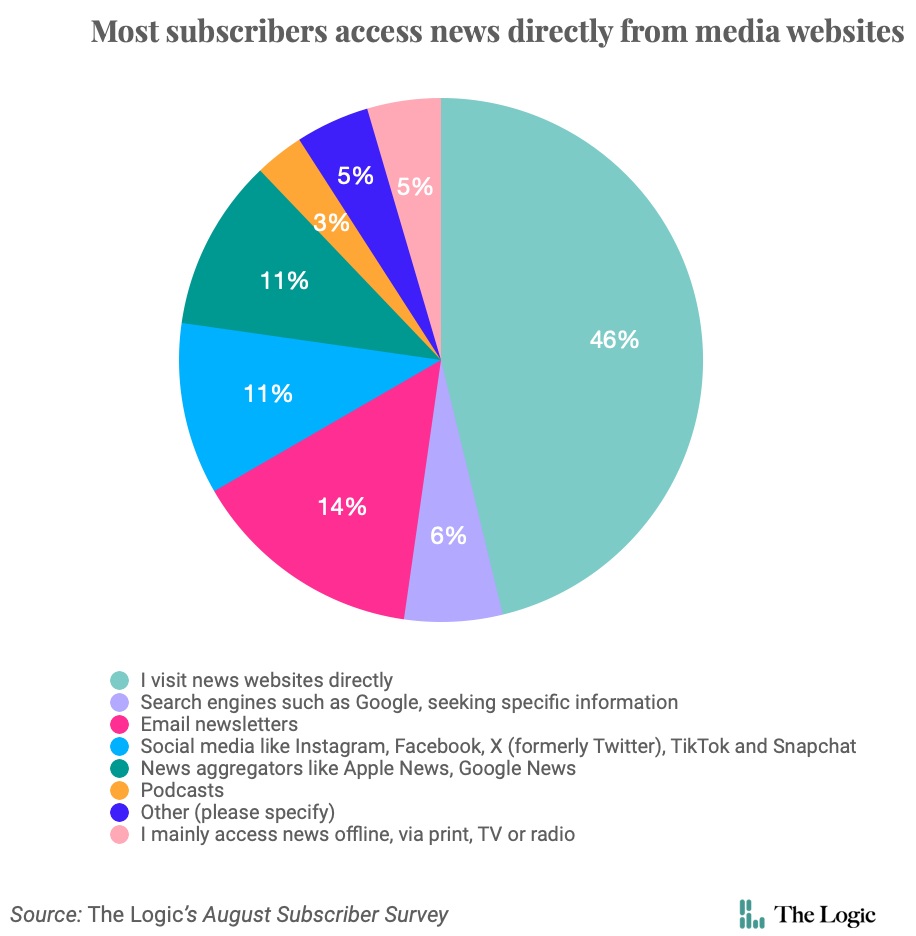
Participants said they currently rely most on news websites that they visit directly, at 46 per cent, while smaller numbers of respondents said they rely most on email newsletters, social media or news aggregators like Apple News or Google News.
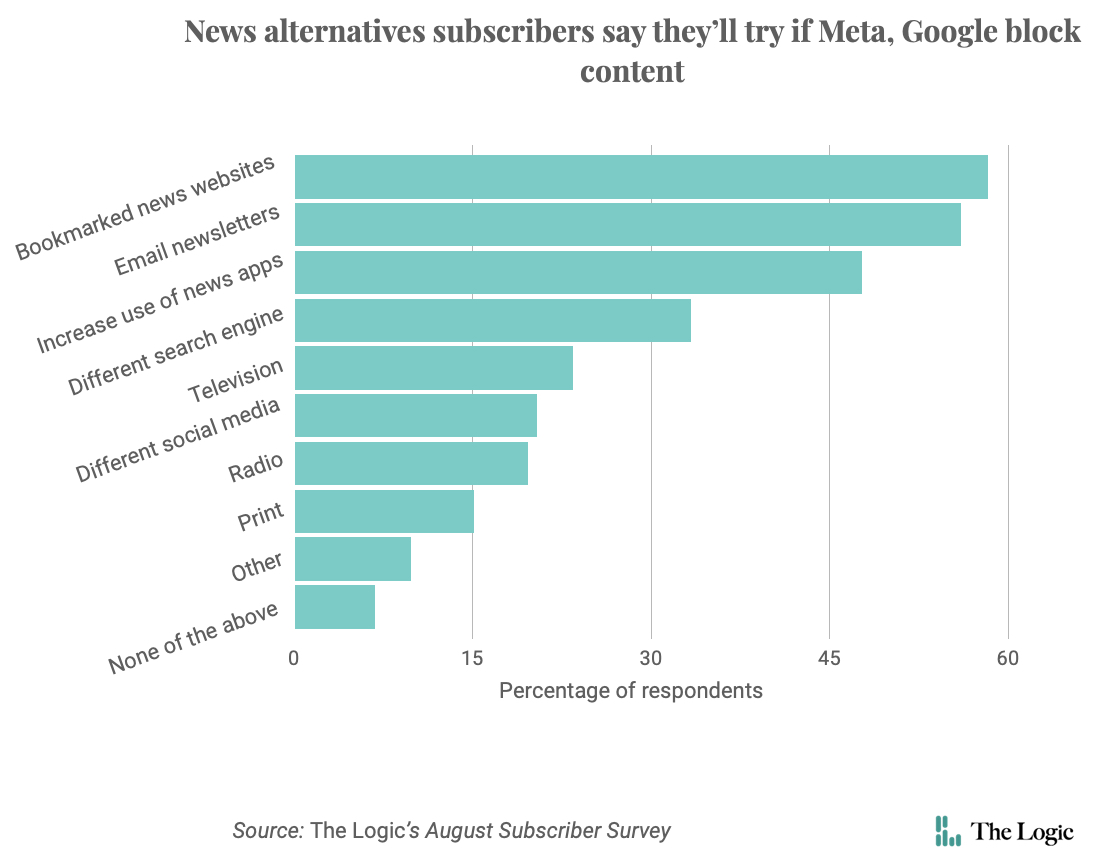
Subscribers were also asked how they plan to access Canadian news if content is restricted on Meta and Google platforms. While respondents could select more than one option, the top answer was bookmarking news websites directly, at 58 per cent, followed by relying on email newsletters and increasing use of news apps.
Related Articles


“Already switched over to DuckDuckGo for searching for news (which uses Bing),” one respondent said, while others said they would rely more on other social platforms like X (formerly Twitter). One respondent said that, realistically, they’ll see less news: “I would hope to use apps directly, but the reality is that discovery of Canadian-based news would decrease.”
Respondents disagreed on who was at fault for the standoff that led to Meta and Google threatening to block news. About 38 per cent blamed the federal government, 34 per cent said Meta and Google bore the most blame and 20 per cent said it was equally the fault of all parties. Three per cent blamed news organizations and five per cent were undecided.
(The Logic’s CEO and editor-in-chief David Skok has previously spoken out in favour of Bill C-18; other independent media founders have spoken out against it. The Logic’s newsroom takes no side in the matter. Skok was not involved in the creation of this survey, and has been recused from The Logic’s coverage of the issue for nearly two years.)
“The decline of news organizations is a serious problem, but the tech platforms provided an advertising product that was better than what news organizations offered, and I’m not convinced it’s fair to claw back some of the profits,” one subscriber wrote. “And if there are no limits to the amount they’d have to pay, I think it’s reasonable for the platforms to respond the way they have.”
Others said tech companies were unfairly profiting from news content without paying for it. “These companies are not good faith actors and have no accountability to the public square or citizens of Canada,” another reader said. “The feds positioned and sold the legislation poorly, mind you.”
Respondents also expressed different views on whether the government should hold tech platforms responsible for supporting journalism in Canada. About 42 per cent said Big Tech firms should be legally required to share revenue with Canadian news organizations, while 27 per cent said they should be encouraged or incentivized to pay for news but not required, and 20 per cent said they should bear no responsibility.
A number of respondents said they agreed with the goal but had issues with the law’s framing, which some described as a “link tax.” Some suggested platform taxes, tax incentives or introducing other funding models instead.
“Big Tech platforms will resist if [the bill] is perceived as a link tax,” one respondent wrote. “There should be ways to tax them more for ad revenue—and then reallocate some of those dollars to supporting news organizations and journalism.”
“I feel like the government could probably have come up with some superior, more creative approaches that rely less on a heavy-handed shakedown and less on fairly blindly supporting legacy news organizations. That said, the platforms have sucked so much of the revenue out of the system so quickly,” another respondent said. “A solution that does not involve them contributing some money seems unlikely to work.”
Methodology
The Logic emailed subscribers a private link to an online survey on Aug. 15 and the survey closed Aug. 17. Respondents’ identities were kept anonymous. Subscribers were first asked, “Which source do you rely on most for news?” and could answer “I visit news websites directly,” “Search engines such as Google, seeking specific information,” “Email newsletters,” “Social media like Instagram, Facebook, X (formerly Twitter), TikTok and Snapchat,” “Video streaming platforms like YouTube,” “News aggregators like Apple News, Google News,” “Podcasts,” “Other (please specify below)” or “I mainly access news offline, via print, TV or radio.”
They were then asked, “Which, if any, of the potentially affected Meta and Google platforms do you use to find news and information? Select all that apply” and could select “Facebook,” “Instagram,” “Google search,” “Other Google platforms, like Google News, the Google app or Google News Showcase” or “None.” Next, they were asked, “What alternate methods of accessing news are you most likely to try if content is restricted online? Select all that apply.” They could choose the following options: “Different search engine,” “Different social media platforms,” “Bookmarked news websites to visit directly,” “Email newsletters,” “Increase use of news apps,” “Television,” “Radio,” “Print,” “Other” and “None.”
Next, they were asked, “Who bears the most blame for the standoff that led to Meta and Google threatening to block news in Canada, in your opinion?” and could choose “The federal government,” “Meta and Google,” “News organizations,” “Equal fault of all parties” or
“Other/undecided.” Finally, they were asked, “To what extent do you think the government should hold Big Tech platforms responsible for supporting journalism in Canada?” and could answer: “They should bear no responsibility,” “They should be encouraged/incentivized to pay for news, but not required,” “They should be legally required to share revenue with Canadian news organizations” or “Other.”



Loading...
Thanks for sharing!
You have shared 5 articles this month and reached the maximum amount of shares available.
CloseThis account has reached its share limit.
If you would like to purchase a sharing license please contact The Logic support at [email protected].
CloseGift the full article!
You have gifted 0 article(s) this month and have 5 remaining.
Recipients will be able to read the full text of the article after submitting their email address. They will not have access to other articles or subscriber benefits.
Photo: Photo illustration by Chesnot/Getty Images
Most Popular This Week




In-depth, agenda-setting reporting
Great journalism delivered straight to your inbox.
News
Critical minerals face a funding ‘valley of death.’ Miners hope tax breaks will change that
Briefing
Potash from Belarus en route to United States
Financing instability is slowing down Ottawa’s housing agency, CEO says
Cleveland-Cliffs CEO says federal lawsuit would be a bad business decision for Canada
Best business newsletter in Canada
Get up to speed in minutes with insights and analysis on the most important stories of the day, every weekday.
Exclusive events
See the bigger picture with reporters and industry experts in subscriber-exclusive events.
Membership in The Logic Council
Membership provides access to our popular Slack channel, participation in subscriber surveys and invitations to exclusive events with our journalists and special guests.