Talent Quarterly is The Logic’s regular series on employment trends.
For years, it’s been workers who held sway when it came to remote work.
From the beginning of the pandemic until late 2022, many employees with desk jobs were mostly expected to clack away at their home computers rather than work from a central office. At the same time, labour markets were historically tight and job vacancies soared to record highs, giving employers little leverage to dictate where their people worked.
Talking Points
- During COVID, employees have gained leverage over companies when it came to work-from-home arrangements
- But in the latest quarter, as labour markets slackened and more Canadian firms sought to increase in-person work, employers began taking back control
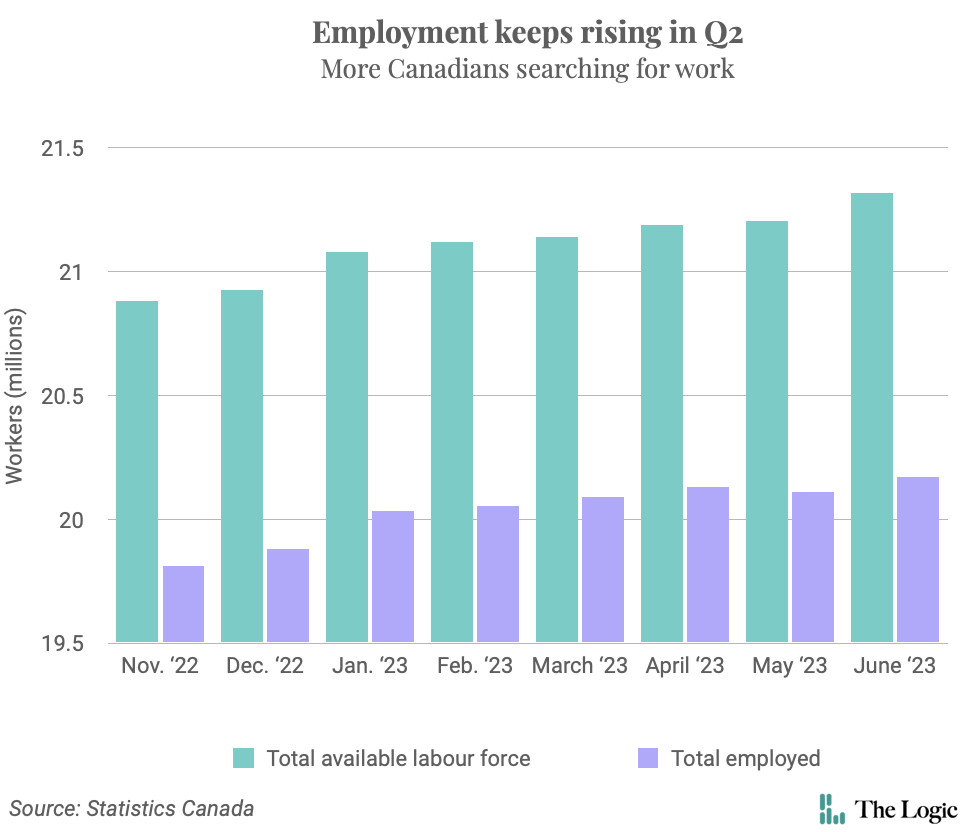
In the last quarter, that changed. Employment increased by 60,000 jobs in June, according to Statistics Canada, after falling in May for the first time in several months. Unemployment hit 5.4 per cent, the highest since early 2022. Job vacancies, while still elevated, have sunk below last year’s peak. Employers, long forced to accept remote work as a given, are starting to wrest back lost ground.
For many large firms in Canada, the April to June period was the first full quarter that they began mandating an increased return to the office. Earlier this year, Royal Bank of Canada told workers to return to office three to four days a week by May 1, following similar announcements from TD Bank and National Bank of Canada. Toronto legaltech company Dye & Durham recently ordered workers back to the office as part of layoffs.
Major U.S. brands including Disney and BlackRock have called for four in-office days a week, while Tesla’s Elon Musk has taken a more vociferous approach.
Should labour markets continue to slacken, companies could assume increasingly rigid positions on whether employees can work from home, according to Brendon Bernard, senior economist at Indeed. The fight over where people work might intensify.
“If the job market were to really weaken, then maybe employers have more leverage to demand either more hybrid work, or even full time in the office,” he said.
The hybrid compromise?
Even if the balance of the work-from-home tussle has shifted, it’s not likely to return to its pre-pandemic form, Bernard said. Instead, the trend has shifted away from remote work and toward hybrid work—or, as Bernard puts it, “from remote work to location flexibility.”
People on the move:
- Jeremy Wilmot was named as Interac’s new president and CEO. Wilmot starts Aug. 1.
- Enthusiast Gaming announced four changes to its senior management team, including hiring Tara Fournier as chief people officer. The firm also announced the departure of chief corporate officer Eric Bernofsky and chief revenue officer Bill Drolet.
- Vancouver-based biotech Zymeworks announced the departure of president and CEO Neil Klompas.
- CloudMD appointed Prakash Patel as CFO, replacing John Plunkett, who will become executive vice-president of corporate development and integration.
- VentureLab’s Melissa Chee stepped down as president and CEO at the end of her five-year term on June 30. COO Matt Skynner will serve as interim CEO.
- Matthew Lombardi, former managing director of OneEleven, joined Telus’s Pollinator Fund for Good as director of platform services.
- Neil Desai, vice-president of corporate affairs at Magnet Forensics, announced he’s stepping away from the role.
- Arteria AI announced John Wallace as its new CFO and Bailey Dougherty as the new global head of professional services.
As of May 2023, about a quarter of Canada’s working population were in fully remote or hybrid work arrangements, according to Statistics Canada—a number that was little changed in the last year. But among that cohort, the share of people in hybrid roles is on the rise, increasing from 25 per cent to 40 per cent between May 2022 and May 2023. Canadians spend more time working from home than people in other developed nations, according to a survey by Germany’s Ifo Institute.
Bernard said that while there has been a shift back to the workplace, it’s been more of a “part-time shift.”
A cautious approach
For the most part, companies are still trying to determine what mixture of in-office work, remote work and hybrid work is best for them, according to Kristina McDougall, founder of Waterloo, Ont.-based executive search firm Artemis Canada.
“We’ve been hearing about ‘Oh, we’re going to go back to hybrid.’ And there was not a real clear definition from anyone around what that might mean,” she said.
McDougall said some of her tech company clients have opted for full in-office work, while others have begun hiring only people who live within reasonable distance from the office to ensure hybrid work is possible.
While work-from-home has played a more dominant role in employee-employer arrangements in recent years, she said discussions around remote work are increasingly complicated by broader economic and financial considerations. Following last year’s tech rout, potential employees are weighing their options before joining new companies.
“In general, there’s a level of caution, it would seem, both on the candidate and the hiring manager side of things. So the processes are maybe moving more thoughtfully than they would have been 18 months ago.”
By the numbers
60,000: Canada’s employment gains in June 2023. Ontario (56,000), Nova Scotia (3,600) and Newfoundland and Labrador (2,300) saw the biggest bumps, while employment slipped in PEI by 2,400.
8.6: The carbon emission reductions, in megatonnes equivalent, that could be achieved if every Canadian whose job allowed for it worked from home. That’s equal to six per cent of Canadians’ total household emissions in 2015.
$33.12: The average hourly wage in Canada as of June 2023. Wages increased 4.2 per cent compared to a year earlier, the slowest rate of growth since May 2022. Average wages were $30.95 among women and $35.21 among men.
More workers, fewer jobs
In coming months, the overall health of the labour market will help determine whether companies will call more workers back to the office.
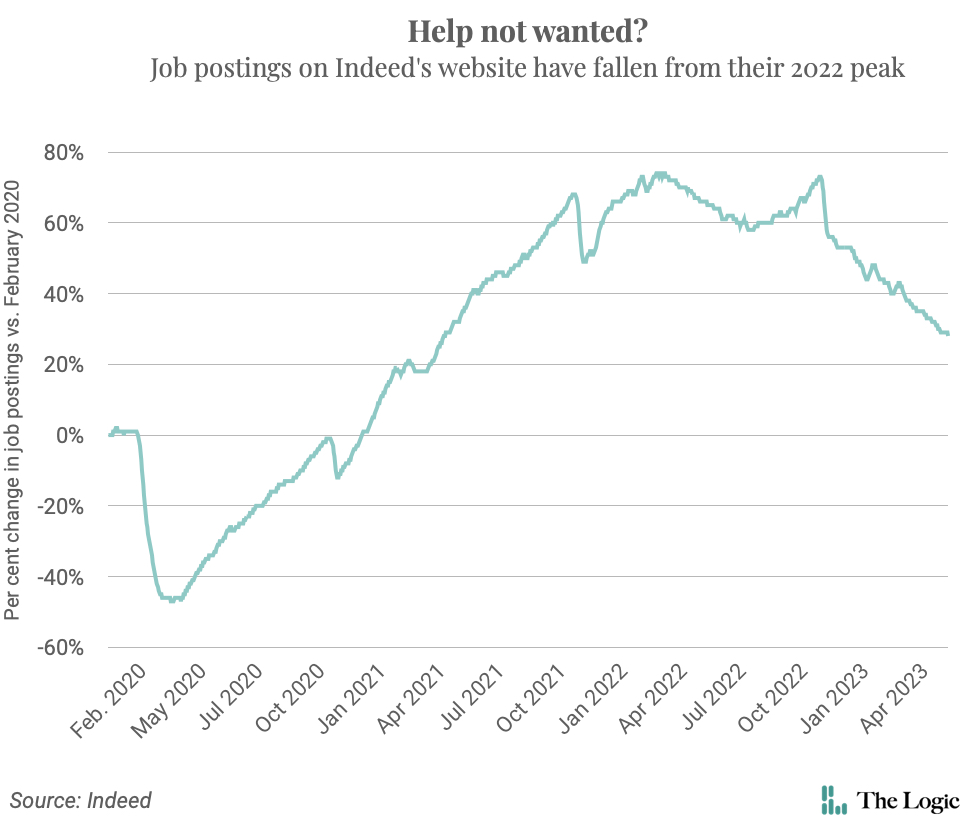
Job vacancies have already tumbled, suggesting markets have at least come down from their peak last year. The number of job postings on Indeed’s website peaked in May 2022, according to Bernard, when they were 74 per cent above pre-pandemic levels. As of early July, that number has slipped to 28 per cent.
“How strong things are is all relative to what’s your baseline,” he said. “But things have definitely cooled down from mid-2022.”
With files from Sebastian Leck