OTTAWA — Ontario’s new plan for sharply increasing its energy supply by 2050 still appears to land the equivalent of many big hydro dams short of what the province and its industries will need, according to its independent electricity agency.
Skip to content
 Power lines in Kingston, Ont., in September 2022. Photo: Adrian Wyld/The Canadian Press
News
Ontario wants to green its power grid by 2050. It will need some Hail Mary successes
Massive hydrogen, wind and nuclear construction needed to close gaps, independent analysis shows
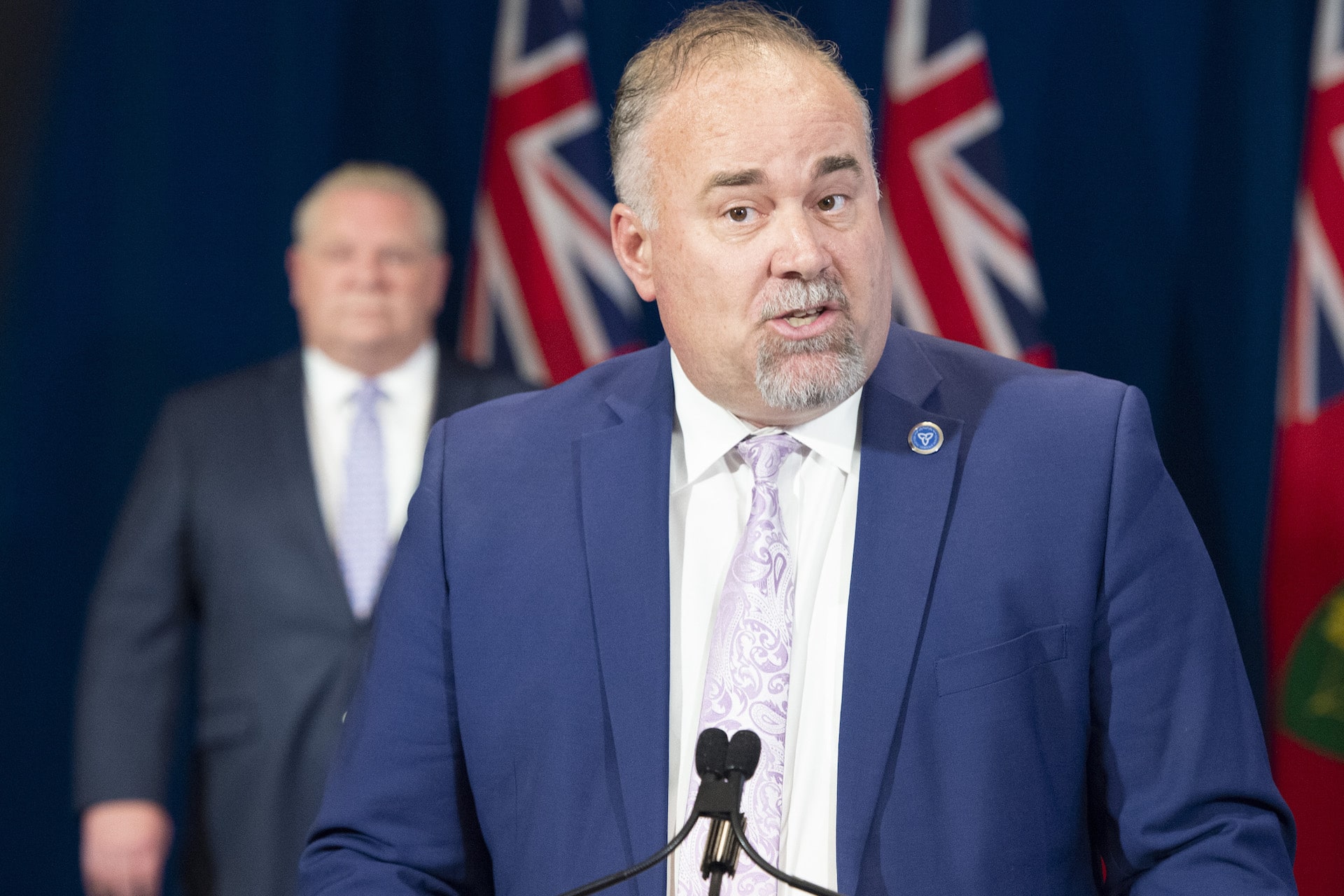
Energy Minister Todd Smith, pictured here as minister of social services, in April 2023. Photo: Frank Gunn/The Canadian Press
OTTAWA — Ontario’s new plan for sharply increasing its energy supply by 2050 still appears to land the equivalent of many big hydro dams short of what the province and its industries will need, according to its independent electricity agency.
Talking Points
- The agency that plans Ontario’s power system says the province will need more than double the electricity generation capacity it has now if it wants a fully green economy by 2050
- The government’s recent plan for getting there counts on massive successes with conservation, hydrogen, wind, nuclear power and “distributed” sources like household solar panels
The “Powering Ontario’s Growth” plan that Energy Minister Todd Smith released in July bills itself as “a detailed overview of where the province is now and how it will build the electricity system that is needed in the years ahead.”
Green energy is an industrial draw. Volkswagen’s Pierre Boutin has said the automaker’s planned battery plant was attracted partly by Ontario’s clean grid, for example.
But green industry sucks back a lot of electricity, the province’s plan says, rhyming off recent major announcements: “Taken together, the forecast increased electricity demand from Umicore, Stellantis, Volkswagen and the electric arc furnaces at Algoma and Dofasco are equivalent to the annual electricity consumption of the Ottawa region.”
Growing fleets of electric vehicles are expected to need 15 times as much juice by 2043—not all of which can be socked into their batteries when there’s surplus power.
A 2022 projection by the province’s Independent Electricity System Operator (IESO) said Ontario will have to more than double its generating capacity from 42,000 megawatts to over 88,000 megawatts by 2050, as industry, building systems and transportation shift from fossil fuels like natural gas, diesel and gasoline to electric power.
At the same time, as the province’s generating stations get old, up to 20,000 megawatts of current electricity production capacity could go offline, and will need to be replaced or preserved.
The gap between the projects clearly outlined in “Powering Ontario’s Growth” and the needs the IESO lays out is in the tens of thousands of megawatts.
Related Articles

Despite its billing as a detailed plan, “Powering Ontario’s Growth” is “just the beginning,” a spokesperson for Smith told The Logic, as the provincial government takes up what the IESO called “no-regret” recommendations, ones that will “keep options open while maintaining the flexibility to take advantage of opportunities as they emerge.”
Detailed planning to 2050 “is a bit of a fool’s errand,” said Michael Powell, vice-president of government relations for Electricity Canada, the industry association for power utilities. We can’t be sure what new technologies will change the energy world in 20 years, he said—but also, because of how long it takes to build anything big, there’s no time to waste.
“It almost doesn’t matter how much power you build right now because you’re probably going to use it,” he said in an interview. “The lesson of the last five years has been all these big megaprojects that seemed like future white elephants have turned out to be in demand.”
The IESO ballparked the cost of building what Ontario will need at $400 billion, and the additional real estate needed for all the new power plants at almost 14 times the area of Toronto. That scenario assumes maximum conservation efforts—and that the climate doesn’t get warmer, which, the IESO noted, could have “a significant impact on future demand.”
“Powering Ontario’s Growth” describes massive construction and expansion plans, some of which Smith announced in the lead-up to releasing the long-term plan:
- Up to 2,500 megawatts of energy-storage projects, which would sock power away when there’s a surplus and send it out to the grid when it’s needed.
- Up to 1,500 megawatts of new natural-gas generation.
- An expansion of the privately managed Bruce nuclear station, adding up to 4,800 megawatts of new capacity to a station that, at 6,550 megawatts now, is already the largest working nuclear plant in the world.
- Four small modular reactors, totalling 1,200 megawatts, at the Darlington plant.
- A 1,000-megawatt pumped-hydro storage facility near Georgian Bay on Lake Huron, and a 400-megawatt project in a former open-pit mine in Eastern Ontario.
Ontario already has refurbishments underway or in the works for the older reactors at its nuclear plants—Bruce (the existing 6,550 megawatts) and Darlington (3,500 megawatts), plus the newer portion of a third plant, in Pickering (2,160 megawatts), addressing some of the 20,000-megawatt preservation problem.
But add up all the projects with megawatt numbers attached to them, and they’re still far short of the 46,000 to 66,000 megawatts of additional generating capacity the IESO says Ontario needs for 2050—by tens of thousands of megawatts.
The nuclear-plant refurbishments come with asterisks, too: Refurbishing the Bruce plant’s reactors should keep them operational until 2064, but the Darlington plant’s reactors will wear out again by 2055, just past the 2050 planning horizon; refurbished reactors at Pickering would go at about the same time.
To close the gap, “Powering Ontario’s Growth” relies on big help from iffy sources.
It borrows from the IESO the notion that Ontario will have 15,000 megawatts of hydrogen-based generating capacity by 2050. Ontario has close to zero now, except for small experiments with blending hydrogen into the fuel for its natural-gas plants.
Converting gas plants to burn hydrogen instead is not science-fiction technology, though Ontario now has just under 10,500 megawatts of generation capacity from natural gas and fuel oil (the province has one older generating station that can burn either). It would need to convert all of that to hydrogen and triple its planned 1,500-megawatt expansion to achieve the IESO’s 15,000-megawatt scenario. And it would have to import the hydrogen.
Small-scale “distributed” power sources, like household solar panels and using electric-vehicle batteries as storage, could help; the IESO estimates Ontario could have 10,000 megawatts of that sort of supply today, and more in the future. “Powering Ontario’s Growth” talks about tapping that capacity but without many details.
Finally, the IESO suggests that Ontario will build 17,600 megawatts worth of wind turbines by 2050, a combination of new and replacements for worn-out ones. “Powering Ontario’s Growth” mentions wind as one of Ontario’s current energy sources but says nothing about a plan to build new wind farms, let alone 17,600 megawatts worth of them.
Premier Doug Ford rode to power in 2018 attacking the governing Liberals’ green-energy policies and cancelled contracts for several wind farms shortly after taking office, including one in Energy Minister Smith’s own riding that already had turbines in place.
If Ontario’s long-term plans are short, said Powell, they’re at least on the right order of magnitude.
The national association representing electricity utilities published a report in February on the state of the sector titled, simply, “Build It.”
To have a net-zero power grid by 2035 and a net-zero economy by 2050, everybody needs to move, the association said: “We need to lean on all available options to achieve this goal, including more renewables, traditional hydro, small modular reactors, carbon capture and energy storage and transmission.”
Electricity Canada followed “Build It” with an April report called “Build Things Faster,” focusing on solutions—many of them to do with setting clear rules for new technologies, beefing up regulators’ capabilities to apply them, and addressing a lack of skilled labour.
“We’re going to have to start thinking about what a licensing process is for locations for small modular reactors,” Powell said. Nobody has sited a new nuclear plant in Canada in decades, he pointed out—working with communities and getting buy-in—and it won’t just happen.
A particular wind-to-hydrogen project in Newfoundland and Labrador is expected to take two years to build but eight to 10 years to get approved, according to Electricity Canada; a hydro dam can take 25 years from concept to commissioning.
Or longer: British Columbia’s Site C dam, a 1,100-megawatt project on the Peace River in northeast B.C., was conceived in the 1950s, got an initial study in 1971, was rejected in 1983, gained new life in the late 2000s and was greenlit for construction in 2014. It’s now expected to be completed in 2025.
“When they started [construction] … no one was quite sure how they were going to use all that power,” Powell said. “Now they’re going to have 1,100 megawatts of firm power, now and into the future, at a predictable and reliable price, and that seems like a gift of foresight.”



Loading...
Thanks for sharing!
You have shared 5 articles this month and reached the maximum amount of shares available.
CloseThis account has reached its share limit.
If you would like to purchase a sharing license please contact The Logic support at [email protected].
CloseGift the full article!
You have gifted 0 article(s) this month and have 5 remaining.
Recipients will be able to read the full text of the article after submitting their email address. They will not have access to other articles or subscriber benefits.
Photo: Frank Gunn/The Canadian Press
Power lines in Kingston, Ont., in September 2022.
Most Popular This Week



In-depth, agenda-setting reporting
Great journalism delivered straight to your inbox.
News
Canadian businesses were bracing for a wave of retirees. Then along came AI
Briefing
Canadian firm in controversial Greenland oil project won’t deploy rig without approval
AbCellera plans to raise US$200M in equity sale
Apotex stock loses steam after first earnings report
Best business newsletter in Canada
Get up to speed in minutes with insights and analysis on the most important stories of the day, every weekday.
Exclusive events
See the bigger picture with reporters and industry experts in subscriber-exclusive events.
Membership in The Logic Council
Membership provides access to our popular Slack channel, participation in subscriber surveys and invitations to exclusive events with our journalists and special guests.