ST. THOMAS, ONT. — Volkswagen and the federal government confirmed some long-awaited details Friday of the plan to build the largest manufacturing plant in Canada.
Skip to content
 Prime Minister Justin Trudeau and Ontario Premier Doug Ford during the announcement on the Volkswagen EV battery plant at the Elgin County Railway Museum in St. Thomas, Ont., on April 21. Photo: The Canadian Press/Tara Walton

News
What we learned—and still don’t know—about Volkswagen’s $7B Canadian EV factory
Questions remain about the sweeping government subsidies for the German automaker
Prime Minister Justin Trudeau and Ontario Premier Doug Ford during the announcement on the Volkswagen EV battery plant at the Elgin County Railway Museum in St. Thomas, Ont., on April 21. Photo: The Canadian Press/Tara Walton
ST. THOMAS, ONT. — Volkswagen and the federal government confirmed some long-awaited details Friday of the plan to build the largest manufacturing plant in Canada.
Local officials said the electric-vehicle battery factory the German automaker will bring to St. Thomas will “dramatically shift” the direction of the town of about 43,000 people, surrounded by Southern Ontario’s green fields.
“Fifteen years ago, many of this media was in St. Thomas, covering what was the Great Recession of 2008–2009. We lost over 5,000 manufacturing jobs in this community,” said Sean Dyke, CEO of the St. Thomas Economic Development Corporation.
Talking Points
- VW’s new battery plant will be the largest factory in Canada, but critics are questioning whether the 3,000 jobs created are proportional to the billions in support VW will likely receive
- The city of St. Thomas, Ont., has high hopes that the plant will shift the community’s fortunes
- VW faces growing competition from rivals, and is trying to focus on technology as its advantage
The plant isn’t “the only thing that we’re working on,” Dyke said, “but it’s certainly the biggest thing we ever will.”
In absolute dollar terms, Volkswagen’s $7-billion plant is likely the most significant auto-industry investment in Canada’s history outside of the 2009 bailout, dwarfing LG and Stellantis’s record-setting gigafactory investment last year. And of the spate of deals over the past three years Canadian governments have made to try to secure an electric future for the country’s auto sector, it’s one of the most controversial. The multi-partisan effort between the federal and provincial governments has drawn flak from federal Conservative Leader Pierre Poilievre, who contends the Volkswagen deal costs too much.
Ontario’s Progressive Conservative Premier Doug Ford, whose government will give $500 million in direct support to VW and “hundreds of millions” more to the surrounding community, said the deal is evidence of putting “political stripes aside.” Prime Minister Justin Trudeau defended his government’s spending on the plant—reportedly $8 billion to $13 billion in federal subsidies over 10 years, a figure matching what the company would’ve been offered to set up the plant in the U.S.—by saying, “We had to put money on the table to show Volkswagen we were serious.”
Related Articles

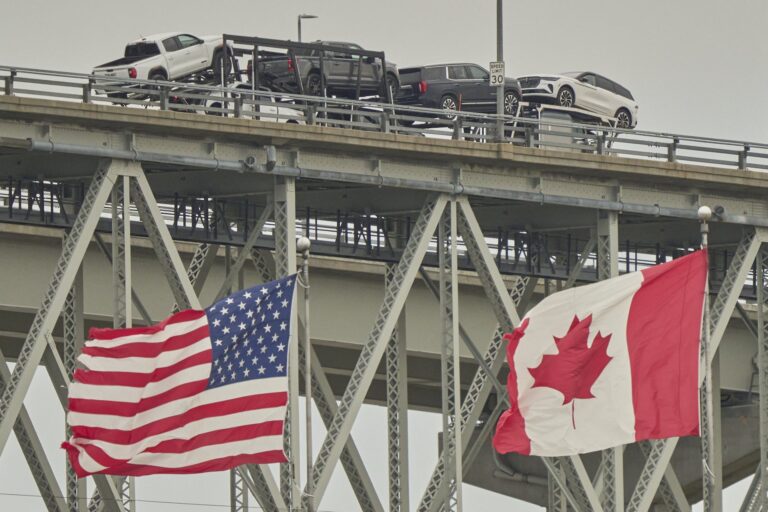
Just as Canada raced to secure the future of its auto plants as the industry transitions to EVs, so too has VW, which faces growing competition from Chinese automakers and American rivals that qualify for U.S. clean-vehicle credit purchase incentives. In St. Thomas, VW’s executives and marketing videos touted the new Ontario plant, its first outside Europe, as having the potential to become the company’s biggest globally as it tries to act more like a startup and a tech company.
Here’s what we learned Friday:
- The plant will employ up to 3,000 people directly.
- It will make up to one million EV batteries a year once it’s completed in 2027.
- Volkswagen will have to build the plant and start making batteries before it qualifies for the promised government subsidies.
- The federal government defended its subsidies, saying the plant will generate an estimated $200 billion in value.
Here’s what we still need to know:
- Innovation Minister François-Philippe Champagne did not directly address what will determine what level of subsidy in the reported $8-billion to $13-billion range the government will ultimately provide, saying only that the plant will pay for itself in five years.
- Trudeau noted that tax incentives in last month’s federal budget for the zero-emissions vehicle industry and its supply chain are tied to the companies meeting labour requirements. He did not address how unions will be part of the contract with Volkswagen, saying, “We will always be there to support organized labour. But the most important thing is that Canadians across this country get good, well-paying jobs.”
- There’s a lot of land left around the VW plant for which no plans have been announced. Asked whether more auto manufacturing could be a possibility, Ontario Economy Minister Victor Fedeli said he’s heading to Germany next month for a fresh set of negotiations for the business park around the plant.
The takeaway: VW’s sweeping promises to the small town will take a decade to materialize—and the stakes are high. Trudeau and the Liberal government have put unprecedented resources toward winning the battery plant over “friendly” rivals like Europe and the U.S., with hopes it will sustain Canada’s auto industry through a high-tech transformation in coming years. Now it’s time to execute.



Loading...
Thanks for sharing!
You have shared 5 articles this month and reached the maximum amount of shares available.
CloseThis account has reached its share limit.
If you would like to purchase a sharing license please contact The Logic support at [email protected].
CloseGift the full article!
You have gifted 0 article(s) this month and have 5 remaining.
Recipients will be able to read the full text of the article after submitting their email address. They will not have access to other articles or subscriber benefits.
Photo: The Canadian Press/Tara Walton
Most Popular This Week



In-depth, agenda-setting reporting
Great journalism delivered straight to your inbox.
The Big Read
Beacon is building an AI empire by fixing Main Street’s software
Briefing
Inovia raises US$200M for new VC fund as it eyes AI’s impact
43% of eligible Albertans voted ahead of Monday’s referendum
AI chip company Tenstorrent raises US$1.5B, valuing it at US$6.2B
Best business newsletter in Canada
Get up to speed in minutes with insights and analysis on the most important stories of the day, every weekday.
Exclusive events
See the bigger picture with reporters and industry experts in subscriber-exclusive events.
Membership in The Logic Council
Membership provides access to our popular Slack channel, participation in subscriber surveys and invitations to exclusive events with our journalists and special guests.







