Listen Now
0:00
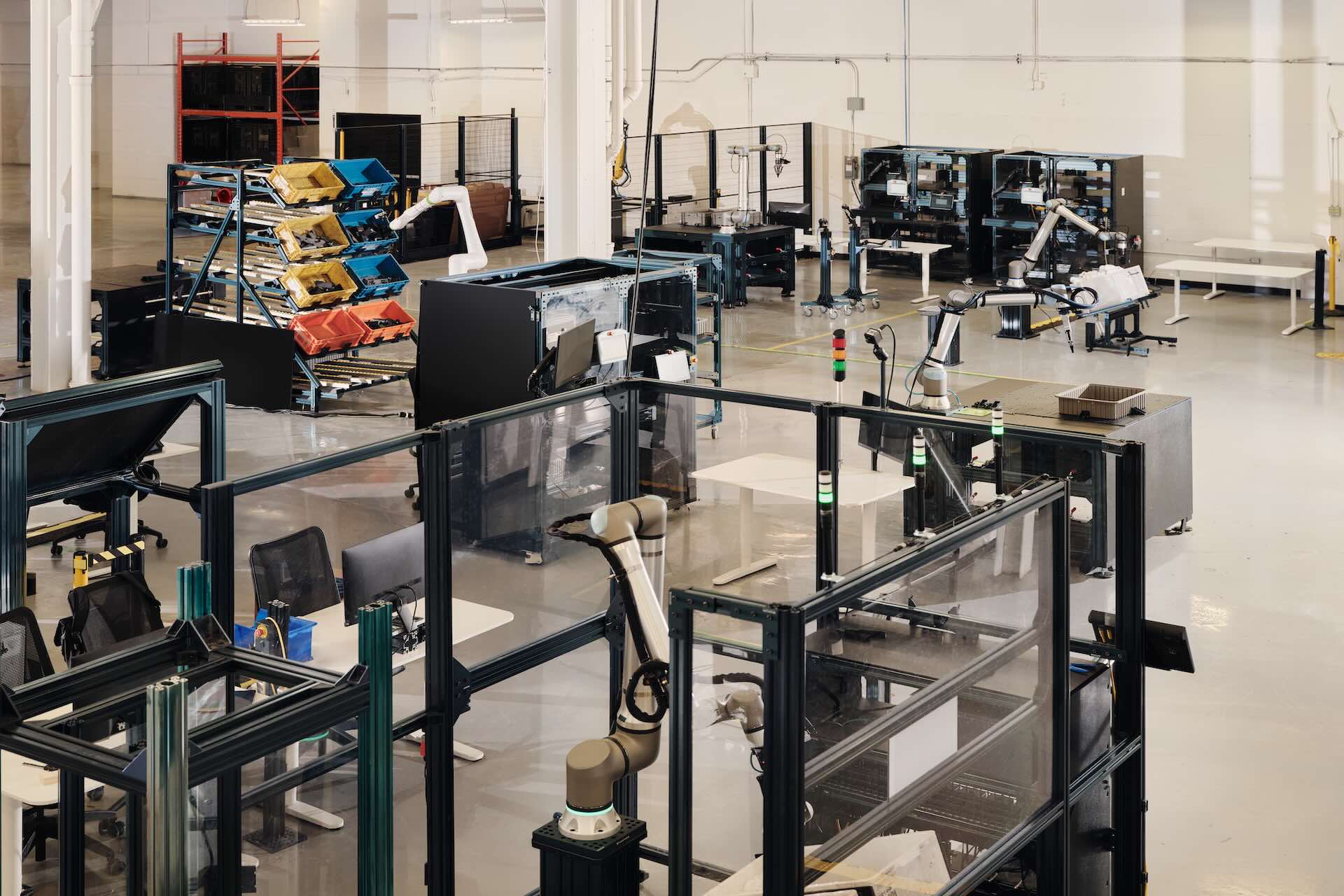
Vention, a Montreal-headquartered robotics firm, has set up a research lab focused on physical AI that will use the data its machines generate on factory floors to make breakthroughs in what they can do and how well they do it.
The company has no plans to compete against startups that have raised huge sums to develop multi-purpose foundation models for the field. Instead, Vention is focusing on improving the software and control systems for robots based on how they’re used in real industrial settings, CEO Etienne Lacroix said.
Talking Points
- Montreal-based Vention has set up a new lab focused on physical AI, which will research ways to make robots perform better and do more on factory floors. The firm is drawing on data from tens of thousands of machines it’s already sold to major manufacturers.
- Unlike other physical AI startups, Vention isn’t trying to build an all-purpose foundation model. It’s instead focusing on improvements for real-life production and assembly problems.
“It’s not profitable to deploy physical AI today,” he said. “We can deploy it at scale with amazing unit economics.”
Vention will use data gathered by tens of thousands of machines it’s sold to manufacturers across North America and Europe since it started in 2016. Many physical AI startups train their foundation or world models on scraped videos, or employ workers to generate examples by completing tasks wearing sensor-covered gloves or point-of-view cameras.
Lacroix claimed Vention’s data is more effective because it comes directly from robots that are already operating on production and assembly lines. The firm’s new lab aims to use that information to solve real challenges with manufacturing machines and expand their capabilities.
One such challenge involves training robots to pull items from deep bins where there’s a high risk of bumping into other machinery or workers. The collision problem has so far restricted many industrial robots to being deployed on slow, simple conveyor belts or to lifting and dropping things within closed cages. “Our clients are just more demanding—the use case is a bit more tricky,” said Lacroix.
Related Articles

The team is also working to automate kitting, which involves unboxing and gathering the different pieces for a particular task—a headlamp, harnesses, brackets and screws on a car line, for example. Vention has tested the technology with a major automaker, Lacroix said.
The firm’s software kit, called GRIIP, is powered by a mix of commercial and open source AI models, plus algorithms and protocols developed in-house that Lacroix said ensure the system achieves “industrial-grade” performance. The code runs on the controller unit that Vention already sells for its robots, without the need for hardware upgrades.
The firm is charging clients US$15,000 a year per machine unit—like a welding cell or pallet-making system—to use GRIIP. Lacroix said that’s a better financial bet than trying to develop a foundation model, which can command only a few thousand dollars worth of revenue per robot. “We really see those base models as a commodity,” he said. “There’s so many people right now developing them.”
The new lab includes both a physical space for experimentation and testing, and a 16-person team. It’s led by Jimmy Li, Vention’s director of physical AI, who got his doctorate at McGill University and joined the firm in October 2024 after a stint at Samsung. Vention has also recruited Joelle Pineau, Cohere’s chief AI officer, as an advisor to the lab; the star researcher has a doctorate in robotics from Carnegie Mellon University.
Vention’s customers include big businesses like 3M, Boeing, Hershey, L’Oreal and Nike. The firm raised a US$110-million Series D round in January at a valuation over US$1 billion. Backers included Investissement Québec, Desjardins Capital and the venture arm of Nvidia.
Leading physical AI startups taking the foundation model approach include Pittsburgh, Pa.-based Skild AI, which closed a US$1.4-billion round in January from the likes of SoftBank and Nvidia, and San Francisco-based Physical Intelligence, which reportedly raised US$600 million in November 2025 led by a Google fund. And as The Logic first reported last month, former Nvidia researcher Sanja Fidler has secured over US$90 million in seed financing so far for Veeda AI, which is developing world models for robotics.
Some 120 of Vention’s 300-plus staff work on R&D, and the firm spends “tens of millions” on innovation annually. Competition for physical AI talent is fierce, Lacroix acknowledged. Still, Vention has attracted researchers from top AI schools like McGill and the University of Toronto by kitting them out with the necessary tools and giving them the chance to work on real-world problems, he added.
“A lot of the PhDs we have are super excited about ‘This is a case that helps me create that snack that I eat every day,’” Lacroix said. “If we crack this, it will go on that [production] line.”