OTTAWA — Canada could boost its economy by billions of dollars by securing a trade agreement with India, according to a study commissioned by business groups backing a deal. Here’s what you need to know:
Skip to content

News
India trade deal could boost Canadian economy by $8B, study says
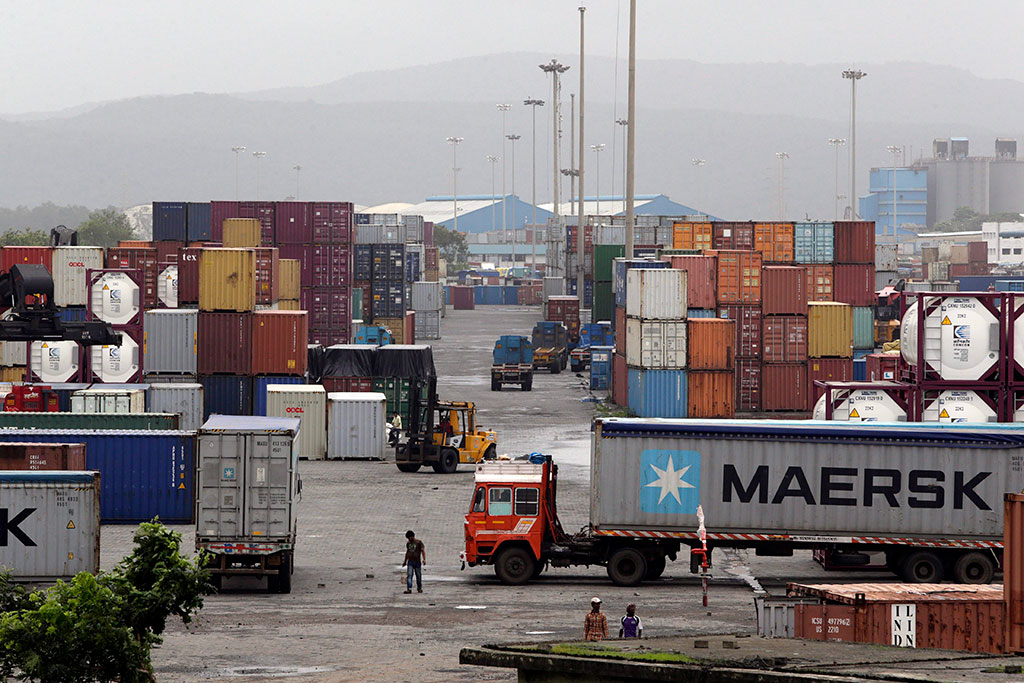
Containers at a terminal at Jawaharlal Nehru Port Trust, India’s busiest, in Mumbai in June 2017. Photo: AP Photo/Rajanish Kakade
OTTAWA — Canada could boost its economy by billions of dollars by securing a trade agreement with India, according to a study commissioned by business groups backing a deal. Here’s what you need to know:
The backstory: The two countries commenced free trade talks in November 2010, but failed to reach a consensus after 10 rounds of negotiations. In March, they relaunched the process, and have since held three more. Bilateral goods exchanged reached $8.96 billion in 2021, with Indian exports making up two-thirds of the total.
The math: Canada-India trade would increase by $5.98 billion under a deal similar to an Asia-wide one sealed in November 2020 that New Delhi nearly joined, according to modelling by Ottawa-based Ciuriak Consulting. If both sides agree to drop all tariffs, the commercial gains could rise to $8.77 billion. The Business Council of Canada (BCC) and the Canada-India Business Council (C-IBC) paid for the study.
Those increases translate to GDP increases of around $5.15 billion and $8 billion, respectively, for Canada, according to projections from Ciuriak, which Global Affairs Canada regularly hires to assess the impact of trade deals. Ahead of the November 2010 launch of negotiations, the department projected a comprehensive trade deal would grow Canada’s economy by US$6.2 billion.
Winners and losers: Canadian fruit and vegetable merchants would sell $1.4 billion more to India with a deal, while mineral exporters would send over an extra $380 million of products. Service sectors would also gain hundreds of millions of dollars in business, although mostly from selling more into a larger local economy. Food-oil exporters and auto-parts manufacturers would lose $161 million and $159 million, respectively.
The moment: “We need to start paying a lot more attention to this market, because the rest of the world definitely is,” C-IBC CEO Victor Thomas told The Logic in an interview. While the Indian economy was stagnating before the pandemic, the International Monetary Fund projects it will be the fastest-growing major economy in 2022.
Ottawa and New Delhi’s last attempt at a trade treaty floundered, but India’s Bharatiya Janata Party government “seems to be much more open and hungry to get some free trade agreements in place,” said Thomas, citing recent deals with the United Arab Emirates and Australia. An agreement with India is crucial to Canada’s Indo-Pacific strategy, said BCC CEO Goldy Hyder in a statement.
Undeterred by the lack of a deal, Canadian institutional investors have poured billions into the Indian economy in recent years, while Indian IT consulting firms have pledged to hire thousands of new workers in Canada. “That’s really the low-hanging fruit,” said Thomas, noting “there’s an opportunity for a lot more.”
Loading...
Thanks for sharing!
You have shared 5 articles this month and reached the maximum amount of shares available.
CloseThis account has reached its share limit.
If you would like to purchase a sharing license please contact The Logic support at [email protected].
CloseGift the full article!
You have gifted 0 article(s) this month and have 5 remaining.
Recipients will be able to read the full text of the article after submitting their email address. They will not have access to other articles or subscriber benefits.
Photo: AP Photo/Rajanish Kakade
Most Popular This Week




In-depth, agenda-setting reporting
Great journalism delivered straight to your inbox.
Exclusive
What the Maple 8’s first chief AI officer is up to
Briefing
Canada unlikely to double non-U.S. exports by 2035 without big investments: Report
Trucking giant TFI to start using driverless big rigs in the U.S.
U.S. fintech Ramp opens Toronto office, expands Canadian offerings
Best business newsletter in Canada
Get up to speed in minutes with insights and analysis on the most important stories of the day, every weekday.
Exclusive events
See the bigger picture with reporters and industry experts in subscriber-exclusive events.
Membership in The Logic Council
Membership provides access to our popular Slack channel, participation in subscriber surveys and invitations to exclusive events with our journalists and special guests.