Justine Hendricks, chief executive of Farm Credit Canada, still likes paper. I know this because of the stack of pages she placed on the table at the start of our interview, the material she had collected in preparation for her meeting with The Logic’s economics columnist. As I take my puny A6 notebook out of my pocket, I’m reminded of something European Central Bank president Christine Lagarde told me about what it’s like for successful women in a man’s world.
Skip to content

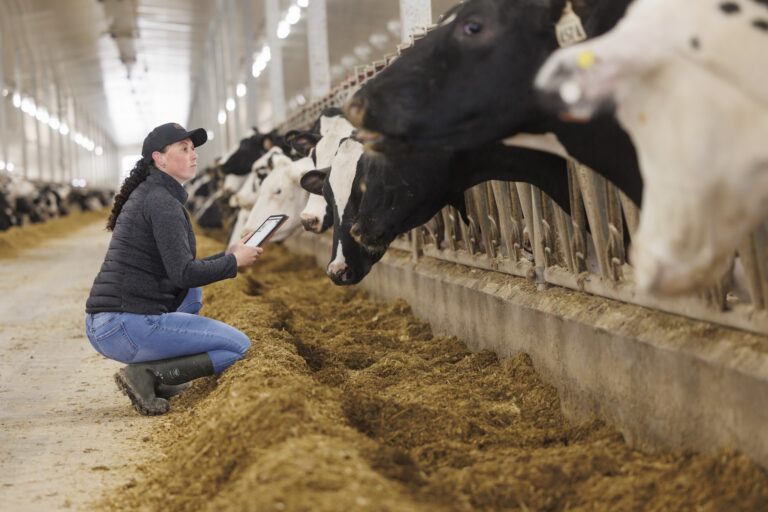
 Hendricks says Canadian agriculture has a “generational opportunity.” Photo: Selena Phillips-Boyle for The Logic

Commentary
Carmichael: Canadian agriculture’s $60B woman is out to shake up an underperforming industry
With a pledge to spend big on agtech, FCC chief executive Justine Hendricks hopes to give Canada’s food sector a jolt
Farm Credit Canada CEO Justine Hendricks, photographed in Montreal in August, 2025. Photo: Selena Phillips-Boyle for The Logic
Justine Hendricks, chief executive of Farm Credit Canada, still likes paper. I know this because of the stack of pages she placed on the table at the start of our interview, the material she had collected in preparation for her meeting with The Logic’s economics columnist. As I take my puny A6 notebook out of my pocket, I’m reminded of something European Central Bank president Christine Lagarde told me about what it’s like for successful women in a man’s world.
“Women, as the minority, have to prove their worth all the time,” Lagarde said in 2016, when she was running the International Monetary Fund. “We tend to overdo it because you have this anxiety to fail and let your colleague females down on occasion.”
FCC doesn’t get much mainstream attention, reflecting the country’s general lack of interest in the business of making food. John Diefenbaker’s government created what was then called Farm Credit Corporation in 1959, seeding the newest Crown lender with $8 million to back loans exclusively for farmers at a statutory rate of five per cent. FCC evolved into a proper financial institution and now it not only lends money to processors, it also backs agricultural technology startups via FCC Capital, the new direct venture capital investment arm launched last year. With nearly $60 billion worth of assets on its books, FCC’s heft rivals that of second-tier private lenders such as Equitable Bank and Laurentian Bank.
Related Articles


Yet no woman had led FCC until former agriculture minister Marie-Claude Bibeau chose Hendricks, a longtime Export Development Canada executive, for the job in December 2022. “We have broken another glass ceiling with the arrival of Justine Hendricks,” Bibeau said in a press release.
FCC’s Montreal outpost is in the upper reaches of a downtown office tower. As my ears popped in the elevator, I wasn’t thinking about asking Hendricks about what it takes to bust through glass ceilings. I mostly wanted to meet the executive who had pledged to invest $2 billion in agricultural technology by 2030, an aggressive pivot by a staid institution that consistently pays its shareholder—the federal government—an annual dividend worth hundreds of millions of dollars.
It’s the kind of jolt that could cause some people to wake up to the food industry’s potential. Canadian agriculture underperforms, both economically and narratively, and a lack of leadership might be one of the reasons. FCC and its chief executive are willing to fill the void. “There’s an opportunity for the industry, and that’s certainly a role we want to play as being that catalyst, to really come together in one voice,” Hendricks said.
Groupthink might explain why the Canadian food business, despite all its comparative advantages, remains an afterthought in Ottawa and on Bay Street. It would be unfair to describe the industry as static, but it still looks a lot like it did when the FCC was created. Almost three quarters of Canada’s roughly 272,000 farmer operators were men in 2016, according to Statistics Canada’s most recent farm census.
My observation is that oxygen that could be used for policy change is consumed by tired debates over supply management, while industry lobbies habitually spend their political capital on demands for compensation for whatever vagary afflicts their members. Whatever the merits of ending supply management, and however justified the latest request for a lifeline, these debates are effectively pre-empting a conversation about what it would take to level up.
It’s not her job, but Hendricks wants to lead that conversation, if only because no one else seems willing to do it. She uses the word “bold” a lot, which isn’t a modifier typically associated with a Crown agency. There are exceptions, but for the most part the leaders of organizations such as Export Development Canada and Canada Mortgage and Housing Corporation keep their heads down. FCC earned the federal government $690 million in the fiscal year that ended on March 31, up from $460 million the previous year. Whatever Hendricks is doing, it’s working.
But Hendricks is changing things anyway. Canadian agriculture has what she calls a “generational opportunity” because it could generate economic growth, help offset climate change, improve the health of aging societies and address food insecurity simultaneously. “Find me a sector that can do that,” she said.
The decision to create FCC Capital and get into venture investing is the best example so far of how Hendricks intends to meet the moment. Canada has a troubling entrepreneurship problem and a chronic lack of funding is part of the problem, so this new pool of capital can only help. FCC is also ramping up its advisory services, pairing a trove of farm-level data with artificial intelligence to help farmers manage risk—including, potentially, by allowing growers to create digital twins of their fields. That could play a role in addressing woefully weak productivity.
Hendricks didn’t come up with those ideas in her lofty office in Montreal, the city in which she grew up, or over lunch with other executives in Ottawa. She spends a ridiculous amount of her time on the road, most of it visiting FCC clients. In July, she took advantage of Stampede week in Calgary to conduct meetings, then spent 10 days driving around Manitoba followed by a few days advocating for Canadian agriculture in Europe.
Lagarde would understand the pace. It’s what you do when complacency isn’t an option. People accept you if you “win their hearts,” Hendricks said. The amount of work required to do so will depend on “each individual, and I think depending on the industry it’s not always easy,” she added. “If you are trying to ask me if I’m an underdog, I’m a total underdog.”
An underdog mentality would serve Canada well right now. Leadership matters, and there are some interesting things happening in agriculture because an agency and its CEO decided to lead. The mainstream might want to take note.
Hendricks and I talked about more than her underdog mentality. Here are some of the highlights:
On FCC Capital’s approach to venture:
“Our money, our capital is worth a lot. We can crowd in the extra, but I think where we’re trying to be… is we’re really trying to take that catalyst role to the next level.
“We want to be that glue, or that oil, in that ecosystem to constantly have it connect, because we think that’s where we want to lead. We’ll put capital on the table, but success for us is not to be the lead [investor], and if so, certainly not all the time. When you’re the lead, there’s a whole infrastructure around being the lead that takes [up] your capacity. If you can be there because you [have] knowledge, and that allows you to do more faster, that becomes a strategic decision you need to make.”
On the ‘Root’ of the productivity problem:
“We leaned into generative AI to create a tool [called Root] to help support the farmer. If your combine breaks down in the middle of the field, you need to order a part, Root can find out where you can get it. You can ask Root, ‘What are all the different programs out there in terms of grants.’ Root will actually help you fill out the grant. We’re just scratching the surface with what we’re going to do with Root.
“The reason the team went there is because we started to notice—and it’s not just provincial, municipal, [it’s] across the country—when everybody’s trying to be more efficient, we’re seeing in these different areas [that] budgets are being cut [even if] for all the right reasons. Those types of services where you could call your local office [to ask] ‘Can you help me with this?’ are just disappearing. So we said, ‘Hey, since we’re FCC and we want to be a catalyst, why don’t we combine that [need] with technology?’ And why don’t we help to bring value?”
On why agriculture struggles to win investment:
“We haven’t positioned it that way. I’m not sure we’ve always seen it as an opportunity.
“I’ve rarely found somebody that said, ‘Oh, I don’t even think about [agriculture] and food…’ But what I’ve come to realize, and that’s what I’ve been saying to the sector recently, is we’re always number seven out of 10 priorities, and my goal is to get it to number five, and my real goal is to get it to the top three. When you’re in seventh place… you’re the decision that [investors] will push out to next year.”
Kevin Carmichael is The Logic’s economics columnist and editor-at-large. He has spent more than two decades covering economics, business and finance for outlets including Bloomberg News, The Globe and Mail and the Financial Post, where he also served as editor-in-chief.



Loading...
Thanks for sharing!
You have shared 5 articles this month and reached the maximum amount of shares available.
CloseThis account has reached its share limit.
If you would like to purchase a sharing license please contact The Logic support at [email protected].
CloseGift the full article!
You have gifted 0 article(s) this month and have 5 remaining.
Recipients will be able to read the full text of the article after submitting their email address. They will not have access to other articles or subscriber benefits.
Photo: Selena Phillips-Boyle for The Logic
Hendricks says Canadian agriculture has a “generational opportunity.”
Most Popular This Week


In-depth, agenda-setting reporting
Great journalism delivered straight to your inbox.
News
MaRS joins forces with accelerator Vimy Forge to help defence startups
Briefing
B.C. sues OpenAI over Tumbler Ridge shooting
Shopify to let Meta’s AI assistant make purchases through Shop Pay
Scotiabank prices $750M defence bond, a Canadian first
Best business newsletter in Canada
Get up to speed in minutes with insights and analysis on the most important stories of the day, every weekday.
Exclusive events
See the bigger picture with reporters and industry experts in subscriber-exclusive events.
Membership in The Logic Council
Membership provides access to our popular Slack channel, participation in subscriber surveys and invitations to exclusive events with our journalists and special guests.