Scheduling dozens of workers on her family’s dairy farm using a whiteboard was just not cutting it for Melissa Hylkema.
Skip to content

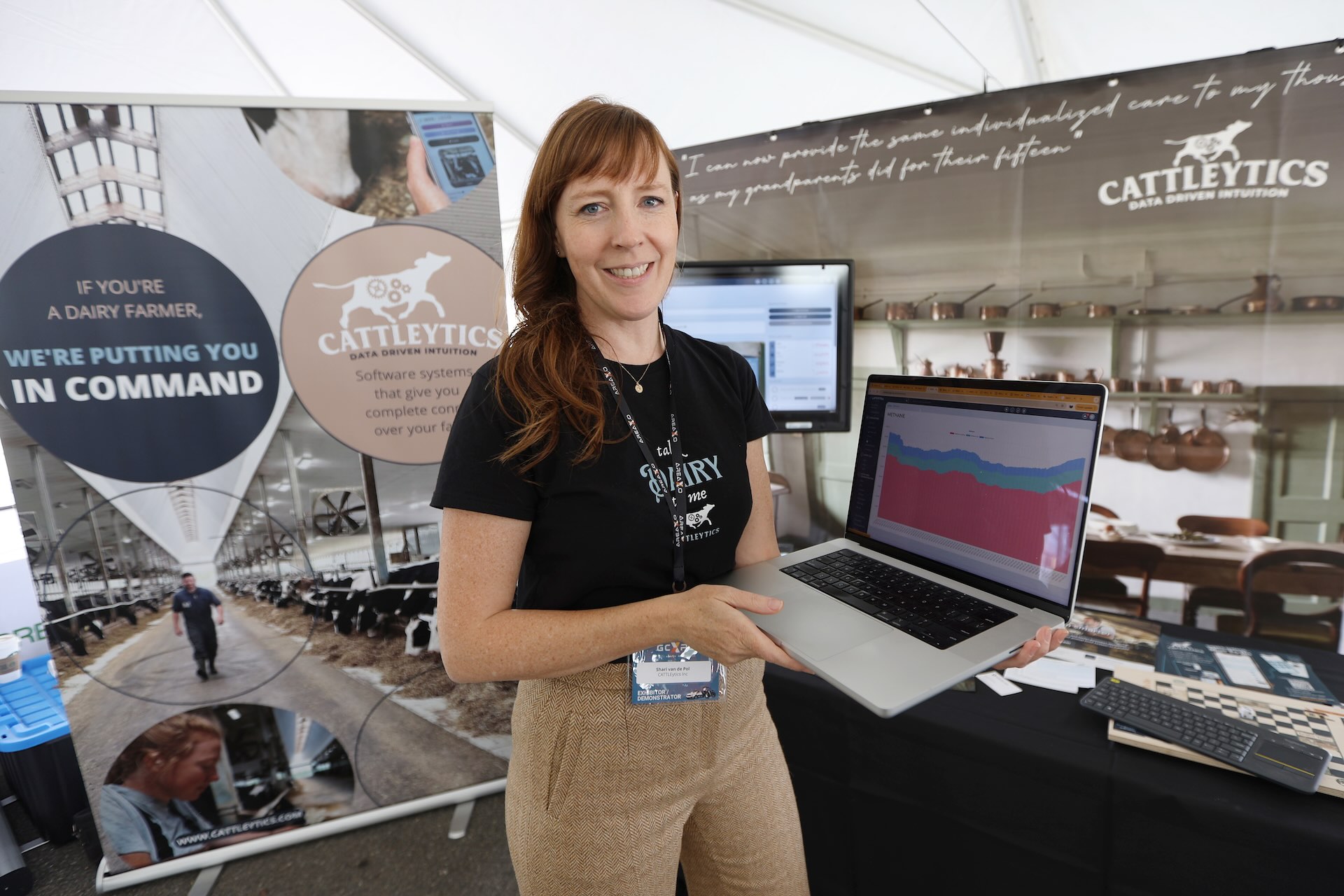 Cattleytics founder Shari van de Pol at a tech demonstration event in Ottawa on Sept. 26, 2024. Photo: Handout/David Kawai
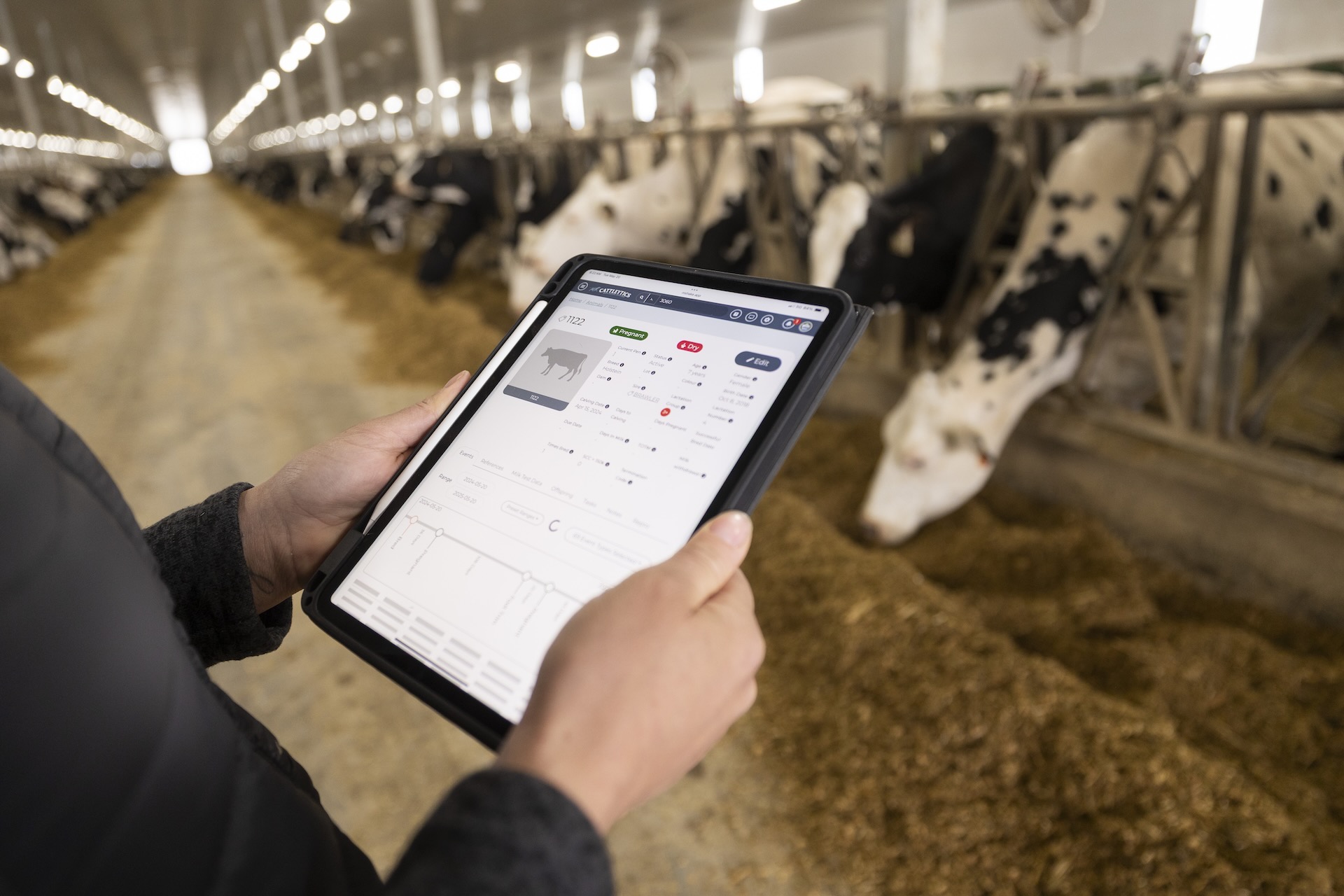 Melissa Hylkema uses Cattleytics’ software to manage her dairy herd. ”All of our cows basically have a Fitbit on them,” she says. Photo: David Stobbe / Stobbe Photo for The Logic

Special Report
Farming was long a Canadian productivity champion. Tech could put it back on top
Moneyball for cows and other tech breakthroughs help the sector overcome labour shortages and overwork
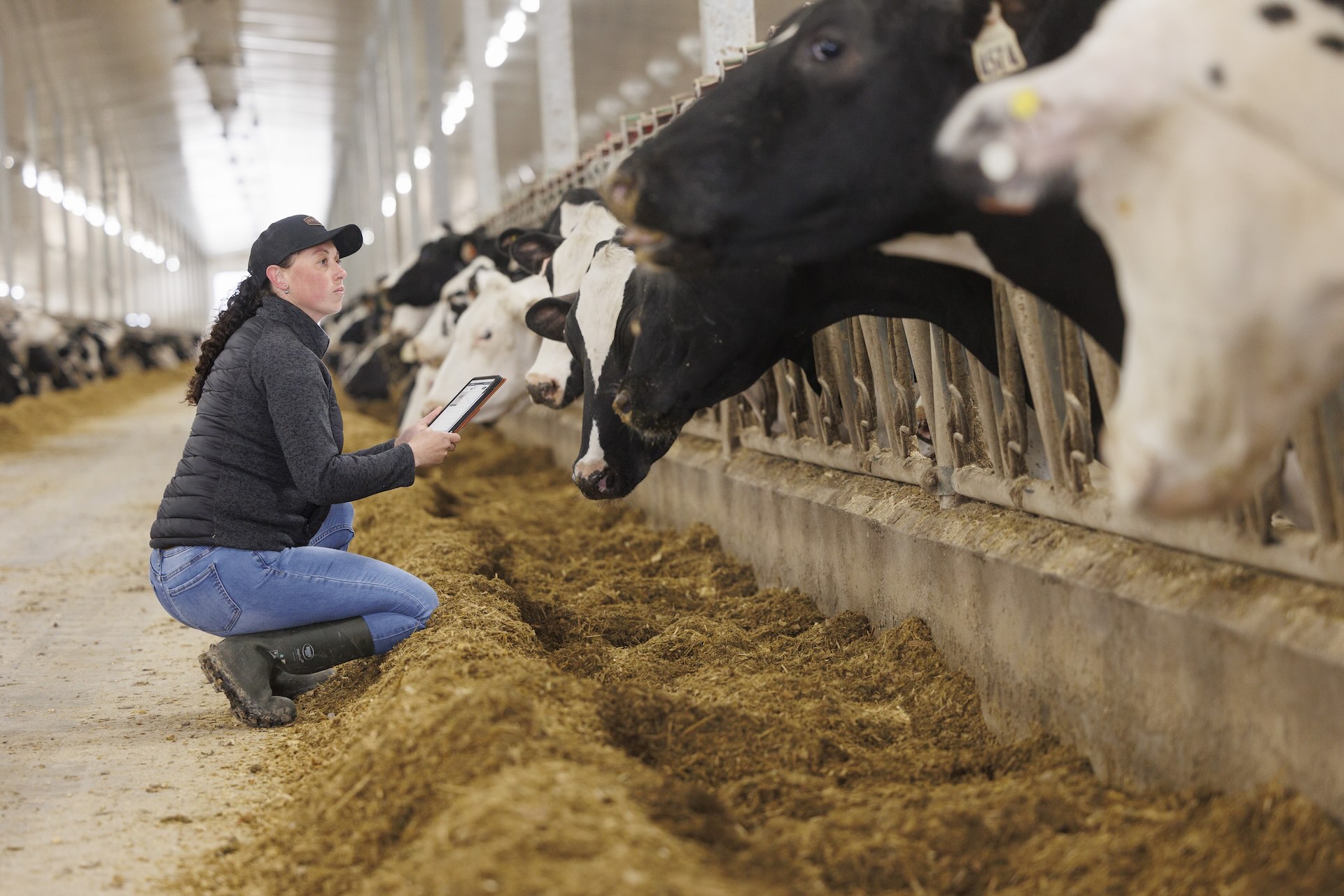
Melissa Hylkema and her family run a dairy farm with about 1,350 head of cattle in Hague, Sask., half an hour’s drive northeast of Saskatoon. They use software from Canadian startup Cattleytics to manage the operation. Photo: David Stobbe / Stobbe Photo for The Logic
Scheduling dozens of workers on her family’s dairy farm using a whiteboard was just not cutting it for Melissa Hylkema.
Five members of the Hylkema family run dairy operations with about 1,350 cattle in Hague, Sask., half an hour’s drive northeast of Saskatoon. That’s big, by Canadian standards, and there’s a lot to keep track of. The Hylkemas have 36 employees, Hylkema says, a mix of full- and part-timers.
Talking Points
- Though it’s plagued by labour shortages and overwork, farming is a productivity champion in the Canadian economy—never have so many people eaten thanks to so few workers
- Startups like Ontario’s Cattleytics are trying to salve the pain points in farm management, helping with everything from scheduling workers to finding all-important needles in haystacks of data
“You do the whiteboard, someone takes a picture of it and that’s their schedule,” she says. But if Hylkema has to make a switch? A mess. “Maybe I’ll text those two people, but then those two people forgot that I texted them, and they’re still looking at their picture.”
This grinding nuisance sucks up time and energy and saps productivity on a farm where efficiency is critical.
Enter Cattleytics, a company based in Hamilton, Ont., with an eponymous platform for managing dairy farms. Founded in 2014 as a veterinary engineering company by engineer-veterinarian-entrepreneur Shari van de Pol, Cattleytics is now also in the dairy productivity business.
“We’re really focusing on those pain points, which [are][are] often labour shortages,” van de Pol says. “People are overworked and they can’t get enough people on their farms. This takes the pressure off.”
Scheduling workers on a sprawling 24-hour-a-day farm is not quite like doing it in any other business. Nor is the vast array of data a farm generates out of everything from weather to animal genetics quite like the pile accumulated in any other sector.
Resilient Canada
Canada has a productivity crisis. This series will unpack the problem and point toward solutions—because in a time of turmoil, a more productive Canada will be a more resilient Canada. Don’t miss the rest—follow this page for the upcoming stories.
Read more from the series:
- Most of you think Canada has a productivity crisis—but there’s hope it can be fixed soon
- It’s time to fix our productivity crisis
- Canada’s oil and gas industry is facing its own productivity crisis
- Canada can’t fix its productivity crisis without fixing housing first
- Looking for a reason for Canada’s productivity crisis? Blame Big Tech
- The rest of Canada could learn a thing or two from agriculture’s productivity boom
- Carmichael: Canada needs to unleash its entrepreneurs to fix its productivity crisis
- Event: How to fix Canada’s productivity crisis
Under Canada’s supply management system, dairy farmers are each allowed to sell a set amount of butterfat each day. “Quota” can be traded like a commodity; it goes for tens of thousands of dollars per daily kilogram of butterfat.
This system, much attacked by U.S. President Donald Trump lately because of the trade limits that protect it, incentivizes Canadian farmers to favour cattle that produce a lot of high-fat milk with the least inputs.
“When you can only provide so much milk, then it really forces you to make more money by being more efficient,” van de Pol says.
If you take a long view, agriculture is an industry of productivity triumphs for Canada. A 2024 report from RBC noted that a group of industries that includes farming—agriculture, fishing, forestry and hunting—has led Canadian productivity growth over the previous 60 years. Output has improved nearly 700 per cent in that time, about double the rate of productivity growth in manufacturing.
Not everyone loves the reasons: bigger farms and higher-tech equipment mean more industrialized farming and fewer farmers.
“There have been negative consequences for rural communities that depended on all of those agricultural jobs,” the RBC report acknowledged. But if we had millions more people producing Canada’s food, they wouldn’t be devising solutions to other problems, researching medical breakthroughs or administering social programs, it argued.
Although agricultural production has grown and grown, its share of the Canadian economy shrank as other industries shot past it—a consequence of success in the industry that led Canada’s first really big productivity boom. All those other sectors, RBC said, “owe part of their success to the fact that farmers got really good at producing food.”
Still, there’s more to do. Productivity growth in Canadian agriculture has slowed.
“The adoption of advanced agri-food technologies is critical in addressing labour shortages, particularly in the horticulture and food processing sectors,” said a briefing note prepared last fall by officials at Agriculture and Agri-Food Canada and obtained by The Logic through an access-to-information request. “Automation and enhanced productivity can mitigate cost and supply chain issues, driving the sector towards sustainable growth.”
Related Articles


Cattleytics has been backed by federal funding, including $800,000 toward the platform’s development (from the Canadian Agri-Food Automation and Intelligence Network, which is largely funded by the Strategic Innovation Fund), and a $450,000 commercialization grant in March. When van de Pol spoke to The Logic, she’d just finished taping an appearance on Dragon’s Den, though she’s forbidden to say whether any of the venture capitalist dragons invested.
Raised in southern Ontario farm country—not on a farm, she hastens to say, though she spent a lot of time in neighbours’ barns—van de Pol was educated as a computer engineer and has worked at edtech company Lumio, Atomic Energy of Canada and IBM. She put that career aside to become a large-animal veterinarian, the specialty that focuses on farm animals.
“IBM is a great company. It wasn’t bringing out my best,” she says. “I needed to be doing something that was connected to nature.”
Cattleytics, now with a full-time staff of 12, plus some extra summer hires, combines both of her streams of expertise. Its platform has three pillars. One is a digital twin of the dairy, “which kind of looks like Facebook for dairy cows,” says van de Pol. Each animal has a profile picture and a file with its milk production, health, genetics, breeding history and so on. But it’s combined with Moneyball for dairy cows, looking for small things—about the cattle themselves or in how they’re tended—that make big differences.
A second pillar is data crunching. Dairy cattle produce milk for about 305 days after calving, but just how much they produce varies. It’s relatively little at first, rising to a peak at the 50-day mark, then trailing off. A given cow’s production curves also change between her first, second and third calves, though the curves tend to stabilize then.
Imagine a herd of 100 cattle, let alone the Hylkemas’ 1,350. How do you get steady, quota-friendly production from that many animals? In hot and cold weather, letting them graze when there’s grass and feeding them silage when there isn’t, when they’re younger and as they age, allowing for miscarriages and stillbirths?
What they eat matters. One of van de Pol’s early findings showed a farmer that when he used cheaper feed, it cost more in lost milk production than he saved up front.
“You have your gut feel, which is often correct, but being able to actually quantify that in dollars and cents is more complex on a dairy than about any other industry,” van de Pol says. (What report do you want? Ask for it in plain English through Cattleytics’s AI assistant, Cowpilot.)
The Hylkema farms are data-intensive operations and use only part of the Cattleytics package. They use one program, DairyComp, to track cows’ key life events, including breeding and lactation cycles. Another, CowManager, monitors their daily activities, like eating, movement and sleep—”All of our cows basically have a Fitbit on them,” Hylkema says—to look for early signs of ill health and to improve breeding.
Managing farmworkers’ duties is not as fun as Moneyball for cows, but it’s critically important, and the third Cattleytics pillar. That’s the part the Hylkema farms currently rely on, though in the long run, Hylkema hopes to adopt the other components, too.
Now, if Hylkema tweaks a schedule, the workers affected get pings on their phones and everyone can see the change. Workers can swap shifts on their own, too. If she does something that might be a mistake, such as scheduling the same person for a late night and the next morning, she gets a warning.
Van de Pol tells of a farmer who ran his farm through a sprawling WhatsApp group chat. “When something’s broken, when a calf needed to be looked at and get another bottle of milk, when anybody needed anything, it was going into the chat,” she says. “At the end of the day, he was probably spending over an hour walking out to check if it was done, trying to get in touch with people, checking this, checking that.”
Tasks can come with how-tos generated with the help of an AI language module that turns jot notes into step-by-step instructions, in more than one language if that’s needed. Hylkema says she doesn’t have a lot of trouble finding workers, but young locals make up a lot of her labour pool and keeping them can be tough so they’re always training new people.
Cattleytics is only one of many firms that sees an opportunity in pushing agricultural production into the future. Telus has an agtech business focused on digitizing farm operations; at the other end of the spectrum, startup Vivid Machines uses AI to process images from cameras mounted on orchard equipment to help growers predict and optimize their output.
Even Farm Credit Canada, a Crown corporation that finances farm businesses, makes venture capital investments in tech companies. Just returning the industry’s productivity growth to recent peaks could mean a $30-billion annual boost to the Canadian economy after 10 years, the agency has calculated.
“The government has really highlighted to us this is a priority—getting our farmers good tools,” says van de Pol. “If we have a productivity crisis—and they keep on highlighting access to skilled labour as one of their bottlenecks—then this is just something that takes that pressure off.”



Loading...
Thanks for sharing!
You have shared 5 articles this month and reached the maximum amount of shares available.
CloseThis account has reached its share limit.
If you would like to purchase a sharing license please contact The Logic support at [email protected].
CloseGift the full article!
You have gifted 0 article(s) this month and have 5 remaining.
Recipients will be able to read the full text of the article after submitting their email address. They will not have access to other articles or subscriber benefits.
Photo: David Stobbe / Stobbe Photo for The Logic
Cattleytics founder Shari van de Pol at a tech demonstration event in Ottawa on Sept. 26, 2024.
Melissa Hylkema uses Cattleytics’ software to manage her dairy herd. ”All of our cows basically have a Fitbit on them,” she says.
Most Popular This Week




In-depth, agenda-setting reporting
Great journalism delivered straight to your inbox.
Commentary
Carmichael: Canadian ignorance about India is a strategic weakness
Briefing
Aritzia shares pop after earnings rise 204%
First Nation in Alberta goes to court over fast-tracked oil pipeline
Chinese EV maker Geely Auto Group to launch in Canadian market in 2027
Best business newsletter in Canada
Get up to speed in minutes with insights and analysis on the most important stories of the day, every weekday.
Exclusive events
See the bigger picture with reporters and industry experts in subscriber-exclusive events.
Membership in The Logic Council
Membership provides access to our popular Slack channel, participation in subscriber surveys and invitations to exclusive events with our journalists and special guests.





