On Wednesday Shopify announced Sidekick, an AI apprentice teased earlier this month that the company hopes will help merchants manage and tool up their businesses. It’s also rolling out more offerings that use machine-generated text, plus new fintech and B2B features. Here’s what you need to know:
Skip to content
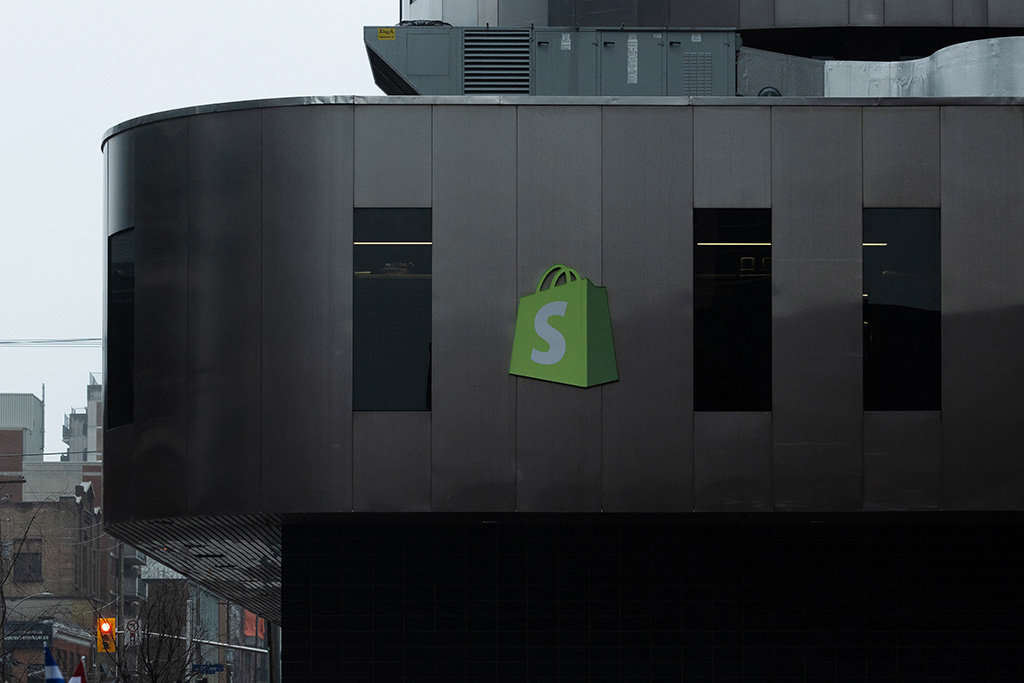 Shopify’s Ottawa office tower, pictured in February 2022. Photo: Bloomberg/James Park via Getty Images
News
With new AI bot, Shopify offers its merchants a Sidekick
‘There is massive upside to AI in the hands of businesses’
Shopify’s Ottawa office tower, pictured in February 2022. Photo: Bloomberg/James Park via Getty Images
On Wednesday Shopify announced Sidekick, an AI apprentice teased earlier this month that the company hopes will help merchants manage and tool up their businesses. It’s also rolling out more offerings that use machine-generated text, plus new fintech and B2B features. Here’s what you need to know:
Sidekick’s powers: The tool is designed to be “an extension of the business owner,” said Miqdad Jaffer, Shopify’s director of product for AI, in an interview with The Logic. Merchants can use Sidekick to perform tasks like editing the appearance of their web stores or implementing discounts, as well as answering a merchant’s questions with plain-language analysis of sales patterns and other trends.
The origin story: Shopify has long used machine learning for functions like detecting fraudulent orders, ranking search results and classifying data. Then, “ChatGPT happened,” said Jaffer. In November, San Francisco-based OpenAI launched the question-answering platform, prompting executives across the corporate world to query how their companies might use generative systems.
Related Articles

Shopify Magic—the firm’s name for its suite of AI offerings—started with a tool that wrote product descriptions for merchants. Jaffer’s team has been encouraged by the number of merchants using the feature since its February launch. “So we accelerated and said, ‘Let’s get this into as many places as we can.’”
Sidekick is one such effort. While Shopify announced the tool Wednesday, it doesn’t yet have a launch date, and the company will initially offer it only to select merchants. “Timing and audience size is going to really depend on the level of quality that we get,” said Jaffer, noting that his team is “running evaluations … more than a couple of times every day.”
But merchants will immediately be able to use Magic for their email marketing, to generate the text in their messages and optimize send times, as well as for store pages and blog posts.
Behind the mask: Shopify was an early adopter of ChatGPT APIs, letting them use the platform to add a product-recommendation chatbot to its Shop app, which lets consumers browse and buy from a range of Shopify merchants. OpenAI’s tech also powers many of the Magic applications, Jaffer said. But “we’re also looking at some open-source models … for some of these task-based use cases.”
While ChatGPT can write convincing responses to questions, other large language models (LLMs) might be better suited to, say, translating instructions into queries for an analytics system. Among the options with which Shopify is experimenting is Llama, the free-to-use model Meta launched last week. Shopify CEO Tobi Lütke signed a statement in support of the tech giant’s open approach.
LLMs need to be trained with data. Sidekick pulls from Shopify’s internal help documentation to generate responses to merchants’ how-to questions, and from information about merchants’ own stores to answer their analytical ones.
Lütke, an AI believer, still regularly writes code for the platform, COO Kaz Netjatian said at The Logic Summit last month. Shopify’s CEO “is very actively participating in” the development of Sidekick, Jaffer said, noting about two dozen employees have been working on the tool. The firm has also rolled out an internal ChatGPT-like system for its employees “to be able to play with [and] just really get familiar with the technology.”
Other missions: Wednesday marked Shopify’s semi-annual product drop, dubbed Editions. Non-AI announcements include a new business credit card for merchants, to add to its bank account and cash-advance fintech offerings. It’s also expanding its business-to-business toolset with a feature that lets merchants buy wholesale from big brands that are also on the platform.
The next issue: Shopify continues to look for more uses for AI, both internal and external. “There is massive upside to AI in the hands of businesses,” said Jaffer, adding “we want to make sure that we find all of the utility for our merchants as well as for ourselves.”
The company reports second-quarter earnings next Wednesday.



Loading...
Thanks for sharing!
You have shared 5 articles this month and reached the maximum amount of shares available.
CloseThis account has reached its share limit.
If you would like to purchase a sharing license please contact The Logic support at [email protected].
CloseGift the full article!
You have gifted 0 article(s) this month and have 5 remaining.
Recipients will be able to read the full text of the article after submitting their email address. They will not have access to other articles or subscriber benefits.
Photo: Bloomberg/James Park via Getty Images
Most Popular This Week




In-depth, agenda-setting reporting
Great journalism delivered straight to your inbox.
News
National Bank CEO warns AI alone won’t give banks a lasting edge
Briefing
Canada and Ontario commit over $5B to support tariff-hit steel sector
Hackers will see cars as major targets in next 3 years, 83% of car-tech workers say
EA shutting down Edmonton studio BioWare
Best business newsletter in Canada
Get up to speed in minutes with insights and analysis on the most important stories of the day, every weekday.
Exclusive events
See the bigger picture with reporters and industry experts in subscriber-exclusive events.
Membership in The Logic Council
Membership provides access to our popular Slack channel, participation in subscriber surveys and invitations to exclusive events with our journalists and special guests.





