Skip to content
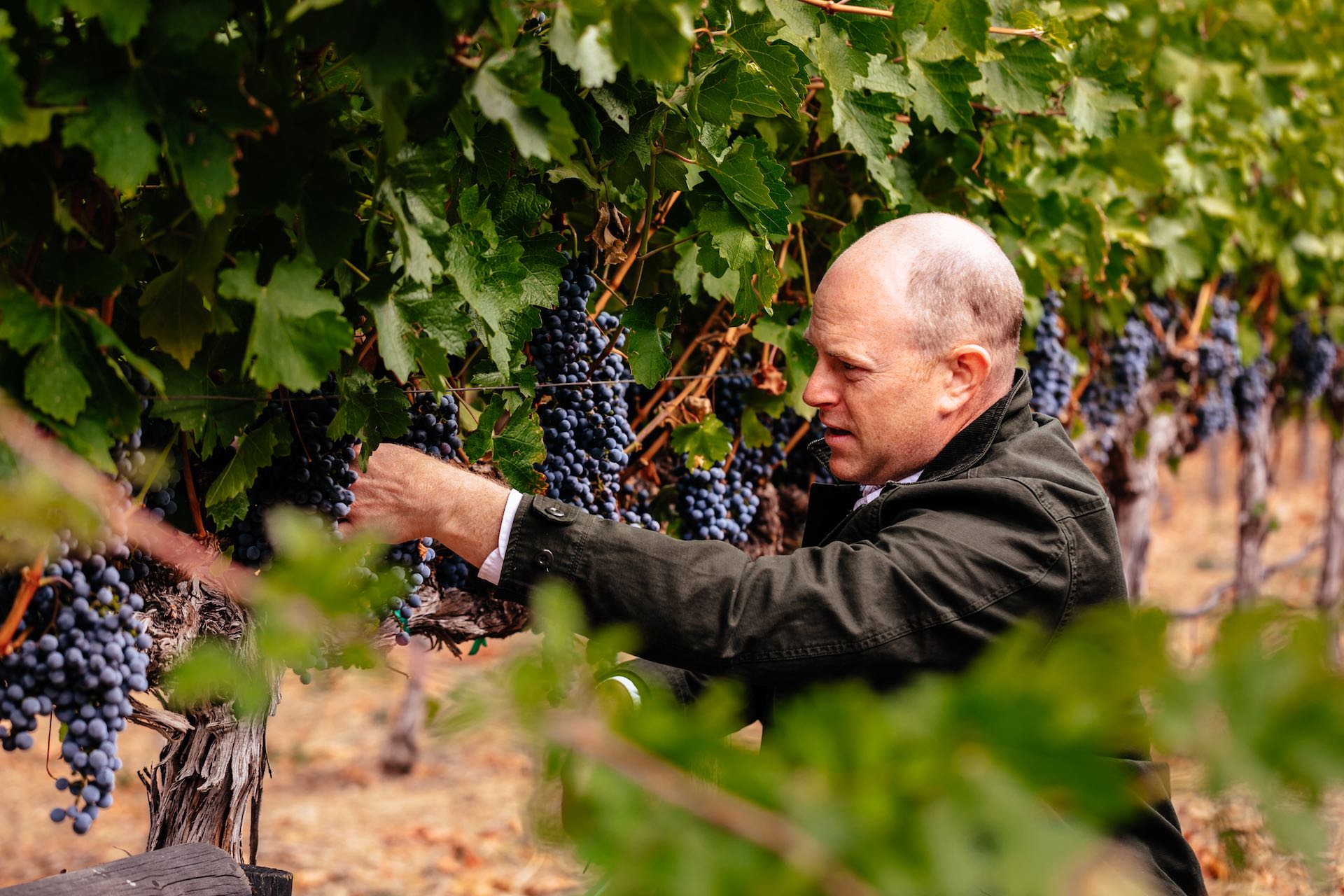
 Sean McBride at his vineyard in California's Napa Valley. Photo: Handout/Emma Kruch
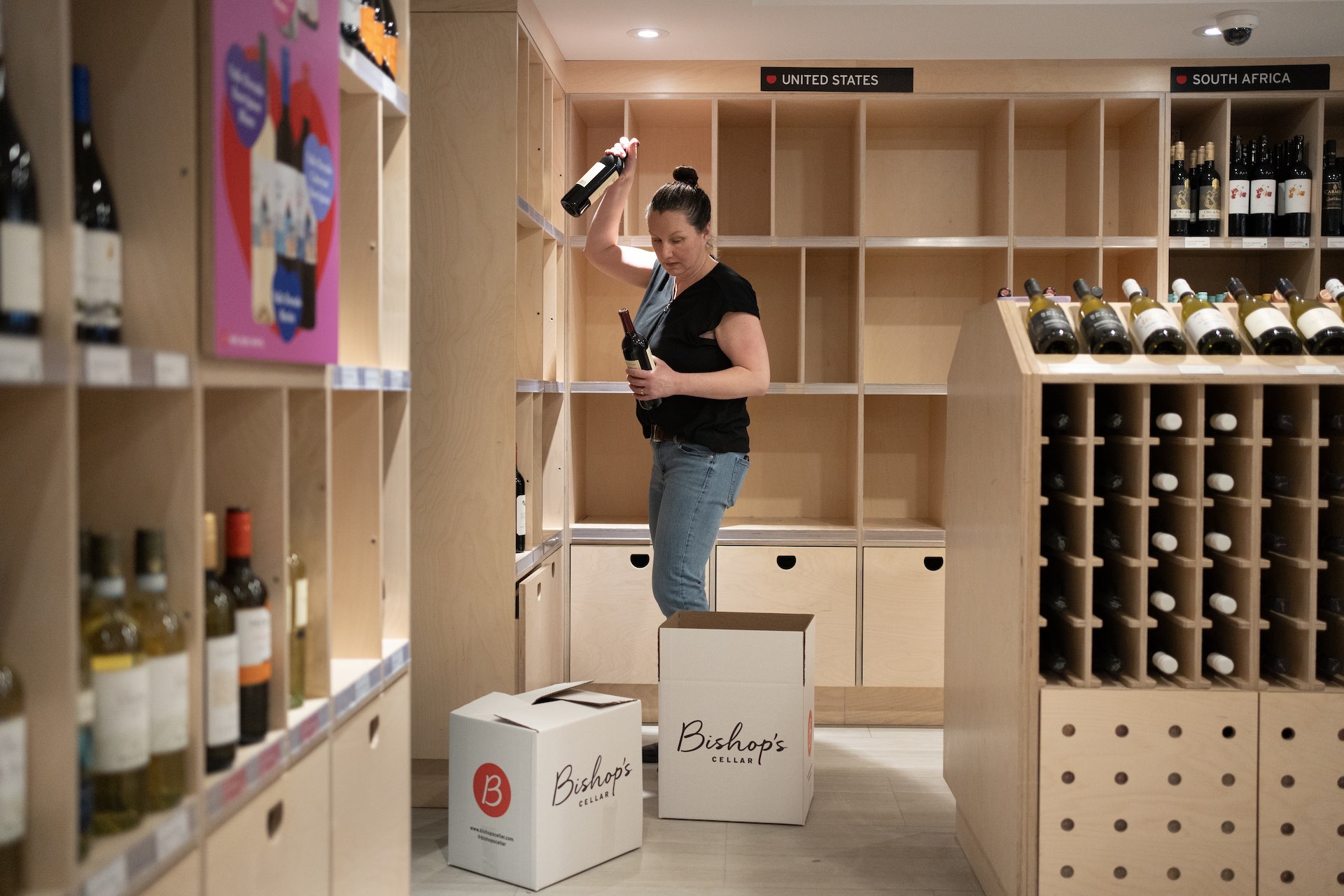 An employee removing American-made wines from the shelves of a Halifax store amid Canada's trade war with the U.S. Photo: The Canadian Press/Darren Calabrese

The Big Read
Who’s winning and who’s getting crushed in Canada’s war on U.S. wine
California winemakers are feeling the pain of bans and boycotts. So are the Canadians who sell their products.
California winemakers like Sean McBride say they're taking a heavy hit from Canadian trade actions against their products. Photo: Handout/Emma Kruch
Sean McBride shipped about 200 cases of wine to Ontario earlier this year from Crosby Roamann, his winery in the Napa Valley area of California. They contained an assortment of Chardonnay, Sauvignon Blanc, Cabernet Sauvignon and the Bon Ton—a specialty line that derives its name and vintage label aesthetic from an early 20th-century Parisian fashion magazine.
They were to appear as by-the-glass offerings on restaurant wine lists or be sold to private clients, but arrived around the same time Ontario Premier Doug Ford banned the provincial liquor board from importing or selling U.S. alcohol. Since even private sales must go through the board, those cases are instead sitting in a warehouse—another casualty of the disruption and uncertainty created by U.S. President Donald Trump and his global trade war.
Canada brought in $590 million worth of American wine last year—some 21 per cent of its imports in a famously competitive product category. So far this year, that share has shrunk to nine per cent, newly released data from Statistics Canada shows. The most recently available monthly numbers are even more dramatic: Canada imported a little less than $1.1 million worth of American wine in May—a 98 per cent decrease from the same month last year, and a 63 per cent drop from April.
Talking Points
- California winemakers have bottles gathering dust in Canadian warehouses as retailers in this country pull back from U.S. wine, turning to alternatives overseas and closer to home
- The amount of wine Canada imported from the U.S. fell 98 per cent year-over-year in May, amid provincial bans and consumer shifts toward local products
The numbers are stark, but the cause is obvious. Trump made Canada an early target in his global trade war, and Canadians are fighting back with their consumer choices. In the case of wine and other forms of alcoholic drinks, however, many premiers chose not to give Canadians a choice at all. Ontario, Quebec and B.C. even pulled bottles off the shelves. Alberta and Saskatchewan recently ended their bans, but others are keeping up the fight.
California winemakers, including McBride, have had to adjust. So have Canadian consumers who can no longer purchase their favourite brands from the Golden State at their local liquor store. While a wine connoisseur might be able to find a decent substitute for a California Chardonnay, it is not as easy for the rest of the global wine trade, built on cultural traditions and agricultural science that in some cases date back hundreds of years, to go with the flow.
Lesle Gibson, who runs Toronto-based importer and distributor Gibson Family Group, ordered the wine from Crosby Roamann that is now sitting in storage. She counts four U.S. winemakers—two in California, two in Oregon—in her listing. Since she is now unable to sell their products, she has focused on those she imports from other parts of the world, including South Africa. In lieu of California Chardonnay, she suggests a “rich and buttery” white Burgundy from a French winery named Domaine Regnard—a wine she says she has been flying through.
“The good thing is that people who would only drink California Cab or Chard are now open to trying other Chardonnay,” she says. Gibson is not sure customers are looking for a permanent shift, though, so she plans to keep her U.S. producers on the list.
Related Articles

Things are different for Harris Davidson, managing director of Rogers & Co., a Toronto-based importer and distributor. His company has about $1 million worth of wine languishing in a warehouse, but that is not his biggest headache. Rogers & Co. has two sides to its business: one acts as an agent for wineries with placements in retail stores of the Liquor Control Board of Ontario (LCBO); the other distributes wine to the hospitality industry and private clients. Both sides have to go through the LCBO, and both depend on U.S. wines—mainly from California but also Washington and Oregon—for about 50 per cent of their sales.
The retail side has been hardest hit. The LCBO has been scaling up its orders of non-U.S. wines, but Davidson says Rogers & Co. has not benefited. On the distribution side, he has been trying to source more wine from Australia, Argentina, New Zealand and “Old World” regions such as France and Italy. He worries, among other things, that anti-American sentiment among consumers will linger even if Ford lifts the ban.
“I think we’re all very disillusioned and disappointed by the behaviour of the president,” Davidson says. “What’s the residual resentment, and how will it manifest itself when U.S. product is available again?” He thinks 30 per cent of customers will be reluctant to go back to buying U.S. wine in the near term. That’s one reason Rogers & Co. is filling its pipeline with new products.
“What’s really unfair and difficult to digest is that one sector has been singled out as the protest sector to the Americans.”
In the meantime, Davidson says the firm has had to let go of some office space and lay off staff—even with the help of a work-sharing program through Employment Insurance that lets the company temporarily reduce the hours of its delivery workers. Those employees then receive benefits to make up for the loss of earnings. “My business could not support the level of overhead that we had without U.S. product. It’s just not viable,” he says. “What’s really unfair and difficult to digest is that one sector has been singled out as the protest sector to the Americans, and we really are not receiving any support from government whatsoever.”
At the LCBO, U.S. wines have given way to rows of Ontario and Canadian-made products. The board’s latest quarterly report, representing the period from Jan. 5 to March 31, said Canadian wine made up 26 per cent of the market share, nearly all of it from Ontario. The U.S. accounted for 15 per cent. According to data provided by the LCBO, sales of wines featuring the Vintners Quality Alliance (VQA) logo have risen 60 per cent since U.S. products were removed. (The VQA label means a wine produced in Ontario or B.C. is made entirely from grapes grown in that province.) Wines from Australia, New Zealand, Italy, Spain and Greece are also selling better than they did last year.
The global wine industry is watching, but it’s not yet rushing to replace U.S. exports to Canada, which would require supply chain shifts. That’s in part because of wine’s relatively long shelf life, says Ignacio Sánchez Recarte, the secretary-general of Comité Européen des Entreprises Vins, which represents the industry in the European Union. “We are not kiwis or strawberries,” he says in an interview from Brussels. The temporary ban on U.S. wine sales in some provinces, Recarte adds, cannot be seen as “an opportunity that the EU wine sector has seized to increase in a significant way our exports to Canada.”
The Australian wine industry is similarly cautious. Canada imported about $14.5 million worth of Australian wine in May—an increase of about 11 per cent over the same month last year. Aaron Ridgway, regional general manager for the Americas at Wine Australia, an industry association, said the market has been challenging in recent years as health concerns have driven a decline in consumption. “There’s definitely a perception out there that Australia may benefit from what’s going on with trade policies regarding other countries,” Ridgway said in an interview from California. “The official line is: we just don’t know.”
One of the challenges is just how much lead time is needed before an Australian wine can appear in Canadian retail stores, largely controlled by provincial liquor boards. A market bulletin that Wine Australia published in March said this can typically take 12 to 18 months. At the end of the day, Ridgway says, wine is an agricultural product—and a “fussy” one at that. “To have international markets convulse and send very mixed signals about levels of demand and what pricing is going to look like is really the last thing that wine needed,” Ridgway says.
There are, however, signs in the data of shifting trade patterns. Canada’s imports of wine from Argentina, for example, grew by 70 per cent in May compared to the same month last year. French imports grew by 43 per cent. There is also the occasional surprise. In April, imports of Chinese wine increased by 18,955 per cent year over year. (You read that correctly: eighteen thousand, nine hundred and fifty-five per cent.) In dollar terms, that sky-high growth brought sales to about $36,400, from $191 the same month last year. There were no imports of Chinese wine in May.
“As trade tensions or regulatory actions affect other traditional wine-exporting countries, importers and provincial buyers may be diversifying their sourcing,” Bing Wan, chairman of importer Baiwan Wines, wrote in an email.
Many Canadian hotels and restaurants immediately stopped offering U.S. wines and reprinted their lists upon the provincial import bans. Le Germain Hotel Toronto Mercer took a “sell it and don’t reorder it” approach, says Lauren Hall, who directs the hotel’s food and beverage programs. Unlike retail stores operated by provincial liquor boards, hotels were able to keep selling U.S. products until they ran out. So were restaurants and grocery stores whose provinces allow them to sell wine. “Those wines had already been paid for,” Hall says, “and it’s also not those winemakers’ and producers’ faults that they can’t sell their wine here. A lot of them are small businesses, as well.”
That’s one reason McBride, the owner of Crosby Roamann, struggles to understand the bans and consumer boycotts. Far from making waves in Washington, they are hurting small growers like him “who have zero interest or power in the politics of it all,” he says, adding: “There’s nothing that not buying my wine is going to teach the Trump administration.”
Clarification: This story was updated to clarify that Lauren Hall works at and was speaking for the Toronto Mercer location of Le Germain hotels.
Loading...
Thanks for sharing!
You have shared 5 articles this month and reached the maximum amount of shares available.
CloseThis account has reached its share limit.
If you would like to purchase a sharing license please contact The Logic support at [email protected].
CloseGift the full article!
You have gifted 0 article(s) this month and have 5 remaining.
Recipients will be able to read the full text of the article after submitting their email address. They will not have access to other articles or subscriber benefits.
Photo: Handout/Emma Kruch
Sean McBride at his vineyard in California's Napa Valley.
An employee removing American-made wines from the shelves of a Halifax store amid Canada's trade war with the U.S.
Most Popular This Week




In-depth, agenda-setting reporting
Great journalism delivered straight to your inbox.
News
So far, foreign-owned firms have dominated Buy Canadian contracts
Briefing
National Defence funds drone skunkworks in Mirabel, Que.
Anthropic commits $10M worth of Claude to Canadian research centres
Thomson Reuters sells majority stake in book business for US$500M
Best business newsletter in Canada
Get up to speed in minutes with insights and analysis on the most important stories of the day, every weekday.
Exclusive events
See the bigger picture with reporters and industry experts in subscriber-exclusive events.
Membership in The Logic Council
Membership provides access to our popular Slack channel, participation in subscriber surveys and invitations to exclusive events with our journalists and special guests.