OTTAWA — The best way to retaliate against U.S. President Donald Trump’s on-again, off-again tariffs is through Canadians’ stomachs, analysis commissioned by the Public Policy Forum suggests.
Skip to content


Exclusive
Canada should turn the trade war into a food fight, new analysis shows
Counter-tariffs on food, drugs and liquor will maximize impact on U.S. economy, report says
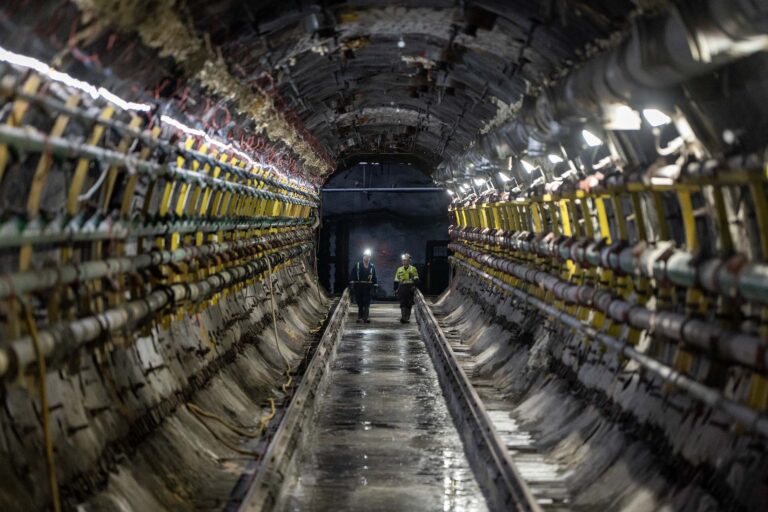
Steep Canadian tariffs on U.S.-produced food will inflict more damage on the American economy than on Canada's, a new analysis says. Photo: The Canadian Press/Don Denton
OTTAWA — The best way to retaliate against U.S. President Donald Trump’s on-again, off-again tariffs is through Canadians’ stomachs, analysis commissioned by the Public Policy Forum suggests.
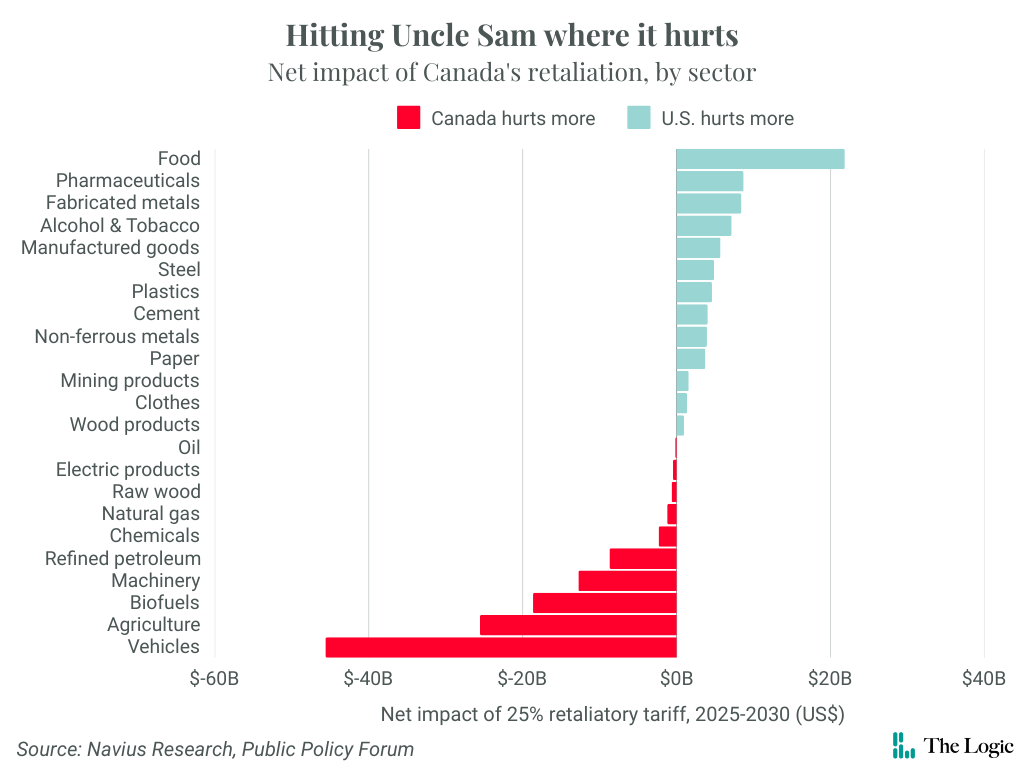
Putting retaliatory tariffs on food imports from the U.S. does more damage to the U.S. economy than Canada’s, by a far wider margin than applying them to other products, according to the analysis by Navius Research, a Vancouver-based consultancy whose services include economic modelling.
Talking Points
- Retaliatory tariffs on U.S. food products will do maximum damage to the American economy with minimal collateral damage to Canada, an analysis commissioned by Public Policy Forum shows
- The report suggests Ottawa avoid hitting back in areas where the Canada and U.S. supply chains are closely entwined, like the auto sector
The assessment is part of a policy memo on Canada’s trade-war options released Friday by the Public Policy Forum, a non-partisan think tank based in Ottawa. While it notes that any retaliation will hurt Canadians as well as Americans, the analysis estimates that a 25 per cent levy on American grocery products would lower the U.S. GDP by US$22 billion more than the Canadian GDP.
Pharmaceuticals and fabricated metals are also near the top of the list of effective targets for counter-tariffs. So are alcohol and tobacco, which Canada is already sanctioning: the authors anticipate a 25 per cent tariff on booze and tobacco would take a bite US$7.15 billion bigger out of America’s GDP than it would out of Canada’s.
“Those are things where we have substitutes available. We have our own agricultural sector, we have international options to buy from Chile or other places,” said Mark Cameron, a Public Policy Forum fellow who co-authored the report. “That has a pretty immediate, direct impact on the U.S.” The report reads like a battle plan that lays out defensive strategies to punch back at the U.S. with the least collateral damage in Canada.
The key, the authors say, is to avoid tariffs on goods tied up in Canadian supply chains, like vehicle manufacturing, as well as things Canadian companies invest in to grow, like machinery. Taxing energy imports is also likely to inflict undue damage on Canada’s economy, the report finds.
“Anything where we are sending our natural resources or raw materials down to the U.S. we are, to some extent, penalizing ourselves by putting counter-tariffs on,” Cameron said.
Trump first announced his intention to impose 25 per cent tariffs on Canadian and Mexican imports in February, but paused the implementation until Tuesday. Then, just two days after the tariffs went into effect, he pulled an about-face, announcing a reprieve on goods covered under the United States-Mexico-Canada Agreement until April 2.
Ottawa already unleashed its first wave of retaliation Tuesday with a 25 per cent tariff on $30-billion worth of U.S. goods including groceries, cosmetics and alcohol. After the U.S. pullback on goods covered by the USMCA, Finance Minister Dominic LeBlanc said his government is prepared to follow up with 25 per cent tariffs on an additional $125 billion worth of goods on April 2 if the trade war continues.
Related Articles


The initial list of counter-tariffs closely aligns with the Public Policy Forum’s conclusions in the report, Cameron said. Already the Kentucky Distillers’ Association has reacted with alarm at the impact on the state’s renowned whiskey. “Bourbon jobs are American jobs, and we grow bourbon jobs by opening markets across the globe,” said the association president Eric Gregory. “Retaliatory measures against bourbon harm these markets and jeopardize growth for years to come.”
The longer list of potential targets, however, requires consultation with affected industries because Ottawa worries about negative implications within Canada, Cameron said. He suggested the government consider larger tariffs on sectors where Americans will feel the wallop most. “There may be some sectors where we don’t want to apply any counter-tariffs, but there may be sectors, like alcohol and tobacco, where we may want to have 50 per cent or 100 per cent tariffs,” he said.
While Trump’s officials have mused about carve-outs for specific industries, like the auto sector, Cameron said Canadians need to be united in their response. The Navius analysis found every region of the country has sectors that depend on close trade ties with the U.S. “This is true whether you look at gasoline and diesel refined in New Brunswick, aluminum exported from Quebec, steel and automobiles from Ontario, potash and uranium from Saskatchewan or oil and gas from Alberta,” the report says.
The analysis predicts Ontario will be hit hardest, with Trump’s tariffs on the auto sector taking an estimated $93.8 billion out of Canada’s GDP. Out west, Alberta’s oil and gas sector faces a $46.6 billion reduction to GDP, while Atlantic Canada’s metal mining, oil refining and fisheries are also projected to lose billions.
With such widespread potential damage, the report warns, “We can’t afford to be split along regional lines, as Canada and Canadians are prone to do.”



Loading...
Thanks for sharing!
You have shared 5 articles this month and reached the maximum amount of shares available.
CloseThis account has reached its share limit.
If you would like to purchase a sharing license please contact The Logic support at [email protected].
CloseGift the full article!
You have gifted 0 article(s) this month and have 5 remaining.
Recipients will be able to read the full text of the article after submitting their email address. They will not have access to other articles or subscriber benefits.
Photo: The Canadian Press/Don Denton
Most Popular This Week



In-depth, agenda-setting reporting
Great journalism delivered straight to your inbox.
Commentary
Carmichael: Canadian ignorance about India is a strategic weakness
Briefing
Aritzia shares pop after earnings rise 204%
First Nation in Alberta goes to court over fast-tracked oil pipeline
Chinese EV maker Geely Auto Group to launch in Canadian market in 2027
Best business newsletter in Canada
Get up to speed in minutes with insights and analysis on the most important stories of the day, every weekday.
Exclusive events
See the bigger picture with reporters and industry experts in subscriber-exclusive events.
Membership in The Logic Council
Membership provides access to our popular Slack channel, participation in subscriber surveys and invitations to exclusive events with our journalists and special guests.