News
Trudeau and premiers show unity in face of Trump tariffs, but Alberta stands alone
Smith refuses to sign first ministers’ statement, calling for end to ‘threats’ of restrictions on energy exports to U.S.
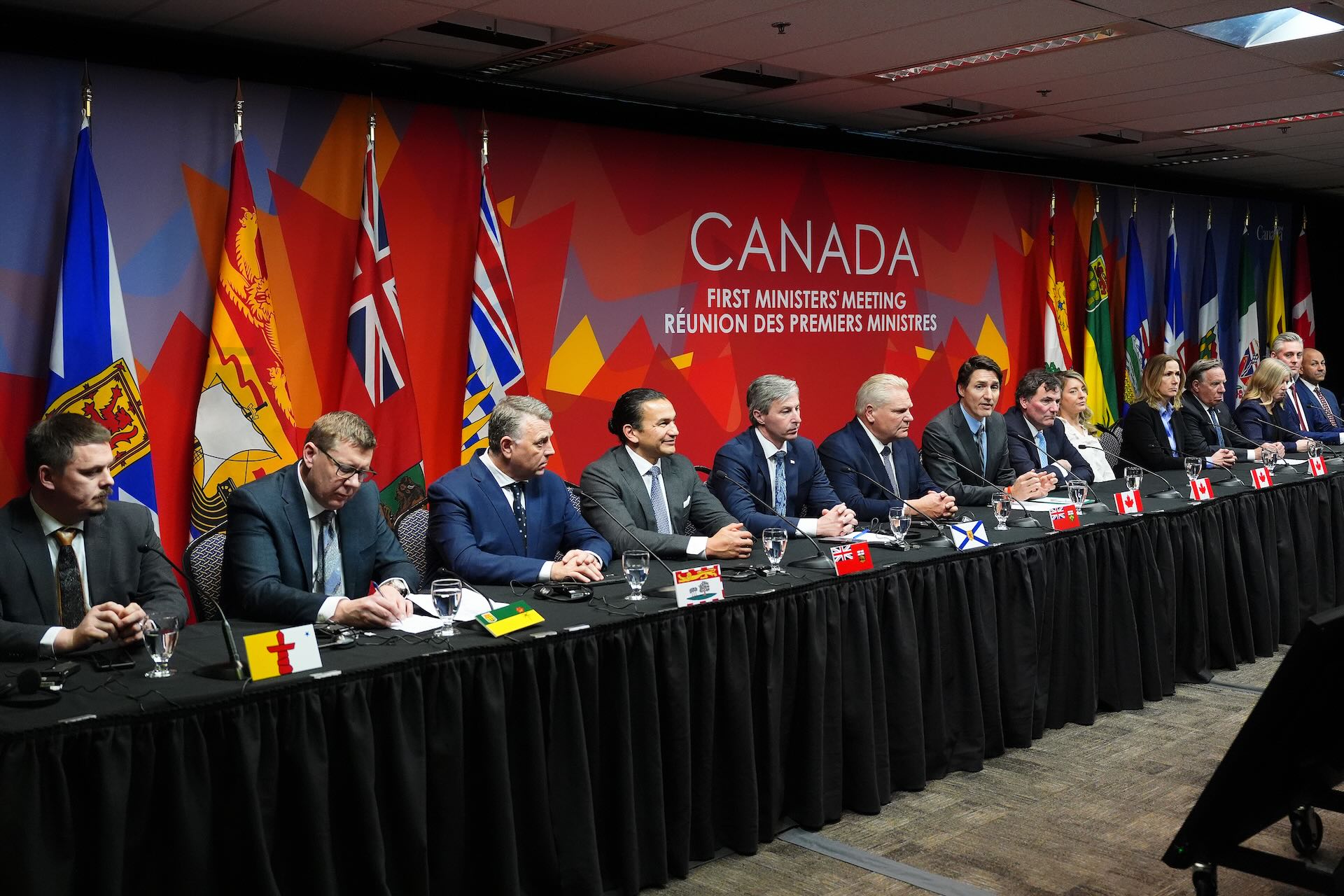
Prime Minister Justin Trudeau, provincial premiers and senior federal government figures at a press conference concluding a first ministers’ meeting in Ottawa, on Jan. 15, 2025. Photo: The Canadian Press/Sean Kilpatrick
OTTAWA — Alberta Premier Danielle Smith refused to sign off on the joint statement that followed Wednesday’s meeting between Canada’s premiers and Prime Minister Justin Trudeau, undermining their message of unity against the looming threat of steep U.S. tariffs.
Talking Points
- Alberta Premier Danielle Smith refused to sign off on the joint statement from the first ministers’ meeting in Ottawa, saying that her province cannot support the federal government’s response to the threat of U.S. tariffs until it rules out restrictions on Canada’s energy exports
- The leaders promised financial support for “sectors, businesses and individuals” harmed by any retaliatory measures
With many unknowns about how, when or even whether president-elect Donald Trump plans to make good on his threat to impose 25 per cent tariffs on all Canadian imports, Canada’s ambassador to the U.S. says those working on the response need to avoid being distracted by his negotiating tactics.
“We will pay attention to what is a real request,” Kirsten Hillman told The Logic after the premiers wrapped up their meeting with Trudeau in Ottawa.
“I think he knows what he wants. He’s just not telling us yet,” she said.
Ontario Premier Doug Ford said the first ministers are united in one goal: “If we had our choice, we’d have no tariffs,” he said at the closing news conference.
Exactly how Canada will fight the proposed tariffs became a source of tension this week after the federal Liberal government would not rule out restrictions on energy exports to the U.S. Ford had floated the idea last month. He has since shifted his focus to calling for a more strongly integrated North American energy industry. On Wednesday, Ford said Smith is concerned about protecting Alberta’s energy sector, but he has a different approach: “Protect your jurisdiction, but country comes first.”
Related Articles

Smith, who visited Trump at his Mar-a-Lago resort in Florida over the weekend at the invitation of Canadian businessman Kevin O’Leary, said Monday that any attempt to take this route would spark a “national unity crisis.” On Wednesday, the official communique released after the first ministers’ meeting came with a grace note: “The Government of Alberta did not approve the joint statement between the Government of Canada and the Council of the Federation.”
Smith elaborated in a social media post on X, using the word “threats” to describe suggested restrictions on Canada’s energy exports south of the border, either through blocking the supply or an export tariff. “Until these threats cease, Alberta will not be able to fully support the federal government’s plan in dealing with the threatened tariffs,” wrote Smith, who did not travel to Ottawa for the meeting but participated virtually.
Before the meeting, Saskatchewan Premier Scott Moe also demanded the idea be taken off the table.
“When you look at the pipeline system, how oil is actually transported into the U.S. and back to Canada … it would be very, very difficult and I think impossible operationally to even consider that,” Moe told reporters earlier Wednesday. “Politically, it would be … more divisive than anything this Liberal government has enacted in the way of policies in the last nine years.”
The U.S. received 97 per cent of Canadian crude oil in 2023. Most of the volume came from Alberta (87.4 per cent) and Saskatchewan (8.9 per cent). That same year, 60 per cent of crude oil imported to the U.S. came from Canada. The pipeline system running between the countries means much Canadian crude oil heads to U.S. refineries before it is then exported back to Canada. The federal government and provinces have argued that discounted crude exports to the U.S. distort the trade deficit that Trump has decried.
Wednesday’s communique lacked specifics on how Canada would push back, beyond promising a “robust response.” It also promised support for “sectors, businesses and individuals” harmed by any retaliatory measures brought in by the federal government. “This includes, but is not limited to, the distribution of revenues from potential retaliatory tariffs as quickly as possible,” it said.
Trudeau promised this would take the circumstances of the individual provinces and territories into account.
“We have also agreed that no one region of the country should disproportionately bear the burden of standing up for all other Canadians,” he said during the closing news conference. “We have made it very clear that everything is on the table as potential responses, but we’ve also been very, very clear that it has to be fair across the country.”
In a morning update on the federal government’s border measures, Public Safety Minister David McGuinty pointedly thanked provinces that have devoted resources to help, “especially Ontario, Quebec, Alberta and Saskatchewan.”
The RCMP and Canada Border Service Agency have been sent extra money for the fiscal year ending in March, he said. They’ve used it to deploy 60 border-monitoring drones, lease two Black Hawk helicopters that will join an existing fleet of nine on border duties by the end of the week, and begin acquiring mobile X-ray scanners and hand-held chemical detectors.
The national interest is at stake, McGuinty said, regardless of other differences.
“We’re not interested in drama,” he said. “We’re interested in making progress.”
At the same time, elements of the Liberals’ border plan are stuck because they require legal changes or funding after March. The fall economic statement booked $81 million in additional border spending this year, and $144 million next year, with more to come later to add up to $1.3 billion. Parliament would have to vote for those amounts, and it can’t do that—or take up measures like new powers for border guards—while Trudeau’s prorogation lasts.
McGuinty said opposition MPs who have vowed to bring the government down and trigger an election as soon as they can should think about the circumstances.
“Our serious obligation here is to come together as a House, if we have to, and pass the legislation we may need,” he said.
Whatever gets decided, a new Canada-U.S. Trade Council made up of companies and industry groups representing banking, steel, energy and other sectors is ready to bolster the response. Among its expert advisers: Steve Verheul, Canada’s chief negotiator for the talks that replaced NAFTA with the Canada-U.S.-Mexico free trade agreement.



Loading...
Thanks for sharing!
You have shared 5 articles this month and reached the maximum amount of shares available.
CloseThis account has reached its share limit.
If you would like to purchase a sharing license please contact The Logic support at [email protected].
CloseGift the full article!
You have gifted 0 article(s) this month and have 5 remaining.
Recipients will be able to read the full text of the article after submitting their email address. They will not have access to other articles or subscriber benefits.