A steady drip of economic sanctions on Russia has turned to a flood as western countries piled on measures to punish the country for its ongoing invasion of Ukraine. Canada and its allies announced a package of measures that, among other things, target the Russian central bank’s foreign reserves, as well as the assets of President Vladimir Putin and his inner circle. Even Switzerland, a historically neutral country known as a place for the world’s super rich to park capital, said it would freeze Russian assets in the country.
Skip to content

News
The ripple effect of financial sanctions on Russia
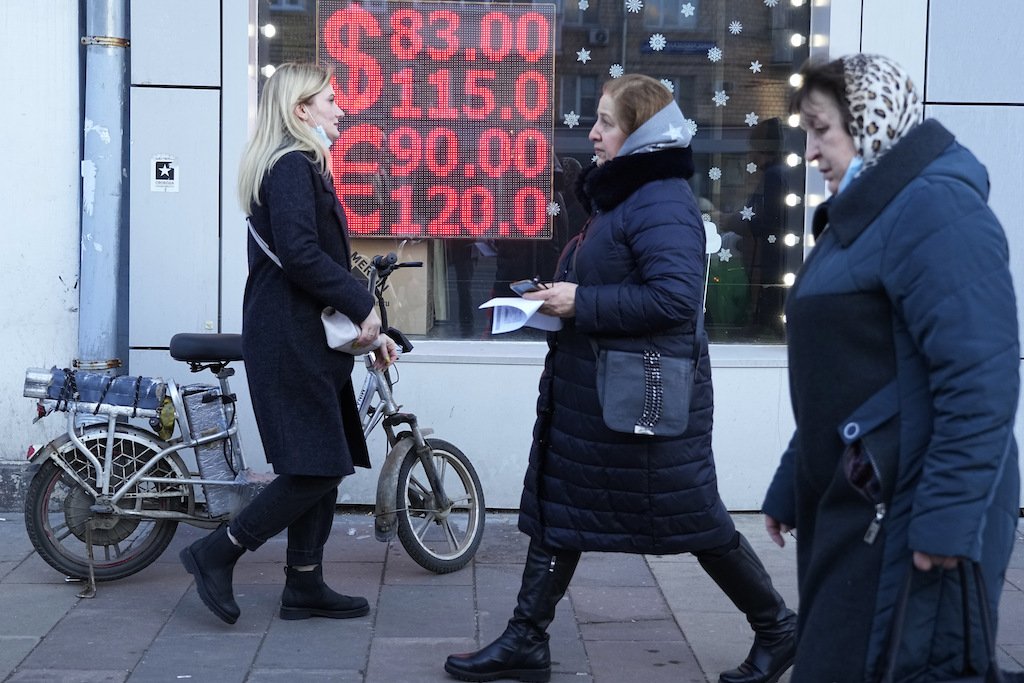
People walk past a currency exchange office screen displaying the exchange rates of U.S. dollar and euro to Russian rubles in Moscow's downtown in Russia in February 2022. Photo: Pavel Golovkin/The Associated Press
A steady drip of economic sanctions on Russia has turned to a flood as western countries piled on measures to punish the country for its ongoing invasion of Ukraine. Canada and its allies announced a package of measures that, among other things, target the Russian central bank’s foreign reserves, as well as the assets of President Vladimir Putin and his inner circle. Even Switzerland, a historically neutral country known as a place for the world’s super rich to park capital, said it would freeze Russian assets in the country.
On Monday, Prime Minister Justin Trudeau announced further measures, including a ban on Russian crude oil imports and increased military support for Ukraine. Canada imported no Russian crude in 2020, the most recent year for which data is available, and hardly any over the preceding decade. Canada and other G7 countries also announced a ban on financial institutions dealing directly with the Russian central bank.
“Our message is clear: this unnecessary war must stop now,” Trudeau said. “The costs will only grow steeper, and those responsible will be held accountable.”
How it’s hitting Russia: The ruble cratered when markets opened Monday, instantly losing nearly 30 per cent of its value. In Moscow, people lined up at ATMs, waiting to withdraw cash from the country’s banks. The European Central Bank warned that the European arm of Sberbank, Russia’s largest bank, was at risk of insolvency. And two Russian oligarchs under sanctions called for peace in Ukraine, breaking ranks with the Kremlin.
Ripple effect: Canada and the U.K. were among the western nations that pushed for the extreme financial sanctions, according to Politico. But the impact may be felt around the world. The New York Times reported that the sanctions could restrict the global flow of capital, raising the potential for a liquidity crunch as Russian companies are unable to pay their debts in full. Western central banks may have to step in to stabilize markets, a Credit Suisse managing director wrote. The measures also prompted an escalation in Russia’s rhetoric toward the West. On Sunday, in response to what he called “aggressive comments” by NATO and tough financial sanctions, Putin placed Russia’s nuclear forces on high alert.
What it means for Canada: The country will be largely insulated from any collateral damage, Patrick Leblond, a senior fellow at the Centre for International Governance Innovation, told The Logic. Canadian banks, like other western institutions, have very little exposure to Russia, he said, and many of the loans would likely be deferred in the hope that the sanctions are temporary.
Bank of Canada spokesperson Alex Paterson said the central bank does not hold any of the Russian central bank’s reserves, nor does it transact with any Russian banks. “The Bank of Canada remains committed to providing liquidity as required to support the functioning of the Canadian financial system,” he said.



Loading...
Thanks for sharing!
You have shared 5 articles this month and reached the maximum amount of shares available.
CloseThis account has reached its share limit.
If you would like to purchase a sharing license please contact The Logic support at [email protected].
CloseGift the full article!
You have gifted 0 article(s) this month and have 5 remaining.
Recipients will be able to read the full text of the article after submitting their email address. They will not have access to other articles or subscriber benefits.
Photo: Pavel Golovkin/The Associated Press
Most Popular This Week


In-depth, agenda-setting reporting
Great journalism delivered straight to your inbox.
News
Critical minerals face a funding ‘valley of death.’ Miners hope tax breaks will change that
Briefing
Potash from Belarus en route to United States
Financing instability is slowing down Ottawa’s housing agency, CEO says
Cleveland-Cliffs CEO says federal lawsuit would be a bad business decision for Canada
Best business newsletter in Canada
Get up to speed in minutes with insights and analysis on the most important stories of the day, every weekday.
Exclusive events
See the bigger picture with reporters and industry experts in subscriber-exclusive events.
Membership in The Logic Council
Membership provides access to our popular Slack channel, participation in subscriber surveys and invitations to exclusive events with our journalists and special guests.