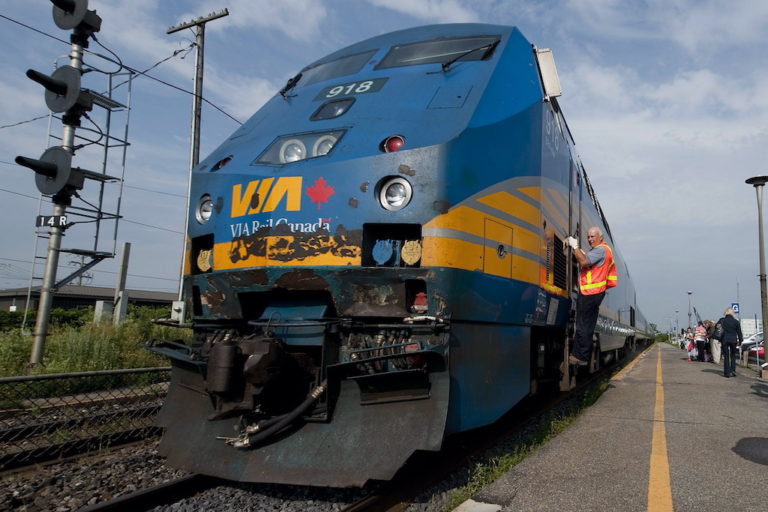
OTTAWA — Since early September, Martin Imbleau has been CEO of the Via Rail subsidiary charged with building a multibillion-dollar, almost all-electric, dedicated line for passenger train service from Toronto to Quebec City. The new link to speed travel in Canada’s most densely populated corridor would be the biggest infrastructure project in decades.
Skip to content

 Imbleau said starting the project with no budget or timeline will ensure its success. “The only way we can protect the taxpayers’ money is by doing the pre-work in a lot of detail,” he said. Photo: Justin Tang for The Logic

The Interview
Via Rail’s Martin Imbleau on why the biggest Canadian building project in decades has no budget or timeline
Leading a startup within a venerable Crown corporation, he’s bringing a new approach to a giant undertaking
Martin Imbleau, CEO of the Via Rail subsidiary building a high-frequency rail project between Toronto and Quebec City, in Ottawa on Nov. 7. Photo: Justin Tang for The Logic
OTTAWA — Since early September, Martin Imbleau has been CEO of the Via Rail subsidiary charged with building a multibillion-dollar, almost all-electric, dedicated line for passenger train service from Toronto to Quebec City. The new link to speed travel in Canada’s most densely populated corridor would be the biggest infrastructure project in decades.
In October, the federal government formally invited bids on the project from three shortlisted consortiums interested in “co-developing” the project. The winning group will take part in shaping the plans before ultimately taking over Via service in the central Canadian corridor; building the new line; and operating the new service, along with a revamped version of the existing one.
Talking Points
- As the federal government turns to a new form of public-private partnership to build a new passenger line from Toronto to Quebec City, it’s chosen Martin Imbleau to lead the public half
- A veteran of Quebec’s utility sector, Imbleau says starting with no budget or timeline and “co-developing” with the private sector is the best way to make the effort a success
A lawyer by education, Imbleau had been chief executive of the Montreal Port Authority. After spending much of his career at Quebec’s Énergir natural-gas utility, he was briefly a vice-president of Hydro-Québec before hopping to the port.
The Logic spoke to Imbleau in Ottawa’s Château Laurier—an old railway hotel, across the street from the capital’s former central train station—as he attended a national rail conference.
This transcript has been edited for clarity and brevity.
How did you come to this job? Did they seek you out or did you seek it?
They did seek me. I was the CEO of the Port of Montreal and was developing large infrastructure. I was there during the COVID crisis. I was there during the strike. And I was there during the supply-chain crisis. So I realized how critical a port is for transportation of goods; it was a fantastic job.
But when you close your eyes and someone says, “Think about it. The largest infrastructure project in the country, to serve millions of citizens—it will change how they travel in the country, and help decarbonize the economy.” It ticks all the boxes.
Related Articles

In a nutshell, that’s the reason why I’m here, and I’m still drinking from the firehose.
What were the first things you had to learn?
A mix of three things: It’s a very large, linear project that takes time. I’m leading a corporation that’s a new corporation, at arm’s length to Via, so it’s almost a startup. And this is a project that has been thought of, in many ways, before. We have an opportunity to start from scratch on all those aspects.
What lessons do you take from the previous attempts that have failed?
I think there’s a recipe for business development, and there’s a recipe for linear-project development. I’ve done wind projects, I’ve done a natural-gas pipeline. Linear projects, you don’t consider them as being one project—it’s a collection of many projects. You have to segment them because otherwise you lose the focus on communities, on engineering—you want to be everywhere all the time. You need to really think about your sequence of meeting with stakeholders, developing the project, doing the engineering, going through the environmental processes.
One other key lesson is that even though it’s a public project and a public service, we should refrain from presenting numbers or deadlines until we have sufficient information and we have done our homework. The only way we can protect the taxpayers’ money is by doing the pre-work in a lot of detail. Money spent up front is money well spent, to avoid surprises down the road.
I live in Ottawa, where the light-rail system is a national joke—
Imbleau draws a circle in the air around his face with one finger, his expression flat. I’m not saying anything.
I can say that because I live here.
I’ve used it on many occasions. As a user, it works very well.
When it works, it’s great. Things keep breaking on it. But one of the lessons from the inquiry into it was, “Don’t overcommit to deadlines, don’t overcommit to budgets.” I hear you applying that lesson. But I also know how these projects come together, which is that politicians, in particular, like making promises about when things will be finished and they like to know what they’re going to spend. How do you deal with that problem?
I develop the project. They make announcements. That’s the big separation. But I’m not that concerned. We’re filling a need that all the communities will want tomorrow, and taking our time, I know, is the right approach.
The way the government has structured the deal so far is just brilliant. It’s a very prudent approach. They’ve created a Crown corporation dedicated to project management. It’s a team of experts that I’m building, only concentrated on managing the project. That’s a key lesson from other projects.
Second, we’ve launched a [request for proposals] and we’ll pick a consortium that will be our private partner to do the development. But the model is to do the co-development together, so it’s not like we give them a mandate and they disappear, or they build something on which they make a profit. We will take a couple of years to co-develop, make the decisions, do the engineering, present options, do cost analysis. We will have many, many gates where we’ll sit down and say, “Yes, this is what we want,” or “No, we’re going elsewhere.”
That is unique. I’ve never done it. I’m not aware of any large project that followed that sequence. It takes a bit longer. But when you make your final investment decision, your engineering is well advanced, your environmental process is completed, you know your options, you know the economics of the operations, you’ve made the right technical decisions.
When you talk about building a team with project-management expertise, do you anticipate hiring consultants to do much of this or will this be the core of Via HFR?
The core will be Via HFR employees. I’m Via HFR’s first employee, so I need to hire a lot of good, skilled people in both provinces. Technical, engineering, project management, financial people, PR. One very important aspect of this project is also the unique opportunity to have meaningful economic reconciliation with Indigenous communities. So, taking the time with the communities, ensuring that we take into consideration their concerns, but also—what are the economic opportunities with this? Again, I don’t want to come in with an existing recipe. It’s so large, it provides unique opportunities for economic participation and economic benefit. So we need people in our team that have the contacts and the relationships and that know how to make those things happen.
What will be the best private-sector contribution in the planning stage?
Innovations in technology. We don’t know what we don’t know—what exists out there that we should be implementing to be faster, more frequent and more reliable?
Second, I think the discipline of private money. Typically, their capital is impatient, where the government capital is patient. I like the discipline the private sector brings in terms of cadence management, keep the beat, make sure it progresses.
And just overall expertise. It’s project management, it’s engineering, it’s construction and civil work. It’s 1,000 kilometres of electric work, 1,000 kilometres of rail, and then moving pieces, bridges, road crossings, all that stuff. We need a spectrum of capabilities that you don’t have in the public sector.
And then what will be the best of the public sector in this?
Having sufficient intelligence and knowledge to participate in the co-decisions and challenge what is brought. That will be my job. And then I will go and say to the government, “We’re doing this and it’s going to cost this, it’s going to be delivered on that date. We’re making that recommendation.”
It’s a check and a balance that I think should work well. But I’ll be very humble and say that we should remain agile and flexible. We see the cake, we think we know the ingredients, but we will establish the recipe in the coming years with the private developer.
Of course it’s going to be a big project. We’ll talk about cost in a few years when we have details, but what is the cost of adding a full lane on Highway 401 or the 417 or Autoroute 20 or the 40, for millions of cars? Do you want to be out there cutting ribbons for a highway, opening more asphalt, or an electric train that moves 17 million people a year?
Do you think you’re going to be the CEO who rides it on the day that it opens, or will that be something for a future leader?
I’m 51. I’d like to be there at the start of operations for sure. I like challenges, I like complex things. Once it’s in operation, we’ll see where we are. But I want to put it in service on a schedule that is before I intend to retire.



Loading...
Thanks for sharing!
You have shared 5 articles this month and reached the maximum amount of shares available.
CloseThis account has reached its share limit.
If you would like to purchase a sharing license please contact The Logic support at [email protected].
CloseGift the full article!
You have gifted 0 article(s) this month and have 5 remaining.
Recipients will be able to read the full text of the article after submitting their email address. They will not have access to other articles or subscriber benefits.
Photo: Justin Tang for The Logic
Imbleau said starting the project with no budget or timeline will ensure its success. “The only way we can protect the taxpayers’ money is by doing the pre-work in a lot of detail,” he said.
Most Popular This Week




In-depth, agenda-setting reporting
Great journalism delivered straight to your inbox.
Commentary
Carmichael: Being boxed in will help Canada focus on what matters
Briefing
Rio Tinto gets nearly $165M in additional federal funds for Quebec aluminum
U.S. to lift tariffs on some Canadian products crucial to Maine: Collins
Carney warns of tech dependence after Starlink disruptions in Ukraine
Best business newsletter in Canada
Get up to speed in minutes with insights and analysis on the most important stories of the day, every weekday.
Exclusive events
See the bigger picture with reporters and industry experts in subscriber-exclusive events.
Membership in The Logic Council
Membership provides access to our popular Slack channel, participation in subscriber surveys and invitations to exclusive events with our journalists and special guests.






