Skip to content

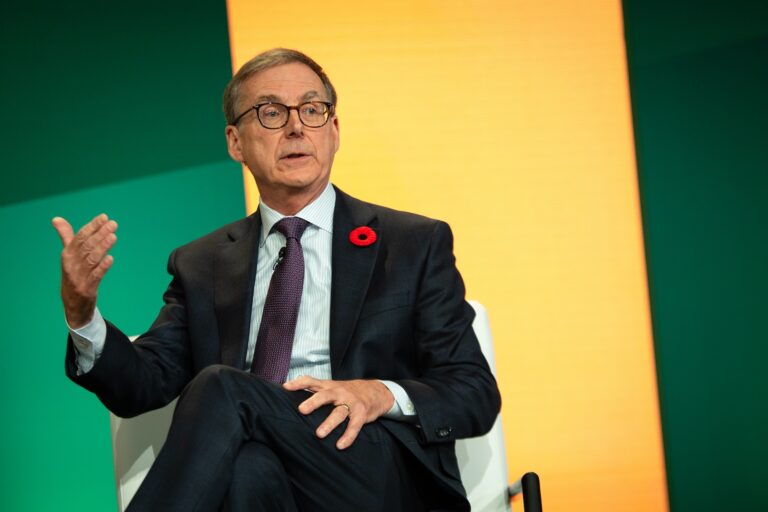
 “So many of the issues we face are global,” Macklem said. “We can only deal with them together.” Photo: Justin Tang for The Logic
 With long-term interest rates rising in an unusual way, Macklem said the central bank is “doing some analysis of the term premium.” Photo: Justin Tang for The Logic

The Interview
Tiff Macklem confronts the new world order
The Bank of Canada governor on the Donroe Doctrine, trade imbalances and whether he’s worried about long-term interest rates
Governor Tiff Macklem at the Bank of Canada’s headquarters in Ottawa on Tuesday, Jan. 13, 2026. Photo: Justin Tang for The Logic
For Bank of Canada governor Tiff Macklem, the unravelling of the global order is personal. “I’ve spent much of my career contributing to that multilateral system,” Macklem said. “I was the international deputy governor here at the Bank of Canada. I was the international deputy at the Department of Finance.”
The deputies are the labourers of global governance. They are the ones who fly out early and then stay up late so their bosses have something to negotiate when they arrive for official meetings of the G7, the G20, the International Monetary Fund (IMF) and all the other institutions that were created after the Second World War to make the world a safer place.
Related Articles

Now Macklem is one of the bosses. Last year, that meant co-hosting the G7 finance ministers and central bank governors with a rotating cast of Liberal finance ministers, as it was Canada’s turn to manage the agenda for a group that also includes the U.S., Japan, Germany, France, the U.K. and Italy. Against the backdrop of Donald Trump’s global trade war, the gatherings were some of the touchiest in the group’s history. “I’ll admit, at the beginning of the year it was pretty tense,” Macklem said.
Macklem has more pressing concerns in 2026 than the future of the international order. He and his deputies need to figure out how uncertainty over the status of the North American free trade zone will affect economic growth this year. The government has handed the Bank of Canada responsibility for open banking and stablecoins. The central bank’s five-year mandate for how it sets interest rates is also up for renewal by the end of the year.
Yet it has been hard not to think about Canada’s place in the world. The meaning of the Trump administration’s apprehension of Venezuelan President Nicolás Maduro—and Trump’s subsequent declaration that the White House would be running Venezuela—was still sinking in when I met Macklem for an interview at the Bank of Canada’s headquarters in Ottawa on Jan. 13.
So was the revelation a couple of days earlier that Trump’s Justice Department had served the Federal Reserve with subpoenas. Macklem offered a loud defence of Fed chair Jerome Powell. He also offered an argument for why the G7 and institutions like it are worth the effort for a country such as Canada.
One example he offered was the ticking time bomb of “global imbalances,” economics jargon for the extreme mismatch between China’s massive trade surpluses and equally large trade deficits.
The world’s trade ledger doesn’t need to balance perfectly in every country, but big surpluses in one place and big deficits in others is an invitation for trouble. The U.S. has a deficit with the rest of the world because its comfort with debt causes it to import more than it exports—a weakness in consumption that China is happy to exploit because its hypercompetitive factories produce significantly more than Chinese households consume. Europe factors in because its relatively weak growth prompts its wealthy savers to seek higher returns elsewhere. Those savings tend to end up in the U.S., inflating that country’s credit and asset-price bubbles.
Those dynamics didn’t cause the financial crash that resulted in the Great Recession, but they are the reason a housing bust in the U.S. caused economic damage around the world. Macklem believes conversations like those that happen at the G7 are the only way to keep something like that from happening again. Canada is “not big enough for people to pay attention to us just because of our size,” he said. “So what do we need to do? We need to bring facts. We need to bring evidence. We need to bring ideas.”
If international governance bores you, then skip to the end where Macklem talks about why long-term interest rates are rising.
This transcript has been edited for length and clarity.
How do you think about the Donroe Doctrine?
I’m not going to take on that question very directly. What I will say is that with the United States intervening in Venezuela, exercising influence in multiple parts of the world, we see this as one of the [ways] the world has become more shock-prone. There are more supply shocks. These aren’t traditional macroeconomic demand cycles. These are shifts in geopolitics. They’re creating uncertainty. They’re disrupting trade patterns. They’re disrupting capital flows. When you think of trade now, you can’t think only about efficiency. You have to think about economic security. You have to think about geopolitical risks. That’s on every CEO’s desk. Now, policymakers have to think about that too. As monetary policymakers, as stewards of the financial system, we have to make sure we’re ready for that.
The G7 used to instill a certain amount of confidence. But isn’t it also falling apart? The most important member of the group has become a belligerent force.
It’s the right question. Let me say a few things.
Canada is a medium-sized country. We’re a very open economy. We rely heavily on a stable, rules-based global financial and trade system. We’ve had open trade with the United States—well, in auto since 1965, more broadly since 1989—that’s been a mutual benefit to both our countries. But the multilateral system is under serious strain. I don’t think it’s dead. I also think we cannot give up on it. So many of the issues we face are global. International trade. Global imbalances. Financial stability. Security. We can’t deal with any of those issues by ourselves. We can only deal with them together.
In terms of [last] year’s G7, I’ll admit, at the beginning of the year it was pretty tense. Our first meeting was in [South Africa]. The U.S. administration was newly inaugurated. [Treasury] Secretary [Scott] Bessent had just been appointed. Trump was threatening Canada with 25 per cent across-the-board tariffs. He was hitting out at the [European Union], criticizing his allies. That first meeting, yeah, it was a bit stiff. It was a bit tense.
But we did a few things. Last year was the 50th year of the G7. It’s a mature group. What are mature relationships about? Mature relationships are about being able to have candid discussions, and about being able to disagree on some things but move on others. That’s what we tried to do. We tried to keep it fact-based, keep it evidence-based. Try to take the emotion out.
One of the keys to multilateralism is to recognize you can disagree on some big things, but that doesn’t mean you can’t keep working on some smaller things. Just maybe that builds some trust, some recognition that there is really some mutual benefit in working together. Then maybe that helps you get back to some of those bigger things.
What are some examples of those smaller things? What were you feeling good about at the end of your presidency?
The pre-eminent one would have to be trade. One of the reporters in Banff asked, “Why wasn’t the word tariffs in the press release?” The word “tariffs” wasn’t in the press release because we didn’t agree on tariffs. So there wasn’t much to talk about. But what did we agree on? Well, we agreed that the global trade and capital-flow system was not working as well as it should. We agreed that these persistent imbalances are posing risks, and they have started growing again. We agreed we needed a better diagnosis of what those were.
Not all imbalances are bad. You have an open trading system precisely because you know your savings don’t have to equal investment in every country and every year. But when you get these large and very persistent imbalances, and you’re not getting the adjustment that you should be getting in the global system, you do get concerned, that’s a risk. That was something we agreed on. We asked the IMF to do more work on helping us analyze the root causes and what constitutes excessive imbalances.
The Chinese trade imbalance is increasing once again. We’re all feeling that. There are lots of anecdotes about non-market policies and practices, but could we actually measure them? Could we measure their impact? If you can’t measure something, you can’t manage it. That was the biggest issue around the table.
What’s your own assessment of what’s driving the re-emergence of global imbalances?
In different countries, it’s being driven by different things. We talked about it a lot before the global financial crisis (GFC), and while it certainly wasn’t the proximate cause of the GFC, these big capital flows into the United States fuelled the subprime crisis and turned a local mortgage crisis into a global crisis. I think the message from the GFC is that they can make a local problem a global problem—so they become everybody’s problem. That’s why you need a multilateral institution, a multilateral framework. You need countries to come together to deal with it. Because what we learned from that is even if you have your own house in order [like Canada did], we [still] got heavily sideswiped by a very deep U.S. recession and when global markets blew up, that had a big impact on us.
Post-GFC, global imbalances went down, and now they’re coming back. Obviously, we had COVID, which kind of disrupted everything. We’ve been through COVID. Why are they coming back? The fundamental issues that were driving them haven’t gone away. In China, domestic consumption is still relatively weak relative to the amount of savings that the economy has. So you see two things. You see a lot of investment getting directed into certain areas. You saw a lot in real estate that didn’t go too well. You saw a lot in the Belt and Road [infrastructure program] that kind of reached its limits. Now, you’re seeing a lot going into exports again, and you’re seeing their trade balance go up.
In the U.S., it’s the opposite situation. They’re spending more than they’re earning, so they need capital inflows to fund that. In Europe, the issue is more that there’s been a lack of investment opportunities. I think Europe is trying to address that. They have increased infrastructure spending [and] defence investments that should absorb more of their savings.
The pivot to industrial policy in Europe, and to a lesser extent here in Canada, could be part of the answer, then?
It depends on what your imbalance is. In Europe’s case, yes, I think Europe needs more investment. That would be good for Europe, and it would be good for imbalances. In China, there’s a lot of talk about trying to strengthen the domestic safety net, improve economic security and unleash more of that savings for domestic consumption. They’ve got a huge internal market. There’s a lot of potential to grow that economy, but it’s proving difficult. You’re seeing ongoing weakness in the real estate sector, and for most people, your biggest investment is your house. If there’s uncertainty in the real estate sector, that’s going to hold back your consumption. So you’re not really seeing the adjustment in China.
I wasn’t aware that the Bank of Canada leads the G7 Working Group on digitalization. What does it do?
The focus this year was very much on AI. We all believe AI is going to be a transformative technology. When? What’s that going to do to our economies? Are our citizens going to benefit? What’s the impact on the labour market? What’s the impact on productivity? And coming back to some issues that we have in common, [the impact of AI] is certainly one. We’re all looking for AI to boost productivity, but we’re all conscious of the risks.
Central banks have an important role in overseeing the financial system. AI has a lot of applications in finance. It could improve efficiency. It could lower costs for citizens. It could create new products. But there may be some risks. A couple of examples. If everybody’s using the same AI, you could get some very crowded trades when everybody’s AI is trying to make the same trade. There’s a relatively small number of very large AI companies, so there’s a risk of some concentration risk.
I want to come back to what you said about not giving up on multilateralism. What will you do to try to keep the faith?
It is important to get out and talk about the value of multilateralism. It’s really important to go back and look at history. Free trade without question has benefited both [Canada and the U.S.]. The U.S. is pulling back. The U.S. has pulled back from a lot of organizations. They have not pulled back from the G7. They have remained engaged. They’ve been important participants. That’s worth underlining. In general, they are taking a much more bilateral approach, but they have not pulled back from the G7. They’re chairing the G20 this year. They’re pulling back from some but they’re not pulling back from all.
In terms of Canada specifically, maybe I’m stubborn, but I think we do what we’ve always done. We have to adapt it to the current context. But what have we always done? We are a middle-sized country. We are big in a few markets, but in general, we’re not big enough for people to pay attention to us just because of our size. So what do we need to do? We need to bring facts. We need to bring evidence. We need to bring ideas. We need to work with like-minded partners. That’s what we need to continue to do. If you look at when Canada’s been successful at the international table, that’s how we’ve done it.
Over the years, Canada has been very well represented at the [Financial Stability Board], at the [Bank for International Settlements], at the Basel Committee. We’ve often had leadership roles in these things. When you’re chairing something, you have a bigger opportunity to make sure that the issues that are actually important to Canada, the issues that are important to Canadian citizens, the issues that are going to matter for the Canadian economy, are actually getting play. That’s what we need to do.
There are a number of nuts-and-bolts issues that finance ministers [and] central bank governors worry about. They’re not very sexy. They don’t get a lot of media attention. We’ve seen big growth in non-bank financial institutions. We measure the regulated financial institutions very well. We have a lot of good data on them. We don’t have as good data [on non-bank financial institutions]. How are we going to get that? Where is it? How can we share information better?
Cybersecurity. It’s a growing threat. We looked at that. We looked at our protocols if there was a serious global cyber event. Quantum computing. Tremendous potential. I won’t pretend to understand quantum computing, but the experts say it’s coming faster than we think. It could potentially have a huge impact on cryptography. Is our financial system quantum-ready? How do we get it quantum-ready? The governors had a very good discussion around how to do that. You’ll see some more on that going forward.
Last question. It’s related. Long-term interest rates are rising in an unusual way. What’s going on, and is it a concern?
For a long time, the term premium was very low. [During] the whole post-GFC period, the term structure was very flat. It certainly looks like the term premium has come back. We are doing some analysis of the term premium.
The term premium in Canada is heavily affected by what’s going on in the U.S., the yield curve in the U.S. As a general rule of thumb, the coefficient is somewhere between 0.5 or 0.7—half to three-quarters just spills over from the U.S. term structure into ours at the longer end. There’s a lot of discussion in the U.S. as to what’s going on there. Our sense is you’ve seen a big increase in U.S. government debt. The U.S. is running six- to seven-per-cent deficits [as a percentage of gross domestic product]. That looks to be a factor that’s affecting the term premium in the U.S.
I don’t think it’s a concern about default. I don’t think it’s a concern about inflation risk. There’s a lot of debt for the market to absorb. When you want to absorb a lot of debt, you’ve got to pay more for it.
So you’re still skeptical that the “Sell America” trade is a real thing?
What you’re seeing in the market is people still want U.S. assets. The U.S. equity market is extremely buoyant. People still want exposure to that. The other bit you are seeing, though, is that they do want to hedge the currency risk more than they used to. Very interestingly, you’ve seen the U.S. dollar move down eight to nine per cent last year against a background where you would have thought tariffs would have caused the dollar to appreciate. The other traditional safe asset, gold, has gone up a lot. So I do think people still want exposure to the U.S. economy, but they are managing that currency risk.
Kevin Carmichael is The Logic’s economics columnist and editor-at-large. He has spent more than two decades covering economics, business and finance for outlets including Bloomberg News, The Globe and Mail and the Financial Post, where he also served as editor-in-chief.



Loading...
Thanks for sharing!
You have shared 5 articles this month and reached the maximum amount of shares available.
CloseThis account has reached its share limit.
If you would like to purchase a sharing license please contact The Logic support at [email protected].
CloseGift the full article!
You have gifted 0 article(s) this month and have 5 remaining.
Recipients will be able to read the full text of the article after submitting their email address. They will not have access to other articles or subscriber benefits.
Photo: Justin Tang for The Logic
“So many of the issues we face are global,” Macklem said. “We can only deal with them together.”
With long-term interest rates rising in an unusual way, Macklem said the central bank is “doing some analysis of the term premium.”
Most Popular This Week




In-depth, agenda-setting reporting
Great journalism delivered straight to your inbox.
News
A tech firm born from post-Brexit trade chaos sets its sights on Canada
Briefing
Aritzia shares pop after earnings rise 204%
First Nation in Alberta goes to court over fast-tracked oil pipeline
Chinese EV maker Geely Auto Group to launch in Canadian market in 2027
Best business newsletter in Canada
Get up to speed in minutes with insights and analysis on the most important stories of the day, every weekday.
Exclusive events
See the bigger picture with reporters and industry experts in subscriber-exclusive events.
Membership in The Logic Council
Membership provides access to our popular Slack channel, participation in subscriber surveys and invitations to exclusive events with our journalists and special guests.





