Prime Minister Mark Carney’s plan to reorient Canada’s economy from one that buys to one that builds contains a lot of big numbers.
Skip to content


Commentary
Carmichael: Carney’s first budget fails to deliver a big bang despite all the big spending
There are hints Carney doesn’t think he has the team to deliver the generational change he’s promised
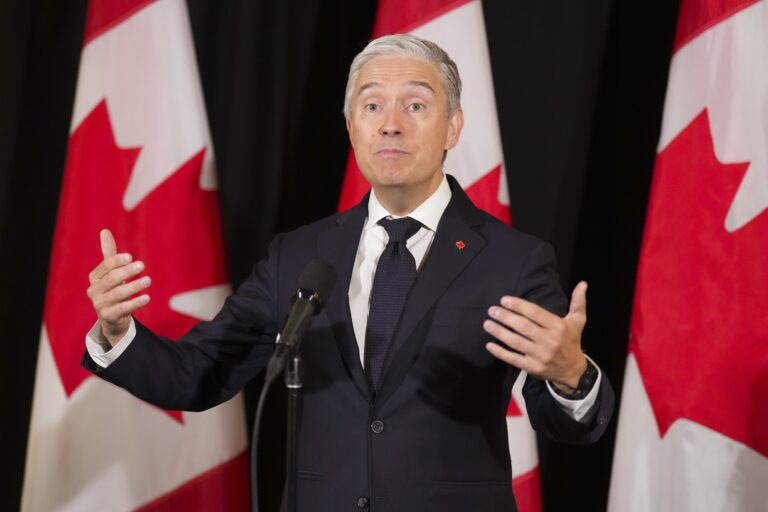
Finance Minister Françcois-Philippe Champagne, left, delivered the first budget Tuesday of Prime Minister Mark Carney's Liberal government. Photo: The Canadian Press/Sean Kilpatrick
Prime Minister Mark Carney’s plan to reorient Canada’s economy from one that buys to one that builds contains a lot of big numbers.
The deficit will surge to 2.5 per cent of gross domestic product if the House of Commons passes the budget bill, and then hover around two per cent of GDP for the remainder of the five-year horizon. By comparison, former prime minister Justin Trudeau’s deficits were around one per cent of GDP.
For those who prefer dollar terms, that’s a shortfall of about $78 billion in the current fiscal year, compared with the previous government’s projection of about $42 billion.
Related Articles


That surge in spending will drive the debt to about 43 per cent of GDP, erasing earlier projections that had debt declining to around 39 per cent of GDP. That isn’t ideal, especially because the world is awash with sovereign debt and central banks remain wary of inflation. That will put upward pressure on borrowing costs, even for the relatively prudent like Canada. The federal government predicts the yield on 10-year bonds will increase to 3.6 per cent in 2028 from around 3.3 per cent now.
Finance Minister François-Philippe Champagne insists the new debt will be good debt—the kind that lays the foundation for future economic growth. He will offset the spending on infrastructure and investment-oriented tax cuts by slashing day-to-day operational spending by some $44 billion by 2030.
There’s a lot going on beneath those top-line numbers, of course. The government had telegraphed much of it, at least in the abstract. So what stuck with me after an initial scan of the budget document was an item in bold type on page 219—effectively the nether regions of the document, the pages that connect the headline announcements in the front section and the appendices where specifics the government doesn’t want to amplify often hide in plain sight.
Carney intends to rebrand something called Interchange Canada as the “Build Canada Exchange,” which will have an “ambitious, immediate-term goal of integrating 50 external leaders in technology, finance, science and other sectors into the public service.” Why? Because there “is a need to bring in talent and perspectives from outside the government into the public service at speech and scale,” according to the budget, confirming chatter around Ottawa that the new prime minister has been coping with a talent deficit as wide as his revenue shortfall.
Budget coverage naturally fixates on questions of accounting. Maybe too little of it considers the dark matter of what’s required to turn numbers in a spreadsheet into policy that improves the quality of people’s lives and facilitates economic growth. If calling Canada an energy superpower was all it took to become one, we would have achieved that status under former prime minister Stephen Harper. If setting up multibillion-dollar funds and calling it industrial policy was all it took to generate sustainable economic growth, former prime minister Justin Trudeau would have a better reputation as an economic manager.
Carney made his name as a central banker. His first attempt at fiscal policy borrows from both of his immediate predecessors as prime minister. His spending program probably could have been more aggressive—the deficit numbers match those of most advanced European countries, for example, and the debt remains manageable. But he isn’t afraid to use the government’s resources to steer the economy. He’s prepared to spend heavily on housing and the green transition, areas where markets have tragically failed.
The mix of Harper and Trudeau might explain why the budget delivers something less than a big bang. The plan is solid, but not spectacular. It’s the budget we needed in the aftermath of the Great Recession, when Harper rushed to balance the budget despite economic weakness. It’s the budget we needed in 2021, when the then-newly appointed finance minister Chrystia Freeland tabled a 725-page document that sprayed money in every direction.
But is Champagne’s budget the one we need in 2025, when the country is just beginning to understand the impact of the Trump shock on Canada’s ability to generate wealth? It will help, but Carney and Champagne could have tried to help more. “The economy needs a total rethink,” said Charles St-Arnaud, chief economist at Alberta Central. Economic policy is “too much about consumption” and not enough about supply, he added. “We planted the seeds 30 years ago.”
Maybe Carney reckoned the team he inherited wasn’t yet ready to execute generational change. There’s a broad consensus that Trudeau’s government put more effort into announcing than executing, exacerbating the feeling that the government can’t get anything done, and that when it tries it doesn’t quite know what it’s doing.
The way the federal government lost its grip on immigration might be the best example of incompetence. The failure to make good on its promise to introduce an open banking regime, the various bad bets on electric vehicles and the unravelling of the consumer carbon tax are others. Poor execution isn’t the only reason productivity growth has stalled, but it’s an important one. Canada had given up on industrial policy. Trudeau reminded everyone why.
But industrial policy itself is fine. China showed the world that it’s possible to hit growth targets and create strategic industries from scratch. Its government wasted a lot of money, but also reduced the country’s dependence on oil imports and did more to lower the cost of solar energy than anyone else by a large margin. The lesson for countries that aren’t hyper-powers is that industrial policy can work, but maybe try to be more thoughtful about it.
You need a critical mass of humans who are empowered, courageous and talented enough to do that thinking, to execute on new and difficult things. That’s the thing about this budget that stands out from all the others that I’ve read. There’s a subtle but serious emphasis on execution that gives the plan an air of credibility that Trudeau’s budgets began to lack.
The decision to shift oversight of open banking from the Financial Consumer Agency of Canada to the Bank of Canada finally puts that policy in the hands of an institution with the heft to resist whatever recalcitrance might still exist at the legacy banks. Handing oversight of stablecoins to the Bank of Canada could pre-empt the delays that have plagued the adoption of financial technology for a decade by assigning it to a powerful agency from the start.
A recruitment drive doesn’t mean public servants are useless. It means the world has changed radically in the last few years and organizations of all kinds are struggling to keep pace. Carney has done well to recognize that the government is no different.
Kevin Carmichael is The Logic’s economics columnist and editor-at-large. He has spent more than two decades covering economics, business and finance for outlets including Bloomberg News, The Globe and Mail and the Financial Post, where he also served as editor-in-chief.



Loading...
Thanks for sharing!
You have shared 5 articles this month and reached the maximum amount of shares available.
CloseThis account has reached its share limit.
If you would like to purchase a sharing license please contact The Logic support at [email protected].
CloseGift the full article!
You have gifted 0 article(s) this month and have 5 remaining.
Recipients will be able to read the full text of the article after submitting their email address. They will not have access to other articles or subscriber benefits.
Photo: The Canadian Press/Sean Kilpatrick
Most Popular This Week



In-depth, agenda-setting reporting
Great journalism delivered straight to your inbox.
Commentary
Carmichael: Canadian ignorance about India is a strategic weakness
Briefing
Aritzia shares pop after earnings rise 204%
First Nation in Alberta goes to court over fast-tracked oil pipeline
Chinese EV maker Geely Auto Group to launch in Canadian market in 2027
Best business newsletter in Canada
Get up to speed in minutes with insights and analysis on the most important stories of the day, every weekday.
Exclusive events
See the bigger picture with reporters and industry experts in subscriber-exclusive events.
Membership in The Logic Council
Membership provides access to our popular Slack channel, participation in subscriber surveys and invitations to exclusive events with our journalists and special guests.