In 2019, Shopify CEO Tobias Lütke outlined an environmental strategy for the e-commerce giant that—at least in purely business terms—made little sense.
By “intentionally overpaying” for credits derived from technologies that remove carbon from the atmosphere, Lütke wrote, Shopify could drastically lower its environmental footprint and spur innovative new ways of reducing emissions.
Talking Points
- Shopify is backing nascent carbon-removal technologies as part of its green strategy, laid out by CEO Tobias Lütke in 2019
- In order to ensure the strategy has tangible environmental benefits, it’s willing to intentionally overpay for those credits in the hopes it can help establish a genuine market for carbon.
However, that would involve dumping money into technologies he acknowledged were “incredibly expensive” and uneconomic, costing upward of US$1,000 per tonne compared to around US$5 for the cheapest versions. Indeed, demand for carbon credits of the kind Shopify would target is “vastly lower than [for] other offsets,” he said.
As of early 2024, the e-commerce company has invested $55 million in 40 carbon removal companies. Each uses unique and sometimes eccentric methods to remove (and then store) carbon from the Earth’s atmosphere, developing technologies that drink up carbon dioxide from ocean water, inject CO2 into volcanic formations or turn “carbon to stone.”
The strategy, led by Shopify’s head of sustainability Stacy Kauk, is a decades-long gamble. If successful, the plan could enrich Shopify with high-quality carbon credits as their demand skyrockets, and could help encourage the development of carbon trading markets—a mechanism that some believe is a critical requirement in the global push to reach its net-zero targets.
“It’s early days, and there’s a lot of uncertainty about where the world will be in 10, 50, 100 years, but being in at the ground level of a fledgling industry is going to have payoffs,” Kauk said in an interview.
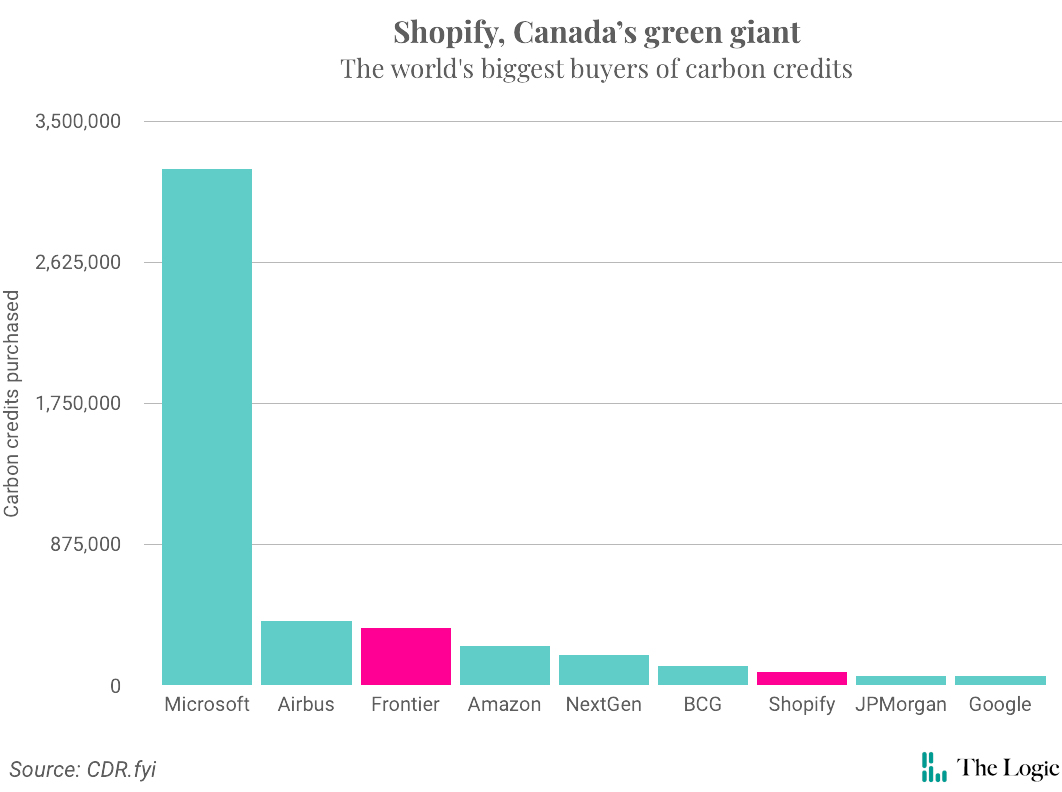
Shopify has spent so much on carbon removal credits that the Ottawa-headquartered company has become the world’s seventh largest buyer in its own right, just behind the likes of Airbus and Amazon. It has purchased 88,516 carbon credits thus far, according to public tracker CDR.fyi. JPMorgan Chase, America’s biggest bank, is the eighth largest and Google is ninth. (Microsoft is by far the world’s biggest buyer of carbon credits.)
The company’s commitment to the effort is such that in 2022, Shopify joined Meta, Alphabet and other major firms to form Frontier, a group that aims to spend upward of US$1 billion on carbon credits by 2030. Frontier is the world’s third largest buyer of the credits, according to CDR.fyi.
Shopify and other companies that buy carbon credits—which are traded by the tonne—can then count them toward their environmental efforts or, in many cases, sell those credits on the open market.
Still, Shopify’s strategy isn’t without risk. Permitting delays have slowed the development of demonstration projects. Some technologies, having proven themselves in a laboratory setting, have run into snags when developers sought to scale them in the real world. The plan has been “full of surprises, full of delays,” said Kauk, who has led Shopify’s carbon credit scheme for the last four years.
Last year, the company reported backlogs in its carbon credit buying plans, and had overall found that the supply of carbon removal opportunities was “increasing slower than anticipated.” Shopify continues to work its way through the backlog, Kauk said, and expects to have an update on the strategy in April.
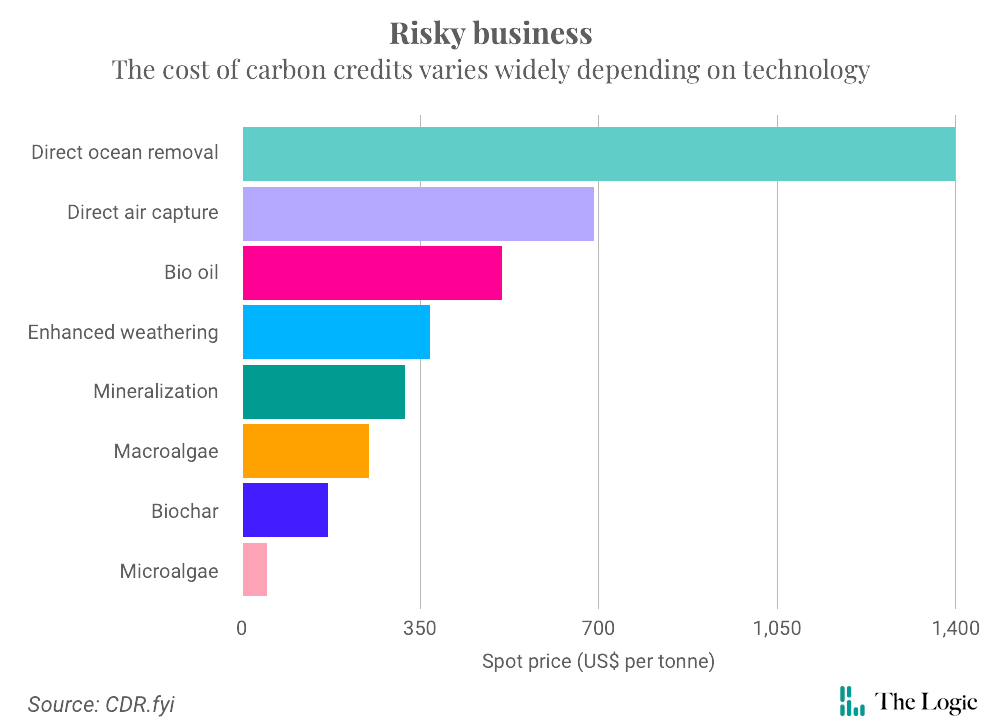
The delays are in part due to Shopify’s insistence that the company “verify” all the credits it buys, a sometimes onerous process that requires third parties to authenticate whether a given tonne of CO2 was successfully stored. That often involves paying above-average prices for those credits—something Kauk refers to as an “early adopter premium.” Shopify has paid upward of US$2,000 for some credits it’s purchased (average costs range between US$50 and US$1,600, depending on the type of technology used).
The overpaying is a feature of the strategy, not a bug, said Kauk.
“We’re not going to go out and just buy credits for the sake of buying credits, and we’re not going to go out there and be driven by a budget or price point,” she said.
As Lütke also described in his initial outline of the plan, Shopify strictly targets carbon removal companies that, for example, use technologies like direct air capture (DAC) to draw CO2 directly from the atmosphere. Such technologies are distinct from carbon capture, which separates CO2 from the exhaust systems of commercial-scale facilities like concrete plants or power stations. Both technologies store the carbon after separation. The latter, Lütke and others argue, simply allow heavy polluters to cover up the emissions they cough up—a phenomenon known as greenwashing that has clouded efforts to curb major sources of industrial CO2.
“The biggest buyers of carbon offsets are often the largest polluters looking to be absolved of their guilt; a modern twist on medieval indulgences,” Lütke wrote in 2019.
Stacy Kauk, head of sustainability at Shopify. Photo: Shopify | Handout
Out of its US$5-million per year Sustainability Fund, Shopify has purchased 5,000 carbon removal credits from Switzerland’s Climeworks, a startup currently operating one the world’s biggest direct air capture plants in Iceland. It bought 10,000 credits from Carbon Engineering, the Bill Gates-backed Canadian DAC company that Occidental Petroleum acquired last year for US$1.1 billion. The deal was viewed as a breakthrough for the technology and a sign of the oil and gas industry’s acceptance of the need to decarbonize.
It has signed offtake agreements with a range of other companies like California-based Captura, whose technology coaxes CO2 out of ocean water, and San Francisco-based Charm Industrial, whose technology takes the leftovers from agricultural fields—stalks, leaves, husks—and heats them into a brown, viscous oil rich in CO2. The oil is then injected into deep underground wells for storage.
“We’re making 40 different bets on 40 very different companies, and we’re hoping that the majority of them are successful but that remains to be seen,” Kauk said.
Despite the strides some companies have made in the sector, carbon removal remains costly. It’s one of the most expensive methods for removing CO2 emissions in a long line of expensive decarbonization technologies.
Carbon removal technologies draw their CO2 from a much more diffuse stream than industrial carbon capture—0.04 per cent in the atmosphere compared with 20 per cent in commercial applications, according to some estimates—making them highly inefficient on a per-tonne basis.
“Right now, they’re much more expensive compared to other ways of reducing emissions,” said Sara Hastings-Simon, an associate professor at the University of Calgary specializing in energy and environment.
“Fundamentally, you have to put a lot of energy in to do that separation,” she said.
Hastings-Simon, who is currently working on modelling cost expectations for CO2 removal technologies, said such methods won’t likely be responsible for massive amounts of carbon removal, but shouldn’t be ruled out as one one among a cocktail of technologies that can be used to reach net-zero.
Other experts are even less convinced. Jonathan Foley, an executive director at Project Drawdown, has said carbon removal is “wildly expensive, far too energy- and resource-intensive, and only removes pathetically small amounts of carbon.”
Even so, as Lütke has pointed out, Shopify’s environmental bet is a much longer bet on carbon removal technologies. It is also, crucially, an attempt to help establish a foundation for carbon markets and by extension carbon trading platforms. Shopify’s willingness to pay a premium for credits sends a “demand signal to the market,” Kauk said.
Kevin Krausert, the CEO of Calgary-based Avatar Innovations, a tech accelerator and investor focused on decarbonization, said trading platforms can help make developing technologies more financially feasible.
“Carbon markets are an absolutely critical component to creating bankable investments in the energy transition,” he said.
Kauk said the strategy is part of a 100-year view that envisions ever-stricter regulations eventually compelling corporations to purchase verified credits to offset their emissions.
“What we’re starting to see with regulations in the European Union, as well as proposals through the [U.S.] Securities and Exchange Commission, is companies will be required to disclose their carbon footprint and what they’re doing about it,” she said.
That could in turn crowd out the market for such credits, and put Shopify in a highly advantageous position. Otherwise, the Canadian e-commerce company will have overpaid trying to encourage an industry that failed to emerge out of thin air.
“Fundamentally, if nobody buys and supports these technologies today, they’re not going to be there when we need them in 2040 and 2050.”