OTTAWA — The black boxes powering the rise of artificial intelligence are packed with copper wiring that shuttles information from one place to another. Hamid Arabzadeh wants to fill them, instead, with light.
Skip to content
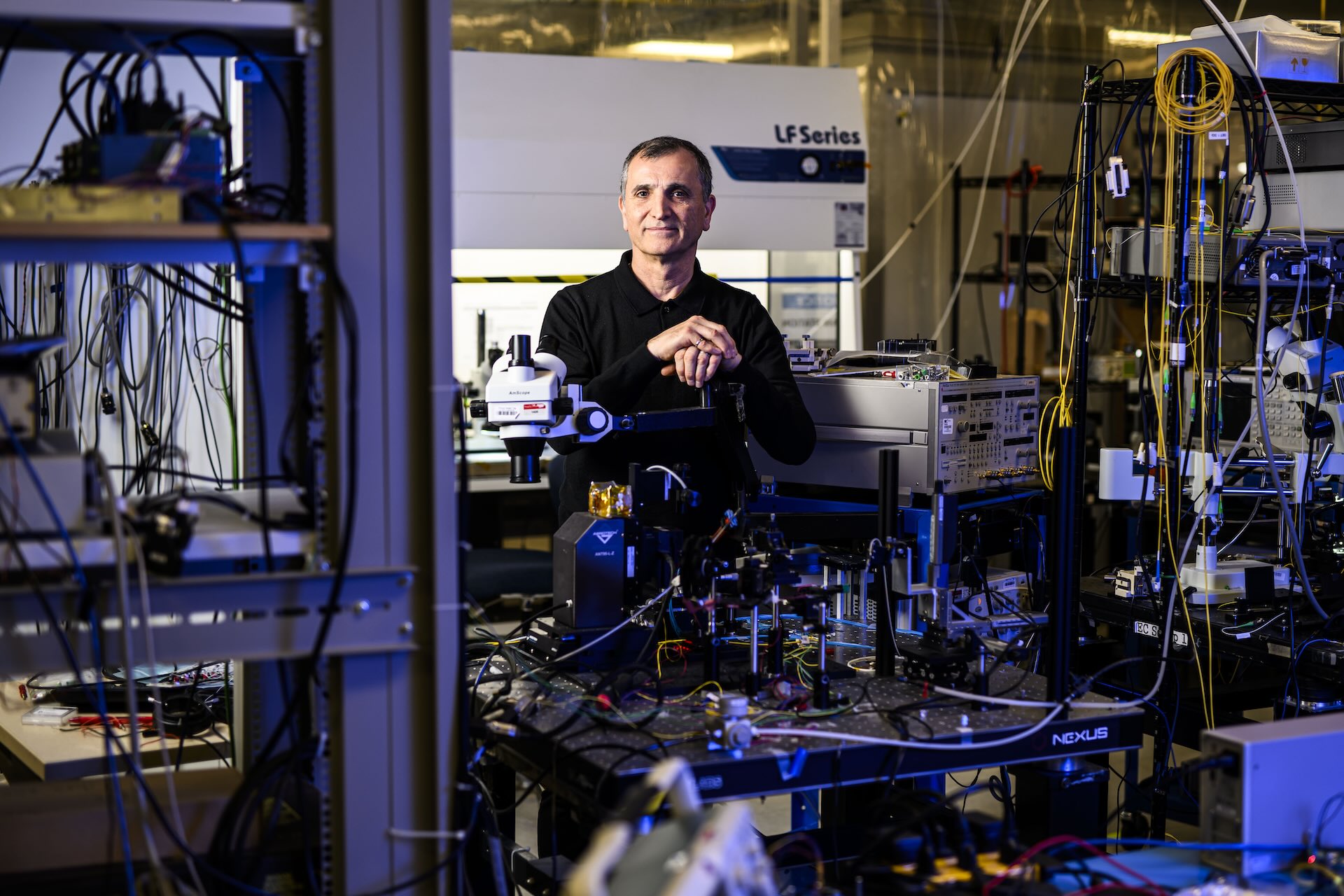
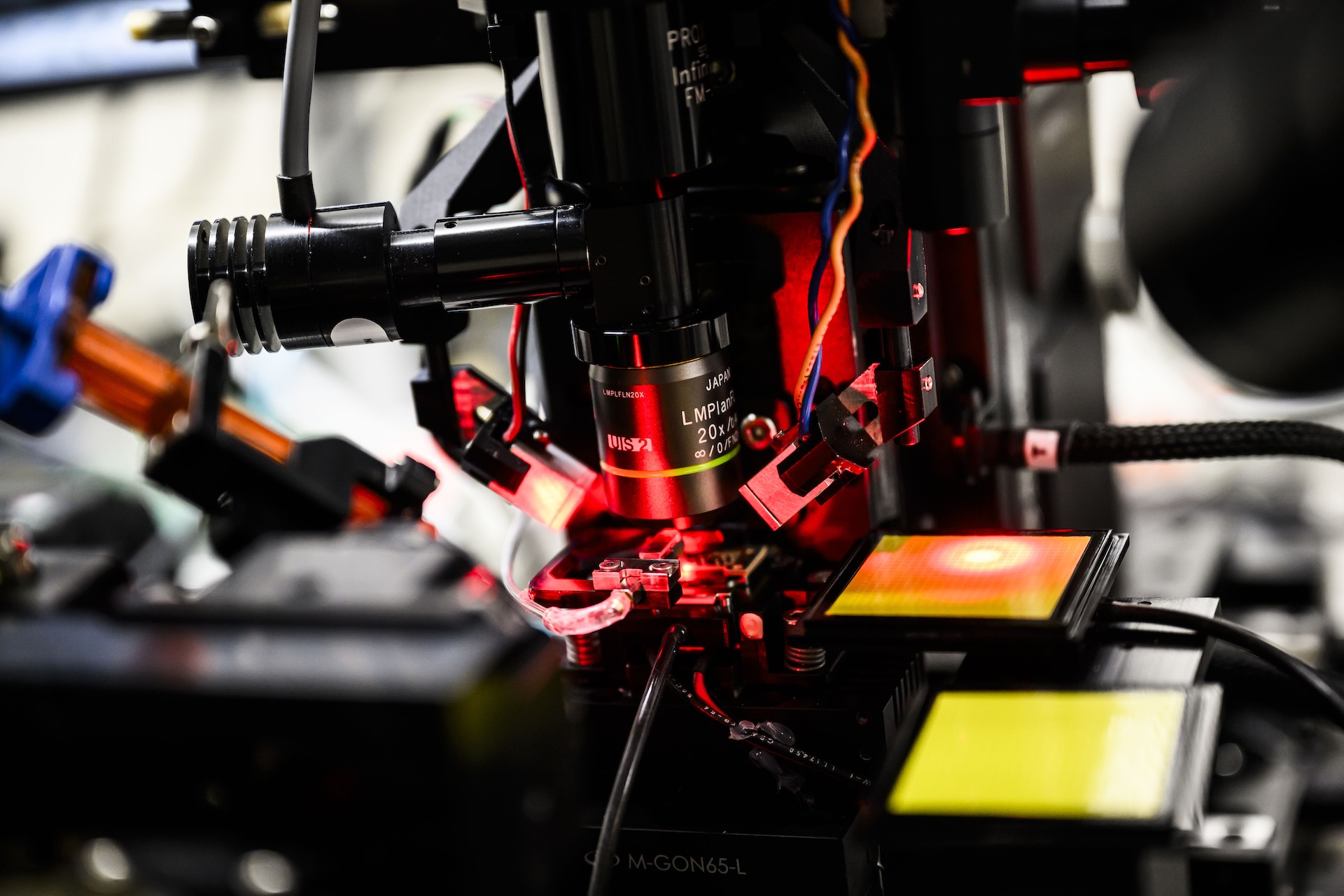 An automated assembly machine producing Ranovus’s Odin optical chip in the clean room at the firm’s Ottawa headquarters. Photo: Justin Tang for The Logic
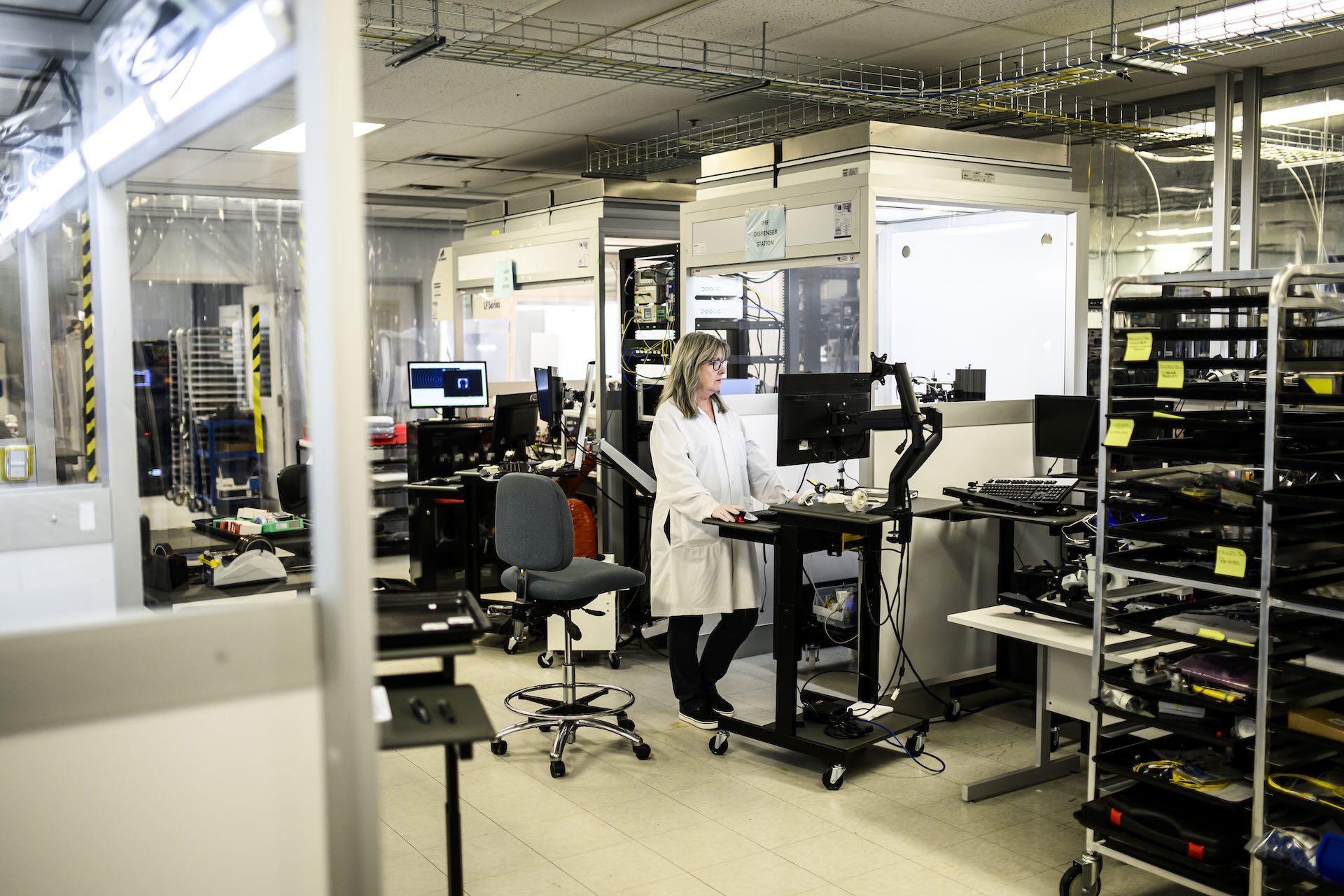 A Ranovus test technician in the product staging clean room at the company’s headquarters in Ottawa. Photo: Justin Tang for The Logic
 A Ranovus employee operates the final test system for the firm’s Odin optical chip at its Ottawa facility, examining the “eye diagram” to check the product’s quality. Photo: Justin Tang for The Logic
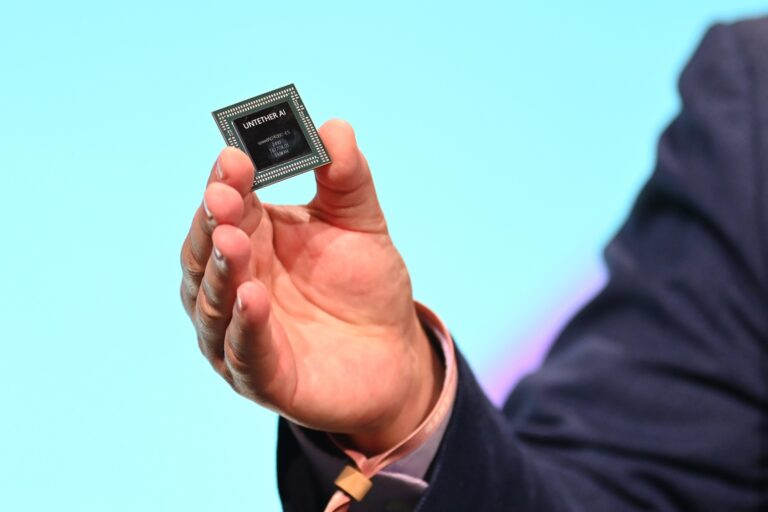
 The Ranovus Odin chip sits beside AI processors and passes data between them across data centres. It’s faster and uses less energy than traditional wiring. Photo: Justin Tang for The Logic

The Big Read
AI hardware has a power problem. This company is using lasers to fix it
Ranovus builds tech to move data between chips faster and more efficiently. It’s one of a growing list of companies racing to meet demand for more powerful AI hardware.
Hamid Arabzadeh started Ranovus 12 years ago after a career in networking equipment. He sees a huge market for technology that can carry information around data centres more efficiently than traditional electrical wiring. Photo: Justin Tang for The Logic
Hamid Arabzadeh started Ranovus 12 years ago after a career in networking equipment. He sees a huge market for technology that can carry information around data centres more efficiently than traditional electrical wiring. Photo: Justin Tang for The Logic
OTTAWA — The black boxes powering the rise of artificial intelligence are packed with copper wiring that shuttles information from one place to another. Hamid Arabzadeh wants to fill them, instead, with light.
Ranovus, his Ottawa-based firm, has an early lead in a new technology called co-packaged optics. Its devices sit beside the processors that train and run AI models, firing tiny lasers down narrow glass fibres to move data between chips. The technology can carry more information than traditional copper cables and take it further, all while using a lot less power for about the same cost.
Talking Points
- Ottawa-based Ranovus has developed light-based hardware that moves information between chips in data centres faster than traditional wires while using less power. It sees a huge opportunity in the exploding demand for computing power to train and run AI models and applications.
- The 12-year-old company has partnered with major hardware firms in AMD and MediaTek to roll out its technology, but faces competition from tech giants and startups developing similar light-based systems
Exploding interest in AI has generated huge demand for computing power. Semiconductor giant Nvidia is the undisputed early winner, as cloud service providers rush to fill their data centres with its servers. But the world is going to need a lot more hardware, and Ranovus is building its business with rival chip designers looking to fill the gap.
Before it could ride the AI wave, though, the company had to survive a major trade shock, plot a new supply chain and reinvent its technology. It’s now up against bigger and better-financed international competitors. Still, Arabzadeh is sure he can win, and do it from Canada. “This technology could transform a copper world to an optics world,” he says. “And Canada is exceptionally placed.”
An engineer by training and raconteur by disposition, Arabzadeh spent the turn of the millennium in Mexico City, Sao Paulo and London working for Nortel, the defunct Canadian networking giant, then ran an optical technology firm in Nuremberg, Germany, that he sold to Cisco for US$99 million in 2010. In 2012, he returned to Ottawa to start Ranovus.
The startup’s original product was a fibre-optic system that connected data centres dozens of kilometres apart. It built a supply chain that circled the world, sourcing parts from Canada, Germany and Singapore and assembling them at a factory in Thailand. By 2018, Ranovus was doing about $3 million a quarter in revenue, and had landed a major Chinese customer that was using its technology in next-generation telecom networks.
Then came the shock. Amid escalating trade and technology fights with Beijing, the U.S. sought to limit some semiconductor exports to China. Ranovus’s device contained one of those chips, and now it looked like it might not be able to sell its product in a major market. “So we had to stop our whole company,” says Arabzadeh.
Ranovus reinvented itself, this time going smaller, shorter and closer. It shrunk its technology to fit into a chip about the size of a quarter called Odin, so that several could slot in right beside a clients’ AI chip. Instead of trying to link data centres to each other, Ranovus went inside the building—its cables now run anywhere from a few metres to a few hundred, rather than for kilometres.
The firm also built a supply chain in North America. Today, Ranovus manufactures and finishes its products at its Ottawa headquarters, using equipment it invented in-house. The back of the facility is a hardware lab, with staff in dust coats and gloves working microscopes and machinery. In front are cubicles and cabins, with the firm’s patents studding the entryway wall.
Related Articles

Ranovus now gets its lasers from the National Research Council of Canada’s expanding photonics fabrication centre on the other side of the city, and its chips from GlobalFoundries in Malta, N.Y.
The new focus opened up a huge new market. “There are millions and millions of copper connections inside the data centre,” says Arabzadeh. But metal wires are limited—the further they go, the slower the signal. They’re also power-hungry, and generate a lot of heat.
Power is key. Data centres need a lot of it—the largest ones use as much as hundreds of thousands of homes—for all their chips and wires, and for the cooling systems that dissipate all the heat the hardware generates. Ranovus claims the latest generation of Odin cuts power consumption by half compared to current cables. As tech giants try to build AI infrastructure while maintaining their green image, research firm Gartner predicts co-packaged optics will account for two-fifths of high-bandwidth installations in data centres by 2026.
That could mean a lot of business for Ranovus and its rivals. “Our world is enabling the AI world,” says Arabzadeh.
Ranovus has already landed two major partners. In 2019, just after its pivot, the company started working with Nvidia rival Xilinx. About three years later, the two firms unveiled their first joint product, a Ranovus Odin chip slotted right into a Xilinx AI chip. Arabzadeh claims it was a “world’s first” that won his company a lot of industry attention.
In between, chip giant AMD bought Xilinx to bolster its AI capabilities, and got the Ranovus partnership as part of the deal. “To leapfrog their competition, they’ve chosen us,” says Arabzadeh, as a worker on the other side of this dual-purpose meeting room pulls a clean room suit from a wardrobe to enter the dust-free area of the Ranovus office.
Tech giants fill their data centres with AI chips from the likes of AMD. But companies like Amazon, Google, Microsoft and Meta are also employing custom processors, which are cheaper and may perform better for the software they run. “They’re building their own versions of tons of things,” says Tom Kao, a corporate strategy advisor at MediaTek, a lesser-known semiconductor giant based in Hsinchu City, Taiwan.
In fact, it’s firms like MediaTek that usually build custom chips for tech giants and other data centre operators. The designers, in turn, bring in technology from other companies. And when a project requires optical connectors, MediaTek calls Ranovus. MediaTek heard pitches from a lot of optical firms, says Kao, who spent almost a decade as a top executive in charge of partnerships at the Taiwanese firm.
But Ranovus, he says, had the best technology package that MediaTek could combine with its AI chips. The Canadian company had experience with both the electrical and optical connections some clients demand. Ranovus could also install the lasers that fire light down its fibres either inside or outside the chips, which gives clients a choice. And Ranovus had already figured out how to actually manufacture co-packaged optics in a cost-effective way.
The two companies also shared a common rival: Broadcom, the US$1.1-trillion market cap hardware firm based in Palo Alto, Calif., with which Ranovus competes on connectors and MediaTek competes on custom chip development.
MediaTek and Ranovus have so far delivered one joint build, a custom AI chip surrounded by eight Odin chips unveiled last March. Neither firm would name the client it was built for, but both expect more to come. “We are approaching customers together,” says Kao, “because the whole industry is just starting to migrate to optical.”
Arabzadeh says the partnership with MediaTek has also helped Ranovus break into Taiwan’s blockbuster hardware ecosystem. Taiwan Semiconductor Manufacturing (TSMC), produces the majority of the world’s most advanced chips, while Advanced Semiconductor Engineering is a major player in packaging and testing. Arabzadeh says that major players from the island are now flying to Ottawa to see what his firm can do.
What those high-profile international visitors find when they get to Ottawa is a non-descript industrial building set between a field and a forest. Inside Ranovus’s headquarters the vibe is closer to the tech sector’s hardware origins than today’s software startup-core—functional furniture and soldering irons instead of a campus filled with slides and nap pods.
Visitors also find some serious talent in photonics, the science of light. Nortel made Ottawa a hub for networking technology, and Ranovus has been able to recruit engineers and executives from the likes of Ciena and Nokia.
Ranovus has about 120 employees today, up from 88 two years ago, and plans to hire up to 60 more people this year. Several of Arabzadeh’s leadership team are former chief executives or technology heads of hardware startups that were sold to Silicon Valley buyers.
After the U.S.–China trade war stopped sales seven years ago, Ranovus has successfully restarted its business. Arabzadeh says the firm made about $5 million in revenue in 2024 and expects to make about $25 million in 2025, with contracts in place for 60 per cent of that already. He expects sales to scale rapidly after that, as companies rush to buy the chips to which Ranovus devices are connected. The goal is for the firm to break even by 2026, then mount an initial public offering in 2027.
Those are lofty ambitions. Hardware is notoriously hard, because startups must typically spend a lot to develop their products. Arabzadeh says Ranovus has raised US$77 million in equity financing so far from investors including OMERS Ventures, the Business Development Bank of Canada, Export Development Canada and San Francisco’s Azure Capital Partners.
The federal government has backed Ranovus, putting up $56 million in financing to help the firm develop its technology and another $4.8 million for it to expand its manufacturing capacity in Ottawa. Innovation Minister François-Philippe Champagne is a fan, dubbing Ranovus a “Canadian champion.” Arabzadeh says the company’s customers and suppliers have also invested, bringing Ranovus’s total capital to US$170 million.
That’s a lot less than some of its upstart photonics rivals. Boston-based Lightmatter, which opened a Toronto office last year, has raised about US$821 million to date according to data from PitchBook. Celestial AI of Santa Clara, Calif. has raised over US$338 million. That doesn’t bother Arabzadeh, who says Ranovus has won clients and manufacturers by showing how well its technology works rather than showing off its bank balance. (“We don’t update our PitchBook stuff,” he says.)
Ranovus and other startups also face competition from major U.S. hardware players. Marvell, which has a growing Canadian presence, rolled out a co-packaged optics product last week. IBM unveiled its own prototype in December, built in part at a facility in Bromont, Que. that it’s expanding with federal funding.
Arabzadeh insists Ranovus has a head start, and better technology. “We’re in production already—we’re not worried,” he says. Plus, there’s going to be a lot of business to go around. Nvidia may dominate AI hardware today, but many in the industry are betting the compute market will fragment between big players, startup chipmakers, and tech giants’ in-house processors. Investment bank Morgan Stanley estimates that 2024 was the high watermark for “merchant” firms like Nvidia and AMD that sell full semiconductor systems. From 2026 onwards it predicts that custom chips will make up two-thirds of shipments.
All those processors will need optical connectors—and many will need more than one. Arabzadeh’s strategy is to have a champion in each category—AMD among the server makers, MediaTek among the custom chip designers, and so on. Ranovus also wants to work directly with the biggest cloud providers and most promising chip startups. Maybe even Nvidia itself some day.



Loading...
Thanks for sharing!
You have shared 5 articles this month and reached the maximum amount of shares available.
CloseThis account has reached its share limit.
If you would like to purchase a sharing license please contact The Logic support at [email protected].
CloseGift the full article!
You have gifted 0 article(s) this month and have 5 remaining.
Recipients will be able to read the full text of the article after submitting their email address. They will not have access to other articles or subscriber benefits.
Photo: Justin Tang for The Logic
An automated assembly machine producing Ranovus’s Odin optical chip in the clean room at the firm’s Ottawa headquarters.
A Ranovus test technician in the product staging clean room at the company’s headquarters in Ottawa.
A Ranovus employee operates the final test system for the firm’s Odin optical chip at its Ottawa facility, examining the “eye diagram” to check the product’s quality.
The Ranovus Odin chip sits beside AI processors and passes data between them across data centres. It’s faster and uses less energy than traditional wiring.
Most Popular This Week




In-depth, agenda-setting reporting
Great journalism delivered straight to your inbox.
News
Ottawa is softening its ban on stablecoin yield
Briefing
Rio Tinto gets nearly $165M in additional federal funds for Quebec aluminum
U.S. to lift tariffs on some Canadian products crucial to Maine: Collins
Carney warns of tech dependence after Starlink disruptions in Ukraine
Best business newsletter in Canada
Get up to speed in minutes with insights and analysis on the most important stories of the day, every weekday.
Exclusive events
See the bigger picture with reporters and industry experts in subscriber-exclusive events.
Membership in The Logic Council
Membership provides access to our popular Slack channel, participation in subscriber surveys and invitations to exclusive events with our journalists and special guests.






