VANCOUVER — When AbCellera posted a nearly US$150-million annual loss at the end of 2023, it was an abrupt turn for a company seen as the lodestar of Vancouver’s biotech startup scene. For the previous two years, it had been awash in royalties from two COVID-19 therapies it co-developed in the midst of the pandemic.
Skip to content
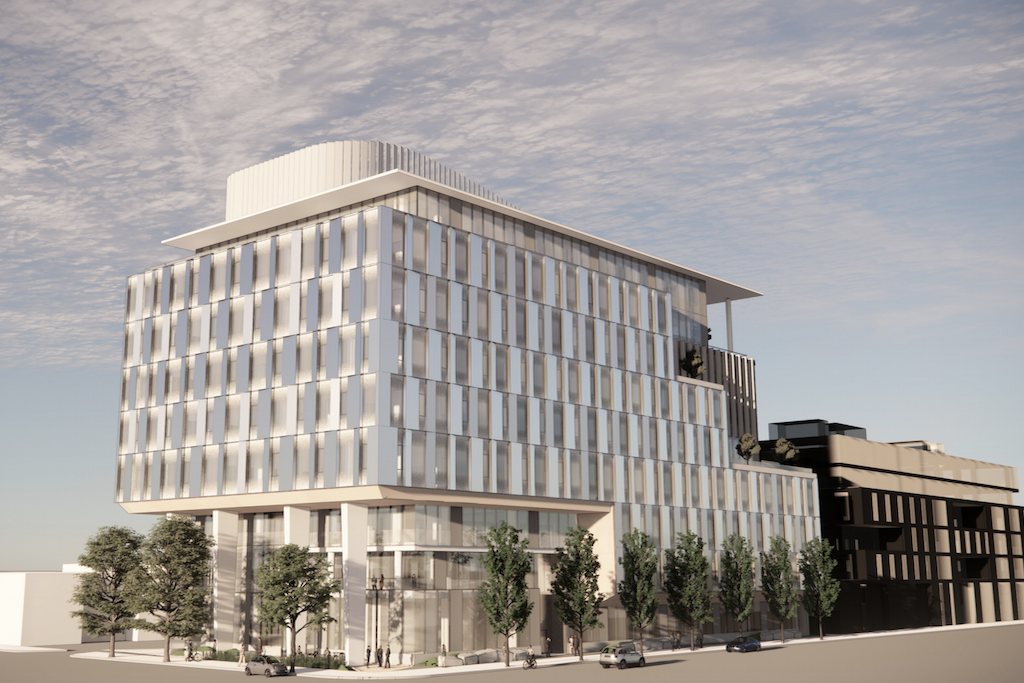 A rendering of the planned AbCellera office in Vancouver’s Mount Pleasant neighbourhood. Photo: AbCellera/Handout

 Federal Innovation Minister François-Philippe Champagne, centre, and B.C. Premier David Eby, left, listening to Raffi Tonikian, AbCellera director of translational biomarkers, during a lab tour in Vancouver in May 2023. Photo: The Canadian Press/Darryl Dyck

The Big Read
Despite billion-dollar pandemic boost, AbCellera still seeks ‘escape velocity’
Two COVID treatments bolstered the Vancouver biotech champion’s bottom line, but now it’s losing money
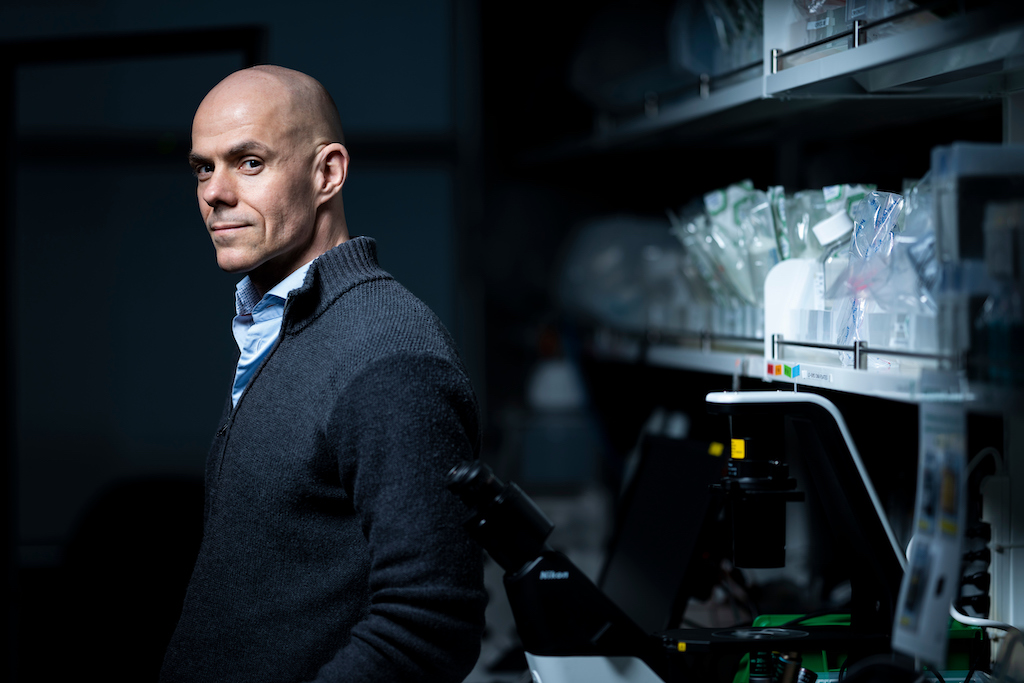
AbCellera CEO Carl Hansen in one of the company's Vancouver labs in March 2021. Photo: Jimmy Jeong for The Logic
AbCellera CEO Carl Hansen in one of the company's Vancouver labs in March 2021. Photo: Jimmy Jeong for The Logic
VANCOUVER — When AbCellera posted a nearly US$150-million annual loss at the end of 2023, it was an abrupt turn for a company seen as the lodestar of Vancouver’s biotech startup scene. For the previous two years, it had been awash in royalties from two COVID-19 therapies it co-developed in the midst of the pandemic.
Both treatments got wide uptake in the United States, earning the company a staggering US$950 million. In a fraction of the time it typically takes drug companies to get a product to market, the relatively young biotech made a name for itself, holding a record-breaking initial public offering on the Nasdaq and building a massive new headquarters as a future corporate anchor on B.C.’s Lower Mainland.
Talking Points
- After bringing in more than US$950 million in royalties from its two COVID-19 antibody therapies, AbCellera posted a loss of nearly US$150 million last year, with royalty revenue of zero
- The Vancouver-based biotech, like other firms that experienced a pandemic windfall, must now chart a path without that ongoing revenue stream. AbCellera now expects to focus more on developing its own drugs, rather than partnerships, though long-term profitability may be in the distant future
By 2022, though, the ground beneath AbCellera started to move. The two treatments lost efficacy against newer coronavirus variants, and royalties from the drugs dried up. “The virus had shifted,” recalled Carl Hansen, the firm’s co-founder and CEO in a recent interview with The Logic. “COVID, in my opinion, has become—at least for now—a well-handled problem.”
Rare is the CEO who takes a collapse in demand for his company’s best-selling product in stride. Yet despite the bleak earnings news and a languishing stock price, Hansen seems unfazed. Biotech is a long game, he noted, and companies that reach “escape velocity”—a tech metaphor Hansen often reaches for to describe an elite class of firms able to fuel their own growth through product development—take decades to do so.
But AbCellera has a lot more fuel than your average scaleup—some US$800 million still available to fund the next stages of its ascent. Since the cash started pouring in, Hansen and his team have been using the money to grow AbCellera aggressively, while shifting the company’s focus to developing its own pipeline of drugs. That’s a potentially far more profitable model than its current go-to approach of partnering with other firms, and one it aims to have in place years ahead of schedule.
Achieving escape velocity isn’t easy, though. For biotechs, it means not only creating a blockbuster drug, but repeating that feat over and over, Hansen acknowledged. Many fail, for lack of a competitive advantage that keeps them on that path.
“We believe we are positioned to have a crack at that, but it’s so far away,” he said. “Our sights are focused on having the first one done.”
Related Articles


In one sense, Hansen is describing a reset. Like many companies that were in the right place at the right time to deliver COVID-19 drugs (Moderna, Pfizer); goods and services for the stuck-at-home (Lululemon, Peloton); and technology for virtual work (Zoom, Shopify), AbCellera must contend with a world that mostly returned to its pre-pandemic rhythms. Gym-goers returned to their fitness clubs, ditching their connected exercise devices; bosses enforced return-to-office policies; and, for many who came down with it, COVID-19 seemed no worse than the flu.
Hansen believes the company is not too old, or invested in its current products, to change its ways. He co-founded AbCellera in 2012, building an antibody-discovery platform harnessing the power of artificial intelligence. In his mind, the firm is only entering adolescence.
What started as a six-person firm working out of a University of British Columbia lab quickly gained traction. In 2018, it had more than two dozen partnered discovery programs and received a four-year contract from the U.S. Defense Advanced Research Projects Agency.
Investors, including Silicon Valley heavyweight Peter Thiel, bought into the vision. They wrote cheques totalling more than US$115 million, according to PitchBook, starting with a Series A in the latter half of 2018.
The last venture-capital round—a US$105-million Series B in May 2020—came on the heels of AbCellera’s first COVID-19 therapy breakthrough. Its researchers had discovered a promising antibody and partnered with Eli Lilly to co-develop what would become bamlanivimab. Its success prompted AbCellera to go public earlier than initially planned.
Bamlanivimab, and a secondary therapy called bebtelovimab, became AbCellera’s first blockbuster drugs. The first received rapid emergency-use authorization from both the U.S. Food and Drug Administration and Health Canada.
Internally, the unusually quick ascent of the therapies was seen as a “non-dilutive financing event”—essentially, a windfall. Combined with the VC, IPO and government funds AbCellera had piled up, the money represented a rare opportunity, and the firm leaped, planning a massive campus in Vancouver’s Mount Pleasant neighbourhood and a 130,000-square-foot manufacturing facility a few kilometres away. It hired extensively, growing from 107 full-time staff at the start of 2020 to 643 in November 2023—a sixfold increase.
The company was in the midst of its expansion, though, when the windfall started to dwindle. Last May, the World Health Organization downgraded COVID-19 from an international public-health emergency to “an established and ongoing health issue.” AbCellera decided against creating more therapies against new variants, and last year, its royalty revenue dropped to zero.
Against the backdrop of the company’s pandemic hey-day, the impact on earnings looked severe. Total revenue plummeted from US$485 million in 2022 to US$38 million in 2023, and AbCellera reported a roughly US$146-million net loss after three consecutive profitable years. Before releasing its latest financial update, AbCellera laid off 10 per cent of its staff—63 people.
It’s not uncommon for early, pre-commercial companies like AbCellera to be losing money, said Steven Mah, a senior research analyst for life science and diagnostic tools at TD Cowen. Considering the typical timelines to commercialization, it’s a “net positive” AbCellera was able to create two marketable therapies so quickly and earn a lot of money from them, he said.
The company’s shares, meanwhile, have been on a downward trajectory since shortly after its IPO. AbCellera offered its shares on the Nasdaq for US$20 on Dec. 11, 2020; they closed that day at US$58.90. But they’ve since mostly fallen, trading under US$10 since about February 2023.
Biotech shares, overall, have lagged amid high interest rates and difficulty securing all types of capital. And despite AbCellera’s bleak earnings, analysts reckon the company’s shares are undervalued at their current price of just over US$4 as of Tuesday. Leerink Partners has rated the stock “outperform,” with a target price of US$10, while BMO Capital Markets gives it a US$12 target.
Mah sees similarities between AbCellera’s trajectory and other companies that experienced COVID-19-related boosts. “They were essentially just printing money,” he said. In some cases, the firms’ fundamentals remain strong even though their revenues and net incomes dropped off a cliff, he added. “There’s a little bit of a backlash, which I think is a little bit unwarranted for some of these companies.”
Consider Moderna, which was 10 years into work on its mRNA vaccine technology when COVID-19 became a pandemic. In 2020, it had sales of US$200 million and lost nearly US$750 million. In 2021, when its COVID vaccine hit the market, Moderna had US$17.7 billion in sales and net income of $12.2 billion.
It’s still selling plenty of COVID shots, and it has potential vaccines and treatments in its pipeline for numerous illnesses—some in advanced clinical trials—but nothing else yet on the market. Last year, Moderna lost US$4.7 billion on US$6.7 billion in sales. Its share price peaked at US$464.85 in 2021. These days, its stock trades around US$100.
Rival mRNA developer BioNTech, which also has a packed pipeline but only a COVID vaccine on the market, saw commercial revenues of €18.9 billion in 2021 fall to €3.8 billion in 2023.
In 2024, these companies aren’t putting up the stupendous numbers they were just a couple of years ago, but they’ve gone from speculative ventures in a corner of the pharma industry to household names with proven innovations; thanks to its pandemic successes, Moderna can afford to lose billions—at least for a while.
The fate of Canada’s Medicago is worse. It had been working on plant-based vaccines for more than 20 years. It got regulators’ approval for a COVID-19 shot, then collapsed following problems with production and its links to Big Tobacco (the plant in question is in the nicotiana family). Medicago’s COVID vaccine also came later than Moderna’s and the one BioNTech produced in cooperation with Pfizer, and although Medicago’s was pretty effective, it wasn’t as good as those others.
Medicago’s intellectual property is in a new corporate vessel called Aramis Biotechnologies, but Medicago is kaput.
AbCellera believes increased focus on creating its own drugs can pull it out of its post-pandemic slump. It’s a subtle, but key, difference from its business model to this point: partnering with outside companies that come to it with specific drug targets in mind. This year, it plans to direct about 40 per cent of its annual capital spend to its internal pipeline and only about 20 per cent to partnered programs, down from 33 per cent in 2022.
The shift aligns with AbCellera’s long-term plans, but the market conditions have added urgency. With fewer biotechs starting up, and existing ones conserving cash, potential partners are fewer and more frugal, Hansen said. “It is time to go now.”
In its partnerships, the firm negotiates royalty rates, and while that figure has been rising on average, it’s typically in the single digits. Between 2015 and 2019, it earned a mean royalty rate of 2.4 per cent. That increased to 4.3 per cent between 2020 and 2023.
In contrast, it developed bamlanivimab on its own and took it to Eli Lilly “at a point where we had something that was ahead of where they could hope to be,” said Hansen. Thanks to its own breakthrough, AbCellera negotiated a 25 per cent royalty rate.
These days, AbCellera is talking up two drugs in its pipeline that Hansen calls potential “blockbusters,” with both on track to enter clinical trials next year. The first, whose working name is ABCL635, would treat a metabolic and endocrine condition with an annual market size of more than US$2 billion. Though the company is stingy with details, it is a first-in-class therapy, meaning it would do something nothing else on the market can do.
The other, ABCL575, would treat eczema and would be considered best-in-class, meaning it outperforms the top available choice on the market.
Other candidates are moving through the pipeline behind ABCL635 and 575. While AbCellera has shared little information about their functions, the company anticipates bringing one or two into “IND-enabling” studies in the latter half of this year, a precursor to human trials.
At some point, AbCellera will likely bring those drugs and other internal candidates to larger biotechs to help commercialize them—though that too Hansen envisions the company one day doing itself.
Analysts have so far greeted AbCellera’s game plan with cautious optimism. Preclinical data for the two potential blockbusters will drive shares this year, wrote Evan David Seigerman, a BMO Capital Markets analyst, in a note, adding, “Investors are likely to view AbCellera’s internal pipeline as the key value driver.” Piper Sandler analyst Allison Bratzel applauded AbCellera’s “maturation of this strategy,” including its “greater willingness to advance internal programs further in development on its own.”
It’s also a way for AbCellera to control news flow, said Mah, noting it won’t have to defer to its partners on how much to disclose to investors. More transparency can help analysts and investors evaluate the company with greater accuracy, he said.
Still, escape velocity may be a long way off. In the meantime, AbCellera has to rely on its cash cushion and existing revenue streams—not least royalties from partnerships—to get there. Mah believes the company will reach sustained profitability, but said it’s difficult to say when.
Hansen, meanwhile, is plotting a timeline that runs far beyond the next windfall, or even AbCellera’s next hit therapy. “If you look at all the examples in the industry,” he said, “you’ll find it’s 25 to 35 years before a company hits the point where they are repeatedly able to create blockbuster drugs.”
Editor’s note: This story has been updated to correct a misheard quote. Hansen said it often takes 25 to 35 years before a company is “repeatedly” able to create blockbuster drugs.



Loading...
Thanks for sharing!
You have shared 5 articles this month and reached the maximum amount of shares available.
CloseThis account has reached its share limit.
If you would like to purchase a sharing license please contact The Logic support at [email protected].
CloseGift the full article!
You have gifted 0 article(s) this month and have 5 remaining.
Recipients will be able to read the full text of the article after submitting their email address. They will not have access to other articles or subscriber benefits.
Photo: Jimmy Jeong for The Logic
A rendering of the planned AbCellera office in Vancouver’s Mount Pleasant neighbourhood.
Federal Innovation Minister François-Philippe Champagne, centre, and B.C. Premier David Eby, left, listening to Raffi Tonikian, AbCellera director of translational biomarkers, during a lab tour in Vancouver in May 2023.
Most Popular This Week


In-depth, agenda-setting reporting
Great journalism delivered straight to your inbox.
The Big Read
Alberta’s referendum is just the start of the turmoil
Briefing
EverWind plans $10B data centre and wind development in Nova Scotia
Canada ready to force Stelco to sell its Canadian operations, Joly says
Feds plan a 60 MW defence-oriented data centre for Ottawa
Best business newsletter in Canada
Get up to speed in minutes with insights and analysis on the most important stories of the day, every weekday.
Exclusive events
See the bigger picture with reporters and industry experts in subscriber-exclusive events.
Membership in The Logic Council
Membership provides access to our popular Slack channel, participation in subscriber surveys and invitations to exclusive events with our journalists and special guests.