VANCOUVER — AbCellera, the Vancouver biotech behind a record-breaking initial public offering, is denying allegations of patent infringement and that its CEO breached an agreement with a now-deceased scientist whose estate claims he helped create the technology the company uses.
Skip to content

News
AbCellera denies claim it uses tech developed by outside scientist
Patent infringement and breach-of-agreement suit was filed in October by estate of deceased researcher
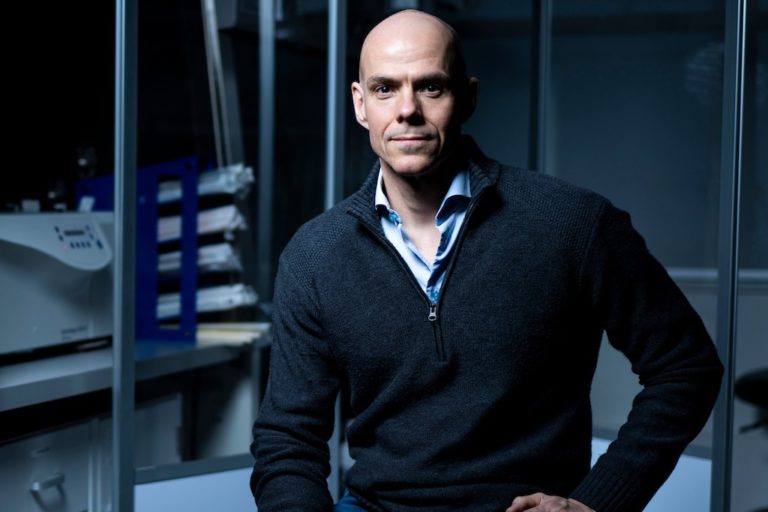
AbCellera CEO Carl Hansen speaks during a funding announcement in Vancouver in May 2023. Photo: The Canadian Press/Darryl Dyck
VANCOUVER — AbCellera, the Vancouver biotech behind a record-breaking initial public offering, is denying allegations of patent infringement and that its CEO breached an agreement with a now-deceased scientist whose estate claims he helped create the technology the company uses.
John William Schrader, who died in October 2019, did not co-invent the methods AbCellera uses to generate monoclonal antibodies or have an agreement with CEO Carl Hansen to commercialize a product together, according to a response filed earlier this month in the Supreme Court of B.C.
Talking Points
- AbCellera, a Vancouver-based biotech, is denying allegations of patent infringement, as well as claims that its chief executive breached an agreement with a scientist he once worked with
- The estate of John William Schrader filed a lawsuit in October claiming it suffered “damages and loss” as a result of AbCellera’s and CEO Carl Hansen’s actions
Hansen and a group of others founded AbCellera, an antibody drug discovery firm, in 2012 out of the University of British Columbia. It quickly became a Vancouver anchor firm, raising significant funding from investors and government, expanding its staff and its headquarters into a massive campus, and holding an IPO that raised hundreds of millions of dollars. As of the end of last year, it was working on dozens of research programs with 41 partners, including Eli Lilly, Moderna and Merck.
But a civil lawsuit filed in October alleged that none of that would be possible without the contributions of Schrader, a UBC professor who worked with Hansen but died after battling a neurodegenerative condition.
The suit filed by Schrader’s estate and his company, ImmVivos Pharmaceuticals, named AbCellera, Hansen and other related parties as defendants.
“Ultimately, Dr. Hansen refused to provide Dr. Schrader any equity in AbCellera and completely excluded Dr. Schrader from the business,” reads the notice of claim.
Related Articles

In 2006, Schrader filed for and later received a patent for a method of isolating cells and generating antibodies. The following year, according to the lawsuit, he and Hansen “formed a relationship to develop and commercialize a process for the rapid and inexpensive generation of high-value monoclonal antibodies,” which it said was a joint venture. The duo received a research grant and Schrader allowed Hansen and his lab to use methods from his patent, the claim said.
In 2011, the two had started to talk about incorporating and commercializing their product, the claim by Schrader’s estate said; their grant was extended and they applied for three more to help with their business plans.
But in 2012, Hansen incorporated AbCellera as its only director and shareholder without telling Schrader, according to the lawsuit. The two continued their partnership until June 2013, though Schrader discovered AbCellera’s existence that February. The claim alleged that Hansen acknowledged the two had agreed to split any future company in half and offered Schrader a five per cent stake over four years, but that Hansen withdrew the offer that August.
During that time, Schrader started experiencing difficulty speaking. He was diagnosed with primary progressive aphasia—a type of disease recently in the news after Hollywood actor Bruce Willis’s aphasia diagnosis—and by 2017 required full-time care. His wife Sabariah Schrader, who is the executor of his estate, inherited the patent, which she transferred to ImmVivos.
The lawsuit claimed Schrader and then his estate suffered “damages and loss” because Hansen breached their oral agreement, and that “AbCellera and/or its subsidiaries” have been generating or intending to generate monoclonal antibodies in a way that infringes on Schrader’s patent.
Hansen, as well as AbCellera and the other corporate defendants, denied the allegations in their response filed earlier this month.
According to AbCellera’s filing, Schrader “was not a co-founder or co-inventor of any of the technology used by AbCellera.” The response says Schrader’s “only ownership interest in AbCellera was reflected in his shareholdings,” though it doesn’t specify what stake he held or when he acquired it.
Schrader did not have an oral or written contract with Hansen, the response says, and the two did not “carry on a business with a common view to profit,” or talk about and agree to how such a business would be structured.
AbCellera also denies it or any of its subsidiaries have used Schrader’s patent or plan to do so, adding that they do not generate monoclonal antibodies in the patented method. Trianni, a company that AbCellera acquired in November 2020, uses intellectual property rights and licenses that it held before becoming part of AbCellera, the response adds.
According to AbCellera, Schrader’s patent is also invalid “for failing to meet the requirements of patentability.” (The patent was granted and issued to Schrader in 2017.) AbCellera argues, among other things, that the patent related to “unpatentable subject matter”; that its claims are “obvious in light of the common general knowledge” at the time it was filed; and that it claimed more than the inventor created.
Lawyers representing Schrader’s estate said they dispute the allegations in AbCellera’s response. “We are focused on advancing Dr. Schrader’s claim in the British Columbia courts,” said Robert Cooper, a partner and trial lawyer at Vancouver-based McEwan Partners, in an email to The Logic.
AbCellera’s lawyers declined to comment and the biotech’s spokesperson Tiffany Chiu said, “As a publicly traded company, we only comment on litigation through public releases and disclosures.”
In its most recent earnings report, the company described the claims as “meritless and frivolous,” assuring investors it would “defend itself appropriately.” Even so, it acknowledged the case could require it to pay damages or have other negative impacts should it lose the proceedings, and that the cost of litigation could be substantial.



Loading...
Thanks for sharing!
You have shared 5 articles this month and reached the maximum amount of shares available.
CloseThis account has reached its share limit.
If you would like to purchase a sharing license please contact The Logic support at [email protected].
CloseGift the full article!
You have gifted 0 article(s) this month and have 5 remaining.
Recipients will be able to read the full text of the article after submitting their email address. They will not have access to other articles or subscriber benefits.
Photo: The Canadian Press/Darryl Dyck
Most Popular This Week




In-depth, agenda-setting reporting
Great journalism delivered straight to your inbox.
Commentary
Carmichael: Being boxed in will help Canada focus on what matters
Briefing
Rio Tinto gets nearly $165M in additional federal funds for Quebec aluminum
U.S. to lift tariffs on some Canadian products crucial to Maine: Collins
Carney warns of tech dependence after Starlink disruptions in Ukraine
Best business newsletter in Canada
Get up to speed in minutes with insights and analysis on the most important stories of the day, every weekday.
Exclusive events
See the bigger picture with reporters and industry experts in subscriber-exclusive events.
Membership in The Logic Council
Membership provides access to our popular Slack channel, participation in subscriber surveys and invitations to exclusive events with our journalists and special guests.






