Listen Now
0:00
From the uplands to the plains, Alberta’s landscape could soon be pockmarked with hulking, power-hungry data centres. Cloud firm Denvr’s original Calgary facility, by contrast, already packs a lot of AI ambition into something more like a portacabin.
Physical form isn’t the only way Denvr is different from the many other players trying to capitalize on the AI boom. The firm is also taking a distinct approach to how it sets up AI infrastructure, to what services it sells and to which customers it courts.
Talking Points
- Neocloud Denvr is taking a different approach to the AI boom than the big-money buildouts of data centres underway across Canada and the world
- The Calgary-based firm builds and operates its own AI infrastructure, then adds models and other services to make it easier for developers to create and sell AI applications. Denvr hopes to create its own market, scaling up its compute capacity as customer demand grows.
“Everyone thinks, ‘Let’s go build a big data centre,’” said Denvr co-CEO Geoff Gordon. His firm instead wants to help build an ecosystem of Canadian AI companies by making it easier for them to develop new applications, then grow alongside them. Denvr also hopes to tap into increasing interest in digital sovereignty, as the public and private sectors pay closer attention to where AI and data live, and who has control.
While big names and big-money investors have flooded into the data centre field, Calgary-headquartered Denvr has serious experience and, it hopes, strategic advantages when it comes to the business of powering AI. Its senior leaders helped develop the so-called hyperscale model that turned the cloud divisions of U.S. tech giants into the backbone of the software industry. Denvr is now using lessons learned from that work, and the money it’s made setting up compute capacity for others, to build something different for itself.
Related Articles


Instead of just building data centres or selling processing power, the firm has set out to be a one-stop enabler of AI, adding software, models and services on top of digital infrastructure. Denvr is also focusing on Canada, which has largely failed to turn its AI research strengths into commercial successes and where businesses have traditionally been slow to adopt new technologies.
Rather than wait around for that to change, Denvr aims to help create the market for its services. “We’re confident we can scale,” Gordon said.
Before Denvr, there was Silent-Aire.
Founded in Edmonton in March 1994, the firm manufactured heating, ventilation and air conditioning (HVAC) systems. In the early 2000s, in the aftermath of the dot-com boom, brothers and former junior hockey players Dan and Lindsey Leckelt switched Silent-Aire from cooling human-occupied commercial and industrial buildings to hardware-filled data centres. Then things really took off.
In March 2006, Amazon started letting web developers store and run their data on the same digital infrastructure that powered its e-commerce sites. Amazon Web Services (AWS) became the first hyperscaler. Google and Microsoft followed, renting out processing power to other businesses to run popular social platforms and applications.
As demand grew, cloud services needed to add new compute, fast. In response, tech giants started to standardize how they constructed, cooled and powered the data centres themselves, the chips and equipment that filled them, as well as the code that let clients use the hardware. They built scores of the facilities around the U.S., and the world.
Silent-Aire’s ACs helped cool a lot of them. The firm also developed modular data centres, factory-assembling electrical, mechanical and temperature-control systems into movable containers that clients could string together and plug in wherever they needed. “We were able to scale as required,” said former co-CEO Dan Leckelt—an approach also embraced at Denvr, where he and a handful of other key Silent-Aire executives are now helping the company scale.
As the hyperscalers expanded into Europe and then Asia, Silent-Aire followed. By April 2021, it was on track for about US$650 million in annual revenue, with about 3,000 employees and offices in Canada, the U.S. and Ireland. That month, Johnson Controls, the Cork-based HVAC giant, announced it would buy Silent-Aire for up to US$870 million in cash. The division still manufactures in Alberta and employs hundreds of people in the province directly, per LinkedIn data.
Meanwhile, Denvr was getting into AI infrastructure. Gordon had previously started a fintech firm selling payment processing services. In mid-2017, he founded Denvr, initially collaborating with bank-technology executive Kyle McCrindle on a financial markets trading platform. “It was just fun, and we put some money into it,” Gordon said.
The duo built AI into the system, which meant they needed access to expensive, specialized chips. “We started thinking about some clever ways to cool them in really high density,” Gordon said. “And one thing led to another.”
Gordon knew some of Silent-Aire’s executives via a shared love of hockey, and began to run Denvr’s designs past them. By September 2022, he and CTO McCrindle had assembled a new machine filled with Nvidia servers to run the trading tool. “We didn’t understand generative AI, because ChatGPT hadn’t dropped yet,” Gordon said. That November, OpenAI released its chatbot, upending the tech industry, driving huge demand for compute and changing Denvr’s trajectory.
Gordon and McCrindle realized that what they’d built for AI-driven trading would transfer well to generative tools. Denvr had already figured out how to operate clusters of hundreds of connected chips, and to add the code that lets them run applications and models. So the firm pivoted.
Denvr began by setting up AI infrastructure for upstart cloud providers in the U.S. Starting in 2023, the firm built over US$1 billion of compute capacity for its clients, putting US$125 million onto its own books in the process, according to Gordon.
As Denvr was pivoting, money started flooding into the infrastructure, with existing data centre operators, institutional investors, cryptocurrency miners and even the odd rich guy all proposing vast new projects to meet the anticipated surge in demand. Denvr could have joined that global race to build as big as possible, competing for the business of hyperscalers or leading labs like OpenAI. That approach, though, is “tremendously risky,” Gordon said.
Instead, Denvr decided to focus on Canada, and on making itself as useful as possible to clients building applications for the AI era.
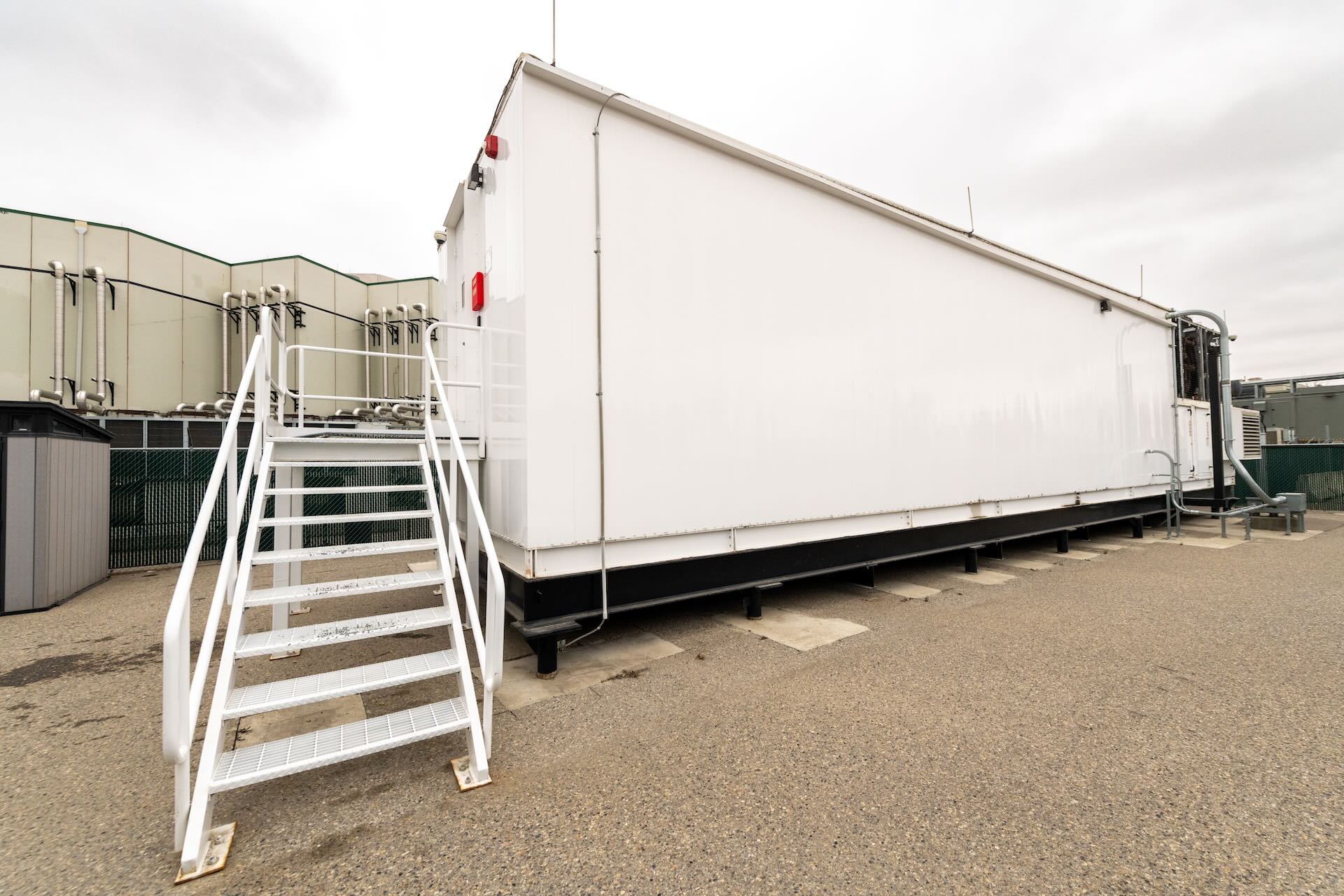
Denvr hopes to carve out a lucrative space for itself in the AI boom.
The biggest companies in the field are the hyperscalers—the likes of Amazon, Google and Microsoft—who commission and run their own data centre campuses. They use chips developed in-house, or bought from the likes of Nvidia. They sell a wide range of services, including storage, processing power and access to AI models that developers can just plug into their applications.
Data centre firms like U.S. giant Equinix or Montreal’s eStruxture, meanwhile, typically operate on a so-called colocation model, renting space inside their facilities to clients that insert their own servers. Customers include hyperscalers, other cloud services and large businesses. Neoclouds like CoreWeave and Nscale run Nvidia’s chips, often in colocation data centres, and primarily sell the processing power they generate to hyperscalers and other tech firms.
Denvr doesn’t neatly fit any of those categories. It claims to be more cooperative and flexible with customers than the hyperscalers. It’s also nowhere near as large. It’s not a colocation provider either, instead building and owning its own data centres.
Denvr also claims it’s not like other neoclouds. Many such firms are “relying on customers to take raw compute, and then figure the rest out themselves,” according to Gordon. Instead, Denvr’s systems are designed to let clients easily develop and run applications atop them. “We’re building this holistic AI stack that can close that gap significantly,” he said.
The firm claims it’s found efficiencies and performance improvements across that stack, from the software it serves clients all the way back to the front doors of its data centres.
Underneath applications like AI agents and chatbots is a bunch of code, including large language models, datasets and rule books that shape what the systems know and can do. Denvr’s flagship Canada AI Platform (CAIP)—which combines its hardware, software and cloud—provides all of that for clients that don’t want the hassle of setting it all up themselves.
Banking engineer Kris Hansen used Denvr’s stack to build and run Comanda, an open-source system of AI agents originally designed to automate repetitive tasks like analyzing financial and company data for investment opportunities. At the time, Hansen was working as the CTO at asset manager Sagard, which was trying to accelerate the adoption of AI within its own walls and at its portfolio firms. Deal makers could use Comanda via Denvr’s cloud, adapting the agents to their own needs and sharing them with others.
Denvr’s compute was cheaper than buying capacity from the hyperscalers, Hansen said. The firm also gave him technical tools he would otherwise have had to build himself. That included useful data, memory features and shortcuts that reduce the cost of running the system. “If you have context, agents are powerful and intelligent,” Hansen said. Without it, “they can be moronic.”
Today, Hansen is a founding engineer at Erebor, a bank that Anduril founder Palmer Luckey started to serve tech firms. Other Erebor staff are now exploring using Denvr’s services to power some of their software development work.
Underneath all that code is physical AI infrastructure. Like Silent-Aire, from which it has recruited several executives to help it scale, Denvr has developed modular designs for its data centres. The Calgary firm can build clusters as small as one to five megawatts and then add more as demand increases.
Denvr buys components for its power, cooling and networking systems from external suppliers, then puts them together according to its own designs. It’s easier now to find good gear than in the early Silent-Aire days, partly because equipment manufacturers previously focused on the oil and gas sector have pivoted to sell to compute facilities, said former Silent-Aire co-CEO Leckelt, who’s now Denvr’s co-CEO. “Everybody wants to be in this data-centre business.”
Alberta’s energy and mining industries have trained lots of electricians, plumbers and other tradespeople who can also work on data centres, said Marc Kronewitt, Denvr’s executive officer for business development, and another Silent-Aire alumnus.
Denvr claims its equipment design makes its facilities significantly more energy efficient than the massive ones proposed around Canada, and uses very little water. Its liquid-based method for cooling hardware also lets it pack more gear into the same space. All that means Denvr doesn’t need the large parcels of land and dedicated power plants of some data-centre megaprojects.
While the CAIP is Denvr’s big play, it can also set up and manage a private version for select clients, either in its data centres or in customers’ locations. Amii, the Edmonton-based national AI institute, has been exploring working with the firm on its compute needs, said Amii CEO Cam Linke. “Working with awesome Canadian providers is the way we should be doing these things.”

Some 530-odd kilometres northwest of Denvr’s Calgary data centre sits a project that seems like the antithesis of its approach: Kevin O’Leary’s Wonder Valley.
Announced in December 2024, the proposed colocation campus in Greenview, Alta. was supposed to open next year, grow to 7.5 gigawatts of capacity and attract a hyperscaler as its anchor tenant. Touted as the world’s largest data centre, Wonder Valley is perhaps the best-known example of the Field of Dreams strategy that many firms are taking to AI infrastructure—a bet that if you build it, customers will come.
Tech firms are snapping up as much compute as they can get right now, so all this new data centre capacity is likely to be filled eventually. Still, Denvr—where annual recurring revenue currently tops US$10 million, per Gordon—is using a different strategy. The firm is trying to help create demand instead of waiting for it to come, and only adding capacity if it will be used.
As a result, Denvr is pushing its cloud services to researchers and developers piloting AI solutions or doing R&D, Gordon said. “They’re noodling.” That experimentation could eventually yield widely-used applications, although for now it’s quite small-scale.
Denvr is also forming alliances of startups, incubators and other organizations in different sectors that can use its platform and also develop technology together. The CAIP Defence Coalition, announced last week, currently includes Dominion Dynamics and Sapper Labs, two Ottawa-based firms looking to sell to the Canadian Armed Forces.
For those partners, as well as potential corporate and government customers, Denvr’s homegrown credentials are a significant selling point. “We’re 100 per cent Canadian,” Gordon said—the firm’s ownership and leadership team are wholly domestic.
Denvr also engineers and builds in Canada, and delivers its services via the cloud and national networks, said Kronewitt. “If you are a native AI company in Canada, you don’t actually have to cross the border—your data stays here.”
Government and business leaders have expressed concern about securing Canada’s digital sovereignty amid geopolitical tensions and Washington’s quest for technological dominance in AI and beyond. While U.S. tech firms promise to safeguard Canadian data and control, there’s increasing interest in homegrown providers for critical AI applications. The federal and Alberta governments have signalled they want to buy sovereign compute for their own needs—contracts for which Denvr plans to compete.
Businesses also increasingly care about sovereignty. Ottawa-based Tidal Point is exploring working with Denvr to fill a small but critical gap in its Canadian armour. Founded in July 2024, Tidal Point develops AI agents that help financial services firms automatically analyze cybersecurity risks and document their compliance with regulatory requirements.
The startup’s system currently uses commercially-available AI models. User queries first pass through an algorithm called a reranker, which looks at all the information that’s going to the model and prioritizes it to produce a better answer. While clients can choose to run the AI models in hyperscalers’ Canadian data centres, the tech giants only operate rerankers out of the U.S., according to Tidal Point CTO David Whyte. That means an American entity subject to U.S. law is touching the data, adding more compliance work for customers.
Tidal Point is in talks with Denvr about running an open-source reranker on its Canadian infrastructure, said Whyte, a former executive at the Communications Security Establishment. He hopes Denvr will eventually offer more cutting-edge models so that Tidal Point can run its AI application entirely at home. “When someone asks us, ‘Where does my data go?’ I want to be able to say, ‘It never leaves Canada,’” he said.
Denvr hopes international customers will want that, too. “Canada is seen as a trusted partner,” said Kronewitt, adding that firms in Europe and Asia—where power is in shorter supply—are considering running some AI applications from and in Canada. Denvr can scale, both at home and abroad, by turning Canadian power, infrastructure and software into AI services, Kronewitt said. “The ones and zeros get exported to the rest of the world.”
Denvr may not be building massive data centres today, but it still needs money to fund its ambitions.
The firm has set up about US$100 million of its own AI infrastructure so far. Denvr has raised just US$12.5 million in equity capital to date, largely financing itself from the profits of previous work, according to Gordon. He said the firm will look to raise more equity funding, and can draw on substantial debt financing if the right expansion opportunity arises.
Denvr will start adding new AI infrastructure later this year to serve defence, health and other sovereignty-focused sectors. The firm has dibs on two Alberta sites with a combined capacity of almost one gigawatt, though it won’t use all of that at once, and clients might ask it to expand in other provinces instead.
Gordon won’t build unless he’s sure there’s demand, but he’s also sure it’ll come. AI is “still very profound,” he said. “It’s taking the world time to figure out how to create value with it.” When it does, Denvr plans to be ready.