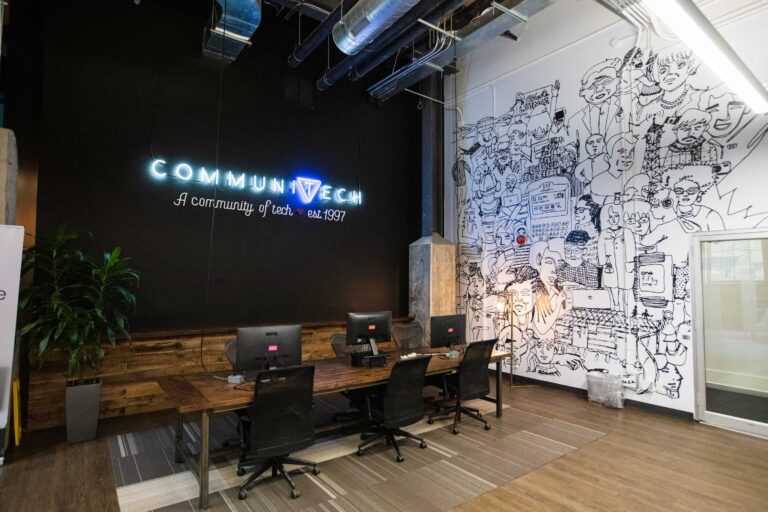
Communitech, one of Canada’s biggest startup hubs, is poised to beef up its board of directors with a slate of local tech executives, amid criticism that its support of the startup community in its base of Waterloo, Ont., has wavered in recent years.
Skip to content


News
Communitech beefs up its board to build bridges with local founders
CEOs of Magnet Forensics and the Accelerator Centre are among the incoming directors at the Waterloo, Ont.-based startup hub
Communitech’s office at the Tannery Building in Kitchener, in June 2023. Photo: Nick Lachance for The Logic
Communitech, one of Canada’s biggest startup hubs, is poised to beef up its board of directors with a slate of local tech executives, amid criticism that its support of the startup community in its base of Waterloo, Ont., has wavered in recent years.
Talking Points
- Communitech has nominated four new directors to its board, three of whom are CEOs from the Kitchener-Waterloo tech community
- The appointments would increase the representation of tech executives at the organization, which has struggled to serve local entrepreneurs in recent years
Adam Belsher, CEO of cybersecurity firm Magnet Forensics, is up for nomination at Communitech’s annual general meeting scheduled for later today, along with Hongwei Liu, CEO and founder of MappedIn, and Ruth Casselman, CEO of the Accelerator Centre. Iain Stewart, who retired from his role as president of the National Research Council of Canada in December, is also nominated for a board seat.
The new appointees—which Communitech members still need to approve—would increase the representation of tech executives at the organization, which has struggled to serve local entrepreneurs in recent years.
Communitech experienced high employee turnover and a drop in membership after the COVID-19 pandemic, and an increased reliance on government money to operate. CEO Chris Albinson, who took the helm in 2021 after returning to Canada from Silicon Valley, introduced a new strategy to bet on tech winners across the country, including through a $200-million-plus venture capital fund. But the approach alienated some in the community and the fund has fallen short of its financial targets.
Related Articles

“A lot has changed in all workplaces over the past four years,” said Casselman, a board nominee who works with early stage firms both as head of the Accelerator Centre—another startup support hub in Waterloo—and as chair of the Golden Triangle Angel Network. “I think it’s realistic that the needs of founders would have evolved, and as an ecosystem, we need to continue to evolve to meet those needs,” she said. “That’s probably a good reason why Communitech has expanded some of the voices on its board to ensure that all voices are heard across the ecosystem.”
Before the latest nominations, almost half of the people on Communitech’s 12-person board were from tech startups and scaleups. The others were from large corporations, including Deloitte, Interac, Manulife and Postmedia. The four incoming directors would bring the board to 16 people, the maximum Communitech is allowed under its bylaw.
Benjamin Bergen, president of the Council for Canadian Innovators, said he’s encouraged by the board nominees. He said it shows Communitech may be responding to Ontario expert panel recommendations that called on the province’s regional innovation centres to improve their governance to better serve innovative companies.
“I’ve also heard from leaders in the Kitchener-Waterloo tech community that they hope to see this important institution return to its roots—helping local entrepreneurs commercialize and drive growth,” said Bergen, who recently helped CCI launch Waterloo Inc., a community platform for entrepreneurs in town. “Communitech will benefit from adding expertise of tech CEOs, who are best positioned to understand the operator’s perspective on driving growth in the digital economy,” he said.
Communitech isn’t alone in facing questions about the value it creates for entrepreneurs and the broader economy out of taxpayer dollars. A recent report from the department of Innovation, Science and Economic Development and Statistics Canada found that startups that participated in accelerators and incubators scarcely earned more revenue than other firms, and any advantage they did have was short-lived.
That lack of measurable impact is seemingly having an effect on other accelerators and incubators. At MaRS, an accelerator in downtown Toronto, new CEO Alison Nankivell cut about 20 positions in June, including several senior roles, in a bid to reset the business model “toward a more agile and lean organizational structure.”
Casselman, the only nominee who agreed to speak with The Logic on the record, said she hopes her position on the board can help establish some coordination between Communitech and the Accelerator Centre, so that the organizations aren’t duplicating support or leaving gaps for founders. “My goal across the board is to ensure that the tech ecosystem continues to be very well aligned,” she said, “and very focused on serving the needs of founders.”



Loading...
Thanks for sharing!
You have shared 5 articles this month and reached the maximum amount of shares available.
CloseThis account has reached its share limit.
If you would like to purchase a sharing license please contact The Logic support at [email protected].
CloseGift the full article!
You have gifted 0 article(s) this month and have 5 remaining.
Recipients will be able to read the full text of the article after submitting their email address. They will not have access to other articles or subscriber benefits.
Photo: Nick Lachance for The Logic
Most Popular This Week




In-depth, agenda-setting reporting
Great journalism delivered straight to your inbox.
Analysis
Carney’s $500B investment claim requires some generous math
Briefing
Loblaw is adding AI monitoring to its distribution centres
Calgary startup turning industrial waste heat to power closes $138M funding round
Portage closes US$600M fund focusing on fintech
Best business newsletter in Canada
Get up to speed in minutes with insights and analysis on the most important stories of the day, every weekday.
Exclusive events
See the bigger picture with reporters and industry experts in subscriber-exclusive events.
Membership in The Logic Council
Membership provides access to our popular Slack channel, participation in subscriber surveys and invitations to exclusive events with our journalists and special guests.