WINDSOR, Ont. — The mood at the Factory House was friendly but quiet—even for a Monday night in winter—as diners at the sports bar off Ford Boulevard digested the day’s news.
Skip to content
 Shane Potvin, chair of the Ford City Business Improvement Association. Photo: Anita Balakrishnan for The Logic

The Big Read
Canada’s carmaking capital is staring down a tariff apocalypse
Trump’s reprieve was met with exhausted relief in Windsor, Ont.—but few places wait in greater dread for what comes next
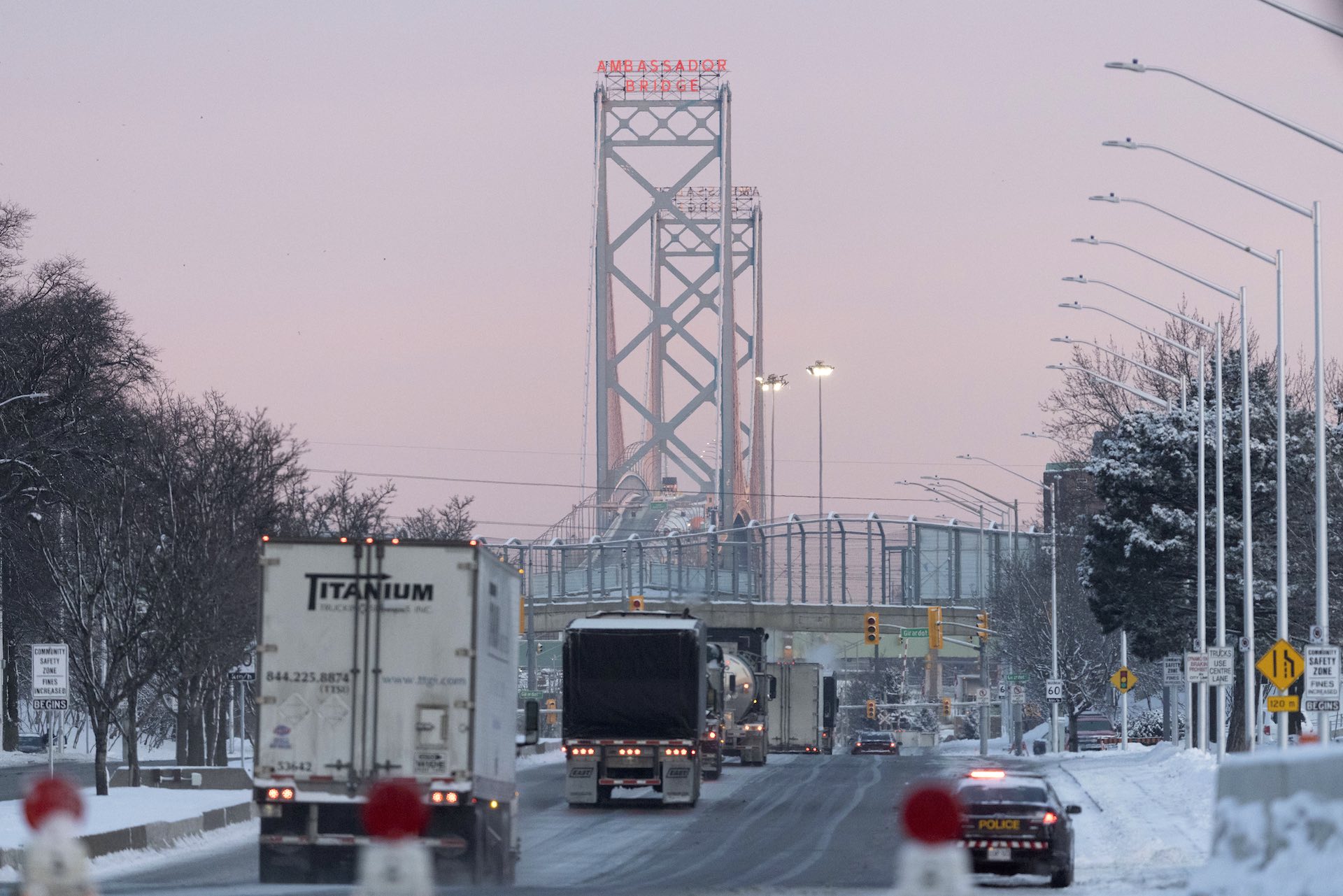
Traffic heading toward the U.S. over the Ambassador Bridge, a key link between the automaking centres of Windsor, Ont., and Detroit. Photo: The Canadian Press/Nicole Osborne
WINDSOR, Ont. — The mood at the Factory House was friendly but quiet—even for a Monday night in winter—as diners at the sports bar off Ford Boulevard digested the day’s news.
In the hours after U.S. President Donald Trump hit pause on his North American trade war, chatter in the bar near the Stellantis Canada auto plant included the occasional exclamation: Did you hear the tariffs aren’t coming today? But conversations quickly gave way to the unspoken thought that follows a near miss: What if he comes at us again?
Talking Points
- For a region like Windsor-Essex—where about 42,000 of 468,000 residents work in manufacturing—the potential catastrophe of an auto-sector shutdown is never far from mind
- The impact of 25 per cent tariffs on goods crossing the U.S. border could have greater impact on the industry than the shutdown during the COVID-19 pandemic, says one union leader
Ryan Donally, CEO of the Windsor-Essex Regional Chamber of Commerce, turns to a fight analogy to describe the prevailing outlook in a city long considered Canada’s automaking capital: “Perhaps we never took that blow. Maybe we’re not bleeding right now,” he says, adding: “We are potentially about to get hurt. So we must change our course of action. We must be mindful that the risk of injury is coming.”
Few places in Canada took as much solace as Windsor in the 30-day delay on tariffs that Trump agreed to on Monday, in return for commitments by Ottawa to step up efforts to prevent fentanyl and migrants from entering the United States. Yet few wait in greater dread for what comes next.
If the president goes ahead on March 5 with the blanket 25 per cent tariffs he’s threatened, the auto manufacturing industry that sustains the city would shut down within a week, industry leaders have warned. For the region of Windsor-Essex, whose industries are interwoven with the U.S. carmaking epicentre next door in Michigan, the effect would be crushing, says Donally. Some 42,000 of the region’s 468,000 people work in manufacturing.
Related Articles


As the hours ticked down on Monday to Trump’s decision, Donally gathered an emergency task force of business leaders ready to, in his words, “stop the bleeding” they expected from tariffs. Even with the one-month reprieve, Donally says, his task force has no intention of slowing down.
That’s because the impacts of an auto-sector shutdown are never far from the minds of Windsor residents, who had front-row seats to the economic havoc in Detroit during the 2009 recession, and experienced its collateral effects. Shane Potvin, chair of the Ford City Business Improvement Association, has led efforts to revitalize a business district that emptied in the wake of the closure of a nearby Ford plant decades ago. That’s something he said his organization has been working to repair.
“It’s a car town,” he says. “The building around the corner from my building was the location of the first union in Canada.”
Both Potvin and Donally point to the multiplier effect that good industrial jobs have on the rest of the community: unemployed workers don’t have benefits to go to local massage clinics, or wages to spend at local coffee shops. Auto-parts makers who close down don’t hire accountants to help manage their businesses, or trucking companies to move their products. By some estimates, five to eight jobs in other industries rely indirectly on each auto worker.
Emile Nabbout, president of Unifor Local 195, represents dozens of auto-parts and manufacturing workplaces. Since the tariffs were announced, there has been a unity between company and union leaders that would previously have been “beyond comprehension,” he says.
“There is quite a possibility that production will come to a complete stop. That will go beyond the devastation we faced during the COVID-19 pandemic shutdown.”
Trump’s purported reason for invoking emergency tariff powers—that Canada has done too little to stop fentanyl from entering the U.S.—is bewildering to a population with first-hand knowledge of how the border works, Nabbout adds. They know, for instance, that it is the U.S. border patrol, not Canadian border services, that searches vehicles for drugs like fentanyl as the cars enter the United States.
As a result, many here suspect that fentanyl is a pretext. And if tariffs are coming regardless of Canada’s actions, the question is how to prepare.
“Perhaps we never took that blow. Maybe we’re not bleeding right now. We are potentially about to get hurt. So we must change our course of action. We must be mindful that the risk of injury is coming.”
In the rest of Canada, business and political leaders have spoken of improving interprovincial trade, and expanding into new markets. For companies in a car town whose complex, highly integrated industry largely serves U.S. buyers, that talk brings little comfort. The idea they would send, say, a car door overseas just to spray on a coat of paint seems far-fetched when they’ve been getting the job done across the river in Detroit. The U.S. city’s towers loom so close that, as Donally puts it, you could hit General Motors’ offices “with a golf ball.”
You might expect that companies could simply move more parts across the border ahead of time to front-run the tariffs. By and large, though, the data suggest that didn’t happen, says Jackson Wood, who works in global trade intelligence in the logistics firm Descartes. That’s especially true of the auto sector, because each auto part has to be modified by multiple companies before it can go into a final product. Any manufacturer able to simplify that process will have done so during the previous supply-chain shocks of the past five years, Wood says.
In other words: there is no fat to cut here, and no Plan B that companies haven’t already enacted.
Donally worries that, if anything, focusing on interprovincial and overseas trade would leave Windsor farther from the economic action. The city is just a day’s drive from about 200 million consumers, but those potential buyers are nearly all Americans, in an expanse stretching from Illinois to Tennessee. From Windsor’s location at the furthest reach of southwestern Ontario, it takes nearly as long to get goods to Quebec.
Potvin, of the Ford City BIA, sees the recent surge of Canadian pride and the push to buy local as a much-needed course correction from the pandemic-fueled shift to e-commerce giants. But people remain nervous, he says.
Regardless of what happens over the next 30 days, Nabbout says, the union will keep pushing for worker protections and improvements to supports like employment insurance, while Windsorites look for new ways to fend off the disaster Trump is holding over them.
“We are committed to continue fighting,” he says. “There are a lot of things we haven’t put on the table, and hopefully Donald Trump is going to realize that.”



Loading...
Thanks for sharing!
You have shared 5 articles this month and reached the maximum amount of shares available.
CloseThis account has reached its share limit.
If you would like to purchase a sharing license please contact The Logic support at [email protected].
CloseGift the full article!
You have gifted 0 article(s) this month and have 5 remaining.
Recipients will be able to read the full text of the article after submitting their email address. They will not have access to other articles or subscriber benefits.
Photo: The Canadian Press/Nicole Osborne
Shane Potvin, chair of the Ford City Business Improvement Association.
Most Popular This Week




In-depth, agenda-setting reporting
Great journalism delivered straight to your inbox.
News
Canada faces a satellite-launch crunch as SpaceX retires its workhorse rocket
Briefing
Rio Tinto gets nearly $165M in additional federal funds for Quebec aluminum
U.S. to lift tariffs on some Canadian products crucial to Maine: Collins
Carney warns of tech dependence after Starlink disruptions in Ukraine
Best business newsletter in Canada
Get up to speed in minutes with insights and analysis on the most important stories of the day, every weekday.
Exclusive events
See the bigger picture with reporters and industry experts in subscriber-exclusive events.
Membership in The Logic Council
Membership provides access to our popular Slack channel, participation in subscriber surveys and invitations to exclusive events with our journalists and special guests.






