Voice actor John Q. Kubin dreams of a future where he doesn’t have to record for clients himself yet continues to earn income because a synthetic, neural-network trained clone of his voice keeps working.
“That’d be the most majestic exit from voiceover,” he says.
It’s why the 14-year voiceover veteran—with his gritty, deep voice that commands your attention for truck and whiskey commercials—jumped on Voices.com’s new AI Studio initiative as soon as he could. Even though it was a pilot and many voice talents are wary of artificial intelligence, Kubin recognized the use of AI-cloned voices could be appealing for some clients.
Talking Points
- Founded in 2005 by David and Stephanie Ciccarelli, Voices.com claims to be the top marketplace for voiceover talent online. Now under new CEO Jay O’Connor, the software firm in London, Ont., is pushing ahead with a new AI-powered strategy that puts its voice talents in control of their own voice clones
- As with other creative work, generative AI is causing friction between voice over actors and production studios. That’s boiled over into a strike between union SAG-AFTRA and video game publishers that hinges on worker’s rights relating to AI and remains unresolved
“From the client standpoint, they are going to come to the site for the first time and go, ‘I don’t want to look through a thousand people,’” he says. “I’m obviously here for a reason to do something faster and easier and cheaper.”
Kubin is one of the top featured talents on Voices.com, a London, Ont.-based software company and self-described “world’s #1 voice marketplace.” Founded in 2005 by previous CEO David Ciccarelli and his wife, Stephanie, Voices.com provides companies—including advertisers, media and entertainment businesses—access to more than four million voice actors around the world. Last year, the company named Jay O’Connor as interim CEO, and recently made the move permanent. While Ciccarelli remains on the company’s board, O’Connor is forging ahead with a new AI-powered strategy.
Now that Kubin is one of the options on Voices.com’s AI Studio, which launched in June, clients can hear what Kubin sounds like reading a script without the need for him to record a demo by using Voices.com’s text-to-speech technology.
While projections show that generative AI will create a bigger, more valuable market, voice actors worry about being replaced and are seeking labour protections. Talent and the production industry are embroiled in an ongoing strike over the details of how and when AI can be trained by a performer, or used to do the job in place of a human.
But O’Connor sees a new frontier that he needs to lead. “We believe that AI simultaneously poses both a threat and a massive opportunity for voice actors and for the industry as a whole,” he says. While some low-cost use cases for voiceovers may go to synthetic voices, such as rough cuts of commercials and social media ads for small businesses, the number of use cases for actors to participate in is expanding.
A Market.us report on the AI voice-generator market forecasts that the sector will rise 15.6 per cent annually from 2023 to 2033, reaching a projected total value of US$2 billion in 2025 and US$6.4 billion by 2033. Demand for the service is expected to grow in the advertising and media industry, but also in the health-care, manufacturing, retail, and automotive and transportation sectors.
AI Studio is just the beginning of Voices.com’s multi-pronged AI strategy. It’s now developing real-time voice clones via an API to generate voice content for scenarios like interactive training or personalized health-care delivery. Voices.com is also curating ethically sourced datasets of audio and video content to sell to tech clients that want to train their own AI models.
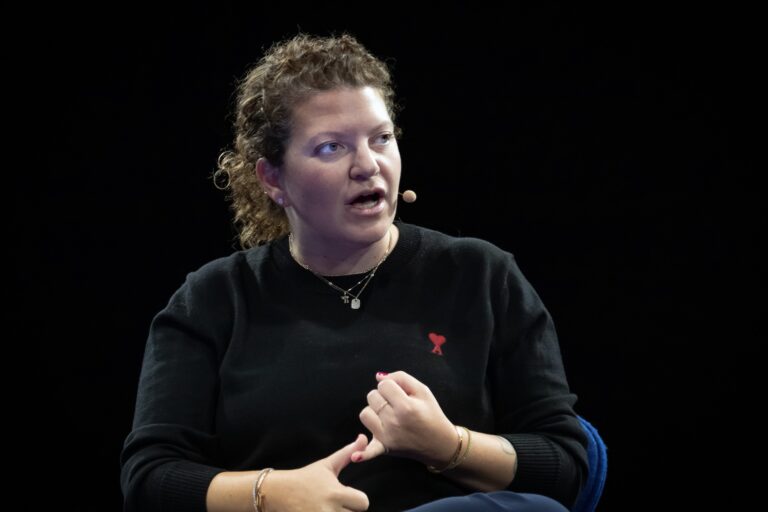
Voices.com CEO Jay O’Connor. Photo: Voices.com | Handout
Generative AI’s capability to deliver tailored human-like content is spurring an ethical dilemma across all creative industries—voice work included—with the bottom line being the threat of replacing human actors with AI. If production studios can take their recorded work and train AI to generate new content, why would they bother hiring humans at all?
To prevent such a scenario, industry associations and unions representing voice actors are pushing for an ethical standard for contracts between talent and employers that respect the three Cs: consent, compensation and control. The National Association for Voice Actors trumpets the slogan as part of its #fAIrVoices campaign, which includes a pledge by Voices.com and four other online voiceover casting companies to never use performers’ audio files for training AI without their consent.
On Voices.com, actors stay in control of their voice clones and manage contracts just as they would if they were directly hired. Clients can type in text to be generated as a demo through AI Studio. Actors set their rates and are paid when their voice clone generates audio, and Voices.com takes a portion for facilitating the transaction. Taking the ethical approach pays, O’Connor says—not only for Voices.com’s own trained models, but for the AI training datasets they sell.
“We have to avoid the circumstance where it’s the sea witch and you’ve sold your voice forever.”
“We have overnight become one of the top couple of players in the world for providing AI training datasets for voice and video,” O’Connor says, adding that they provide datasets to some of the biggest tech companies in the world. The datasets are created by hiring actors for the purpose of training AI models.
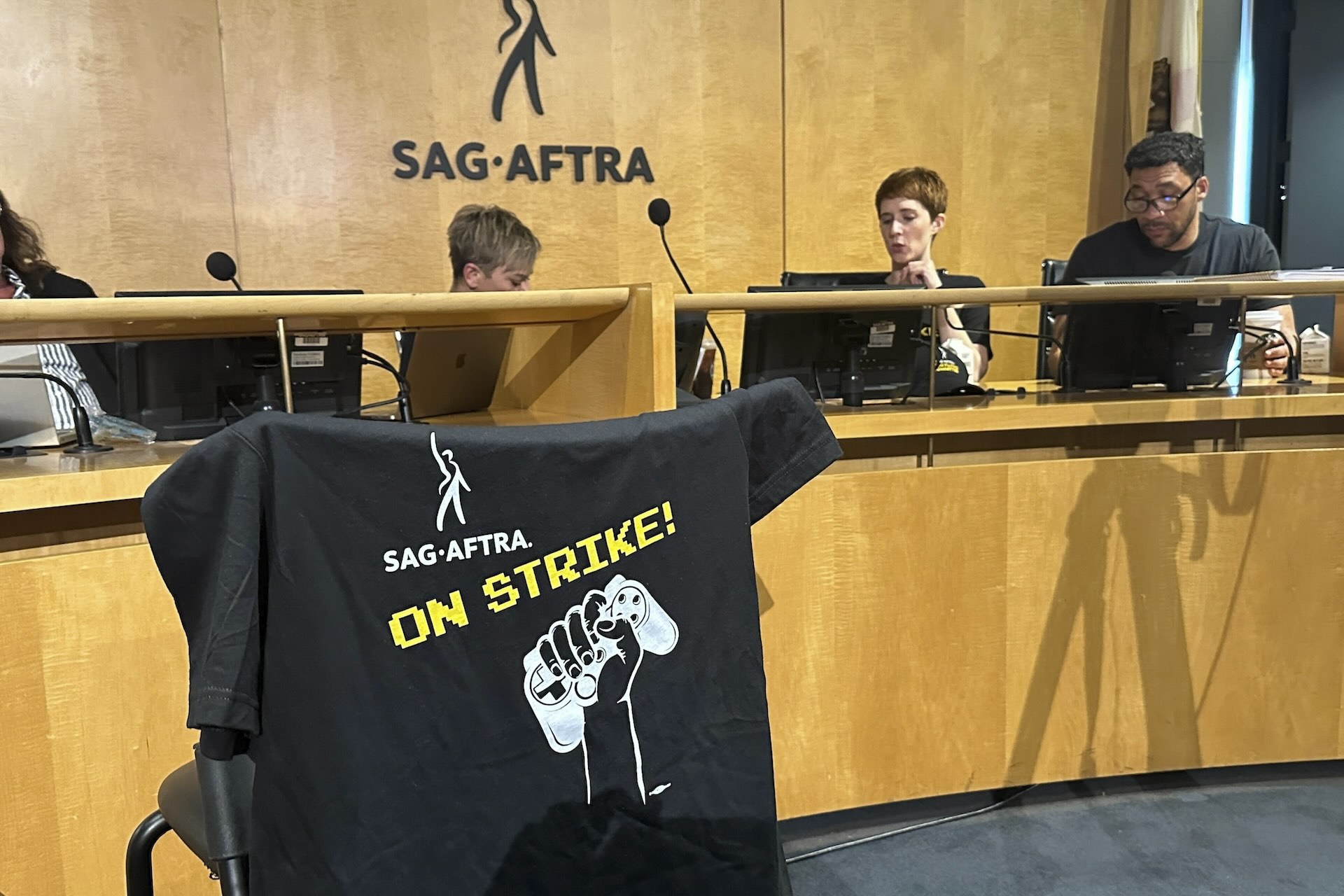
Many contractual rights are yet to be settled in the industry at large. In the U.S., an ongoing strike between video game publishers and union SAG-AFTRA hinges on a dispute over AI. SAG-AFTRA is seeking protections for both voiceover and movement performers in an agreement that would include an actor’s informed consent for the creation of a voice clone and contractual limits on its use.
“We have to avoid the circumstance where it’s the sea witch and you’ve sold your voice forever,” says Ray Rodriguez, chief contracts officer of SAG-AFTRA, referencing the dark bargain at the heart of Disney’s The Little Mermaid.
SAG-AFTRA members at a news conference at the union’s headquarters in Los Angeles on July 25, 2024. Photo: AP Photo/Eugene Garcia
Video game publishers are asking for exceptions to those protections, such as using voice clones in scenarios where a voice is not recognizable. Since voice actors often perform as characters, that’s a no-go for the union, Rodriguez explains.
SAG-AFTRA also wants actors to receive compensation if their name is typed as a prompt for an AI generator.
Voice actor Jay Myers had an early opportunity to create an AI voice clone via Voices.com in 2021. A client hired Myers to create an AI voice assistant that would be embedded in their product. Myers thought, “I fit this really darn well,” but he was cautious in setting up his contract. He consulted several agencies and spoke with SAG-AFTRA, and says that Voices.com took care to ensure clear limitations on the use of the voice clone.
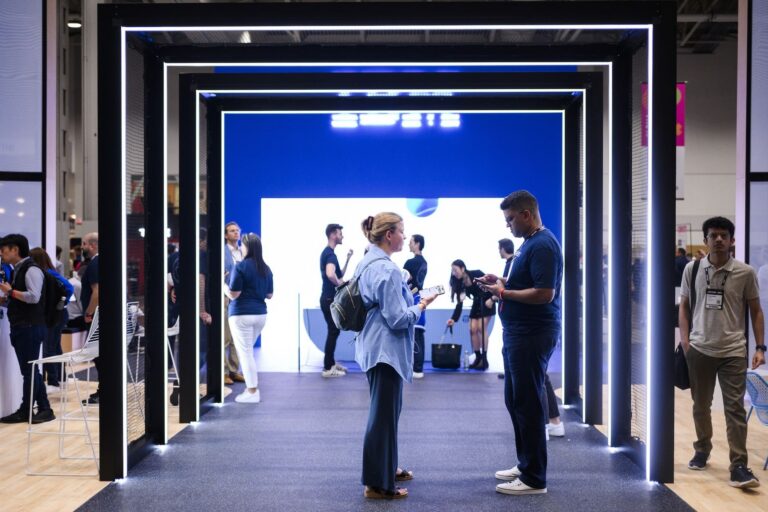
A Market.us report on the AI voice-generator market forecasts that the sector will rise 15.6 per cent annually from 2023 to 2033, reaching a projected total value of US$2 billion in 2025 and US$6.4 billion by 2033. Photo: Voices.com | Handout
It was a great experience, Myers says, but he’s not sure if he’ll ever make another clone. He spent 60 hours recording various phonetic combinations to train it and was presented with the finished product about six months later. While impressed with its quality, he still felt there was an uncanny valley effect.
“My gut with it is there’s just a lot of things that AI, no matter how good it gets, will simply be emulating” a human performance, he says. “What I think people find valuable in any vocal recording is that innate value in a human-to-human connection.… That’s what I’m afraid of devaluing.”
O’Connor estimates that creating a voice clone could be a route that as much as the top 50 per cent of its most active voice talent would take.
Actors like Kubin are already waiting for the residuals to roll in as their clones get put to work, automating away some portion of their usual daily grind. At the moment, it’s not a significant portion of his income, but he sporadically gets emails about being paid a small amount from content generated by AI Studio. Other times, a client will use his voice clone through AI Studio for drafts of a commercial and then hire Kubin—in the flesh—to record the final broadcast cut.
“Everybody on the planet is going to be able to voice clone themselves at a certain point, and it’s going to be like autotune where it’s going to make you sound better than what you are,” Kubin says. “We’ve got to understand and adapt to what’s coming here.”