News
Leading in a chaotic world: The key takeaways from The Logic Summit 2024
What Tiff Macklem, Galen Weston, Isabelle Hudon and others said at The Logic’s flagship live journalism event

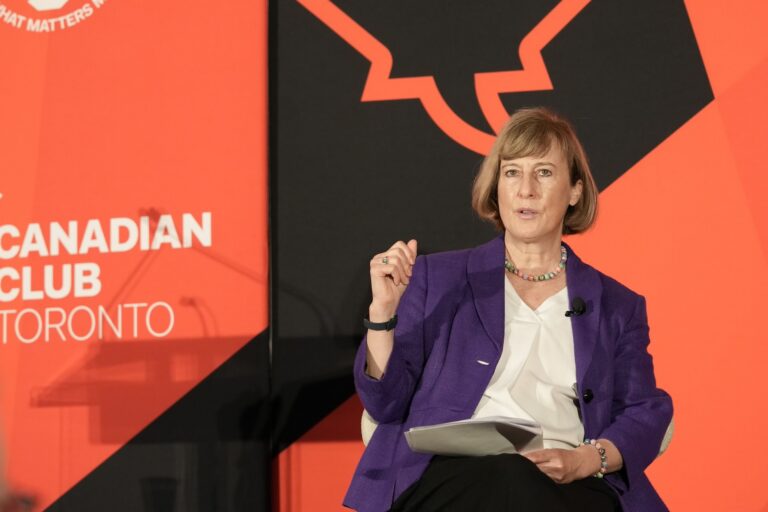
The Logic Summit in Toronto on Monday, Oct. 28. 2024. Photo: Jenna Muirhead for The Logic

If you couldn’t make it to The Logic Summit today, here’s some of what you missed from the interviews and panels at Toronto’s Arcadian Court.
Productivity: Canadians suffer “own goals” in policy that keep us from being our best, said Bank of Canada governor Tiff Macklem. Many economic ground rules need reconsidering through the lens of whether they obstruct companies from excelling and individuals from putting their skills and labour to their best use, he said. “Monetary policy, fiscal policy, tax policies, competition policy, IP policy—we need to look at those,” he said, in addition to things like differing regulations in different provinces that are generally intended to serve the same purpose.
Related Articles


The private sector has its own fixes to make, said Mike Murchison, CEO of AI customer service firm Ada. “There’s a shocking waste of productivity that is experienced by us all by virtue of low-quality customer service,” he said. “The average Canadian will spend roughly 40 days of their life waiting on hold. It’s an abysmal lack of productivity.”
More people could be launching innovative new ventures if Canada made it easier. “What we fail to do, compared to the United States, is really provide a platform for Indigenous businesses and entrepreneurs to thrive,” said Althea Wishloff, general partner at Raven Indigenous Capital Partners.
Read more from The Logic Summit:

AI, and its dark side: Canadians ought to be bolder about leading in artificial intelligence, argued Rebecca Finlay, the head of San Francisco-based non-profit Partnership for AI. “I am concerned as a Canadian that we are not more visible in the broader global AI conversation today, and particularly thinking and speaking innovatively about the way in which AI is being deployed in our star companies,” she said.
“Innovation is happening at different layers,” said Parinaz Sobhani, the head of AI at Sagard Holdings. Hardware, AI models, tools that put those models to practical uses, and actual applications—all are frontiers for innovation, but also can add confusion for potential users. “If you have a broken process, you need to fix that process before inserting AI into it,” she added.
Reken CEO Shuman Ghosemajumder warned of the misuse of generative AI tools, and that building safety measures into products like ChatGPT won’t necessarily help. Cybercriminals have their own generative AI tools, he said, and can use them for sophisticated attacks. “What you’ve got is the most sociopathic AI that has ever been created, in the hands of cybercriminals, without any kind of restriction.”
Basic cyber hygiene like good passwords and two-factor authentication could still mitigate risks, advised John Weigelt of Microsoft Canada.
Read more from The Logic Summit:



Boosting entrepreneurship: “We should not be shy [about] seeing the globe as our market,” said Isabelle Hudon, CEO of the Business Development Bank of Canada, on Canadian modesty. “The real ambition is to build global businesses.”
“It’s OK to not take that first cheque. Swing for the fences,” said Konata Lake, a partner at Torys specializing in M&A, venture capital and private equity.
Leading in chaotic times: “Crisis is part of what [we] do every day. We are involved in every snowstorm, every power outage, every flood, every single thing that happens,” said Galen Weston of Loblaw. “Our business systems are pretty well suited to difficult situations.”
Security is a concern across the board, and it’s hard for smaller organizations to protect themselves. “Our federal government is trying very hard to work with the small and medium businesses that make up to 99 per cent of our economy, but they don’t speak the same language,” said Jennifer Quaid, executive director of the Canadian Cyber Threat Exchange.
CEOs need to work under the assumption that volatility—social, economic and geopolitical—is a constant, said Carolyn Dewar, senior partner at consulting firm McKinsey & Company, during a roundtable discussion on leading through “polycrises.”
“The ones who are handling it well come back to some sort of grounding [principle] of, ‘What do we stand for as an organization? What is our true purpose?’” said Dewar. “People are playing with that and trying to, with their boards, work through it in advance,” she said. “Because in the moment, you have to just react.”
Editor’s note: This story has been updated to more accurately describe Ada’s AI business



Loading...
Thanks for sharing!
You have shared 5 articles this month and reached the maximum amount of shares available.
CloseThis account has reached its share limit.
If you would like to purchase a sharing license please contact The Logic support at [email protected].
CloseGift the full article!
You have gifted 0 article(s) this month and have 5 remaining.
Recipients will be able to read the full text of the article after submitting their email address. They will not have access to other articles or subscriber benefits.