It’s rare that we hear from Galen Weston, one of the country’s most important decision-makers, so let’s go back to his recent podcast interview with Goldy Hyder, the head of the Business Council of Canada.
Skip to content

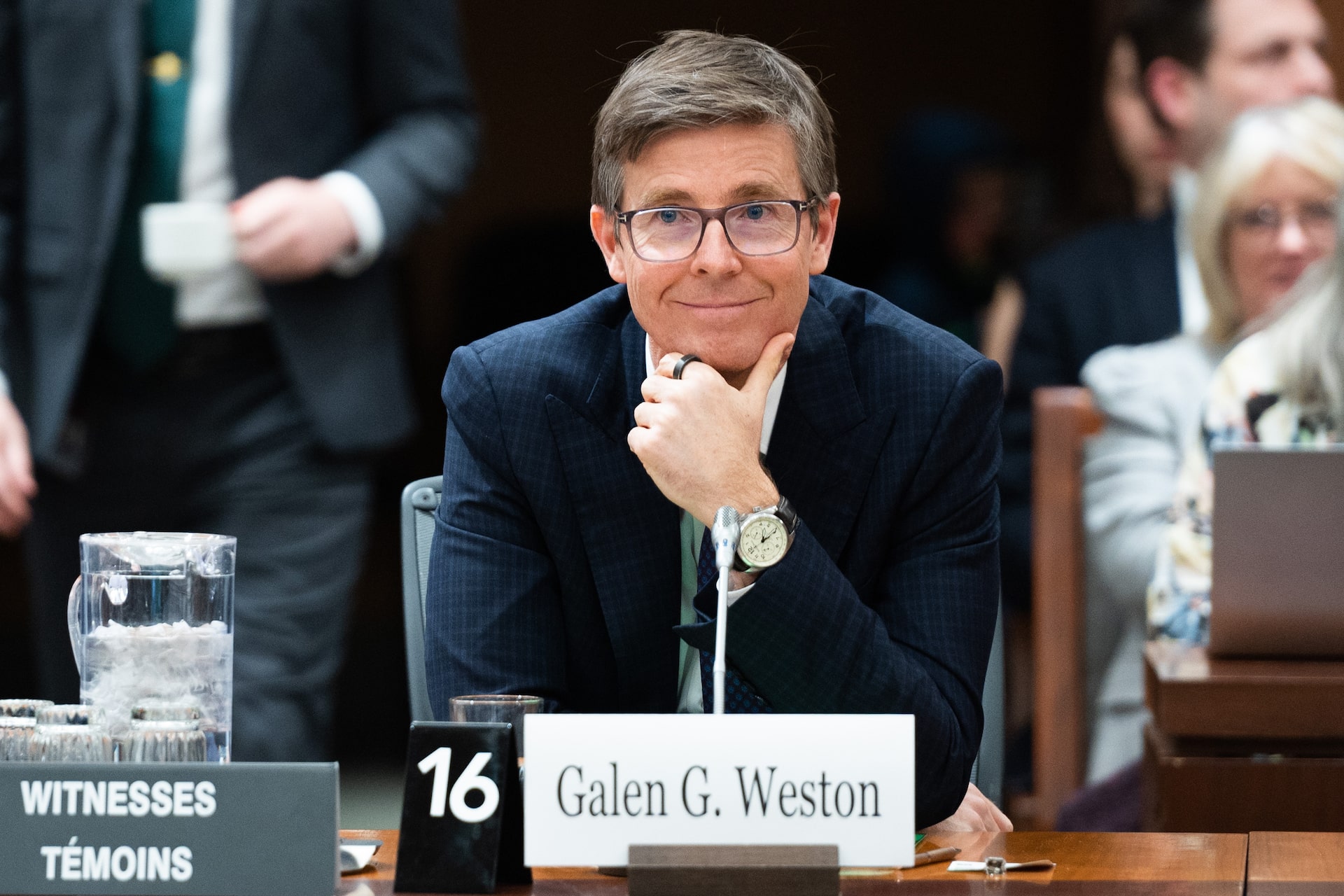 Galen G. Weston at a House of Commons committee meeting on food price inflation in Ottawa, in March 2023. Photo: The Canadian Press/Spencer Colby

Commentary
Carmichael: Galen Weston’s base-hit theory of productivity
The Loblaw boss avoids home-run swings. He thinks Canada should, too
A Loblaws store in Toronto in 2018. Photo: The Canadian Press/Nathan Denette
It’s rare that we hear from Galen Weston, one of the country’s most important decision-makers, so let’s go back to his recent podcast interview with Goldy Hyder, the head of the Business Council of Canada.
The interview wasn’t hard-hitting—the heads of industry groups don’t usually embarrass their members in public. Still, when Weston said one of the things that keeps him up at night is Canada’s long-term prosperity, Hyder pointed out that as one of the country’s largest employers, Weston was uniquely placed to do something about it.
“I’m in a position of enormous privilege, with resources, with a voice, and with access to very, very bright, smart people,” Weston, the effective head of Loblaw, the country’s biggest grocery chain, acknowledged. “We need to have more constructive dialogue with the private sector so that our ideas are heard and understood in the way that they are intended.”
Even if you believe Weston is “greedflation” personified, you could still learn something from what he has to say about creating wealth—a prerequisite for maintaining the quality of life to which we’ve become accustomed, because an aging population means there will be fewer workers around to keep the economy growing. The Weston family has been doing it since the 1880s, when George Weston started baking bread.
Related Articles


“We’re four generations,” Weston said. “It makes you think in decades, not in quarters.”
One lesson is the need for strong competition regulation. Earlier this year, Weston apologized for George Weston Ltd.’s part in fixing the price of packaged bread between 2001 and 2015, agreeing to pay $500 million to settle a class-action lawsuit.
But the Weston family’s business legacy is bigger than one scandal. I found it interesting how Weston thinks about risk. If politicians get over the current fashion of villainizing the rich, they might get some ideas about how to confront the productivity crisis.
“When you are thinking about prosperity over the course of decades, taking a swing that leads to the end of your enterprise doesn’t make sense,” Weston said. “Adding a base hit to a base hit to a base hit over 30 years is going to create more durability, more tenure and more prosperity for the company.”
Weston added: “I think that same concept can apply to the country as a whole. But it’s got to be singles. The country has to hit singles intentionally and continue to advance around the bases. It can’t be foul ball after foul ball after foul ball.”
There’s an echo of Moneyball, the Michael Lewis book about how the small-budget Oakland Athletics managed to stay competitive in the early 2000s by finding players who were good at getting on base—and were undervalued at a time when teams would routinely get into bidding wars over home-run hitters.
George Weston isn’t an underdog. It could finance a moonshot if it wanted to. But Galen G. Weston isn’t Elon Musk, Loblaw isn’t Tesla and Bay Street isn’t Wall Street. Maybe the Weston family’s lesson for the rest of us is to play to our strengths.
Canada is a rich economy, with a nice mix of natural resources, a manufacturing base, financial stability, predictable courts and a decent amount of brainpower. We should strive to be more dynamic, but maybe the way to do that is incrementally—not all at once. We don’t have as much room for error as the U.S. and China. Finance Minister Chrystia Freeland’s relatively sudden commitment to fiscal guardrails is a recognition that the federal government has maxed out its credit card.
A moneyball strategy requires a lot of hard work. Billy Beane, the general manager who Michael Lewis made famous to a business audience, had to fight the received wisdom of how you win baseball games and commit to letting the data guide his decisions.
There is some recent evidence Prime Minister Justin Trudeau is ready to do some of that work. Last month, the government announced that Treasury Board President Anita Anand will create a working group to study ways to improve government productivity, and that she and Intergovernmental Affairs Minister Dominic Leblanc will attempt to accelerate efforts to reduce regulatory friction between the provinces. Earlier this week, the Liberal Party said former Bank of Canada governor Mark Carney will lead a committee tasked with developing “new ideas for the next phase of Canada’s strategy for near- and longer-term economic growth and productivity,” while helping the federal Liberals “shape a pragmatic, focused and high-impact vision for Canada’s economic success.”
Trudeau’s tendency has been to take big swings. He turned his back on bipartisan commitment to balance budgets to create technology clusters from scratch, set up multibillion-dollar innovation funds and stand up new agencies such as the Canada Infrastructure Bank.
Some of those big bets may yet pay off, but the productivity numbers suggest it might be time to choke up on the bat and simply try to get on base.
Kevin Carmichael is The Logic’s economics columnist and editor-at-large. He has spent more than two decades covering economics, business and finance for outlets including Bloomberg News, The Globe and Mail and the Financial Post, where he also served as editor-in-chief.



Loading...
Thanks for sharing!
You have shared 5 articles this month and reached the maximum amount of shares available.
CloseThis account has reached its share limit.
If you would like to purchase a sharing license please contact The Logic support at [email protected].
CloseGift the full article!
You have gifted 0 article(s) this month and have 5 remaining.
Recipients will be able to read the full text of the article after submitting their email address. They will not have access to other articles or subscriber benefits.
Photo: The Canadian Press/Nathan Denette
Galen G. Weston at a House of Commons committee meeting on food price inflation in Ottawa, in March 2023.
Most Popular This Week




In-depth, agenda-setting reporting
Great journalism delivered straight to your inbox.
News
An obscure data standard is the latest open banking holdup—and an unlikely political hot potato
Briefing
OSFI won’t dictate whether banks block AI agents, says Routledge
Deep Sea Minerals files to raise US$5M as U.S. spurs on seabed mining
Celestica expects sales to nearly double next year as AI demand surges
Best business newsletter in Canada
Get up to speed in minutes with insights and analysis on the most important stories of the day, every weekday.
Exclusive events
See the bigger picture with reporters and industry experts in subscriber-exclusive events.
Membership in The Logic Council
Membership provides access to our popular Slack channel, participation in subscriber surveys and invitations to exclusive events with our journalists and special guests.