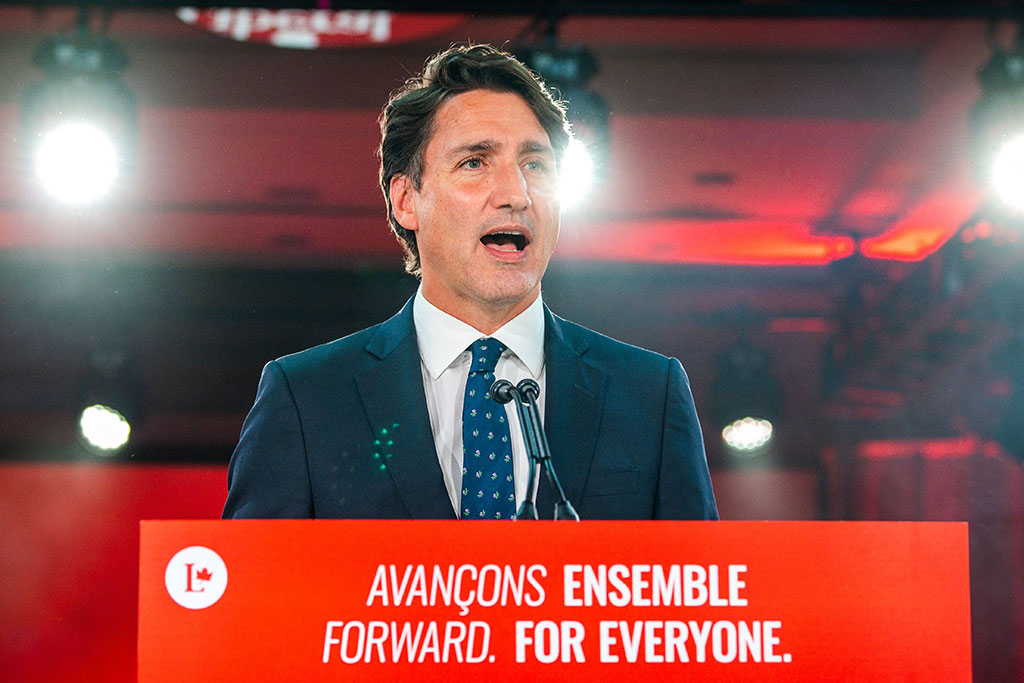
OTTAWA — Justin Trudeau’s Liberals will return to Ottawa with another minority government, after a 36-day contest for the right to lead the Canadian public and economy out of the pandemic.
Startup and scale-up executives, business groups and policy experts say ideas to grow the economy and incentivize innovation have been in short supply this election. In recent years, Ottawa has been “very, very light” on strategy to support digital firms, said Allen Lau, CEO of Toronto-headquartered self-publishing platform Wattpad. “In this campaign, it’s [been] a little bit disappointing [on] the innovation front.”
The victorious Liberals have promised to move forward with major funding for AI, cleantech and biotech, and to implement their existing plans to regulate Big Tech. Here’s what you should expect from the returned government.
Talking Point
The Liberals have been re-elected to a House of Commons with very similar dynamics to the one they called an election to escape. Analysts and practitioners in multiple industries say the continuity is good for stability and progress in their sectors, but the short-term thinking a minority situation requires will likely mean putting off deep questions about reforms to the Canadian economy.
Support for innovators
The Liberals pledged to review the suite of federal innovation programs, continuously evaluating how effectively they’re helping the government meet its net-zero targets, improve “fairness and equality” and so on.
The scientific research and economic development (SR&ED) tax incentive is high on the list of programs that innovation-economy executives will want evaluated. Ottawa issued nearly $3.06 billion in credits in the 2021 fiscal year. Carl Rodrigues, CEO of Mississauga, Ont.-based Soti, noted both the Liberal and Conservative platforms proposed changes to the program but were short on details. “They keep tweaking SR&ED every few years [to make it] harder and harder [to access],” he said. “There’s so much red tape in there.” Revenues at Soti, which makes mobile- and IOT management software, are too large to get the maximum benefit from the program. “They tend to punish you if you grow,” said Rodrigues, whose firm now employs more than 1,200 people.
Business leaders have long expressed concern that the program pays out too much to large firms, and to foreign ones. In the 2019 federal budget, the Liberals increased the SR&ED incentive for small and early-stage companies. The next government needs to ensure the program is “most effective in terms of generating IP and data-rich companies to help commercialize Canadian ideas,” said Benjamin Bergen, executive director of the Council of Canadian Innovators, a scale-up lobby group.
Lau also cited the importance of IP and data. Cleantech and digital technology will play “a big part” in “the future of the economy,” he said. All the major parties have promised action on the former, but “the digital national strategy is kind of taking a backseat right now, unfortunately.”
“I think the big thing here is continuity,” said Peter van der Velden, managing general partner of life-sciences venture capital firm Lumira. “I’d say what’s important is that [Venture Capital Catalyst Initiative] programs, the Venture Capital Action Plan … that will continue.” April’s budget renews the former, which backs funds-of-funds and VC funds.
But, van der Velden added, the federal Liberals haven’t made substantial economic reforms that Canada needs. “I’m worried about spending. I’m worried about next-generation jobs,” he said. “We still don’t have a pension-plan ecosystem that is thinking about Canadian jobs, Canadian innovation, and we need to engage them in that.” The federal government, he said, needs to make sure it isn’t the only source of innovation-focused venture capital in the country.
Finding and retaining talent also remains a major challenge for domestic startups and scale-ups. “Everybody is scrapping over” the best engineers, developers and other professionals, said Rodrigues, noting that U.S. firms recruiting here can pay higher wages than domestic rivals because of the stronger dollar.
He criticized the Liberals’ move to cap use of the stock-options deduction, which took effect in July. “Trudeau and all [are] walking around [saying], ‘Tax the rich,’” he said. “By Canadian standards,” such tech workers “are up there.” The cap does not apply to options issued by Canadian-controlled private corporations—a business structure commonly used by startups—and those from firms with $500 million or less in annual gross revenue.
Regulating Big Tech—and more
All the major parties took aim at Silicon Valley’s largest firms, promising to tax and regulate foreign online platforms to ensure the digital market is open to Canadian competitors—and to pay for the government’s other spending.
The incumbent Liberals had introduced a number of bills—including efforts to overhaul consumer privacy rules, make foreign streaming services pay to create Cancon and add online hate speech to human rights law—that hadn’t been passed into law before they called this election. The party’s re-election platform promised to reintroduce its broadcasting legislation, and add a new bill to restrict online harms like hate speech and terrorist content, within their first 100 days back in office.
The Liberals also pledged to return to their data proposal. Privacy commissioner Daniel Therrien and digital rights advocates criticized Bill C-11 for failing to recognize privacy as a right, and for the exemptions it would introduce for businesses’ use of information. “There wasn’t a proper consultation” with innovative companies on the proposal, said Bergen. “Actually making sure that Canadian firms are not caught between the regulatory giants of [the European Union’s] GDPR and the United States is a real concern.”
The Liberals are also promising “a clear set of rules that ensure fair competition in the online marketplace.” While all the major parties’ platforms criticized the tech giants, they’re “not actually saying what’s unfair,” said Vass Bednar, executive director of McMaster University’s graduate program for public policy in digital society. And those competition-limiting business practices aren’t limited to Silicon Valley giants. “What are the Big Tech trends in our backyard, and do we have the courage to actually call them out and pursue them?” Bednar said, citing domestic department-store chains’ rewards programs and grocery giants prioritizing their own products in online shopping as digital issues for the Competition Bureau.
Lau also said the new government’s digital policy must go beyond cracking down on Big Tech. The parties’ proposals in the current campaign were “more about keeping some of the tax revenue [that] should come to Canada but is leaking out to the tech giants,” he said. While that’s not “the wrong problem to fix, we need a broader national strategy to help us generate more … digital IP, including data [and] content.”
Wattpad has built revenue streams by helping popular users monetize their fiction IP via book, TV and movie deals. Prominent adaptations include The Kissing Booth film series on Netflix and box-office success After. South Korean tech firm Naver announced in January it was buying Wattpad for US$600 million.
“Moving forward, we all know the economy will be much more digitized,” said Lau. “If we are only focusing on capturing the tax revenue that we could have collected from Netflix, I think we are looking at the tree without realizing there’s a forest here.”
Climate and energy
All the major parties have now adopted forms of carbon pricing as central elements of their climate-change policies—the Liberals with their rising backstop carbon levy and rebates (which the NDP platform pledged to keep) and the Conservatives with an alternative personal carbon savings account scheme that provinces could use if they wanted.
But their policy targets have varied significantly. The New Democrats proposed to cut Canada’s greenhouse-gas emissions by at least 50 per cent below 2005 levels by 2030; the Liberals in government set a target cut of 40 to 45 per cent; and the Conservatives pledged to stick with the 30 per cent target Canada initially set for itself under the Paris Agreement.
For Jennifer Winter, an associate economics professor at the University of Calgary who studies climate and energy policy, the worst-case government for climate policy would have been a Conservative minority supported by the Bloc Québécois—a government led by a party not enthusiastic about limiting greenhouse-gas emissions, relying on a party adamantly opposed to a federal government barging into provincial affairs.
“Even if, in some state of the world where the Liberals aren’t able to be as ambitious as they were hoping if they had a majority, I still think it’s good for climate policy in Canada,” Winter said. “A worst-case scenario for a Liberal minority is that the NDP is pushing them to do more on climate policy, [so] this election really is a good-news story for continued and consistent climate policy in Canada.”
But when the Liberals’ environment minister heads to the next UN climate conference in November, Winter said he or she might be tempted to over-promise even more emissions cuts, when the party has already staked out aggressive ground.
“I honestly worry that they’re setting themselves up to fail,” she said.
With another minority government, they can also pick only so many policy fights. A key question to gauge the Liberals’ determination to push harder on emissions reductions, Winter said, is how they define a program meant to give incentives for carbon capture and storage, which has been the subject of consultations over the summer.
“I think that’s going to be the immediate-term policy issue of relevance for oil and gas,” she said. “This tax credit could be incredibly beneficial in reducing emissions in oil and gas.”
And for industries from cement to petroleum refining to steelmaking, she added. “It depends on the Liberals deciding to go forward with the tax credit, and then it’ll actually [produce] quite a bit of investment in carbon capture and storage.”
Housing
The cost of living, and especially of housing, was the ground on which the Conservatives and New Democrats wanted to fight the election. All the big parties promised (in multiple leaders’ events, to get as much attention as possible) to use federal powers to get more housing built, and the Liberals and NDP in particular pledged tax benefits and other help for would-be buyers who find themselves priced out of current markets.
Even for relatively well-paid workers in the tech sector, affordability affects startups and scale-ups’ ability to hire and retain talent. “In Toronto, where we’re headquartered, the cost of living is getting very, very high,” noted Wattpad’s Lau. In December 2019, his company announced a major expansion to Nova Scotia, where housing and other staples are significantly cheaper. Coupled with the pandemic shift to remote work, “our team in Halifax is actually growing very fast right now, and we also have employees from Toronto [moving there],” he said.
“I think all the parties were caught somewhat off guard by how quickly prices went up,” said Western University assistant business professor Mike Moffatt, who studies housing and its relationship to economic growth. (He’s also senior director of policy and innovation at the University of Ottawa’s Smart Prosperity Institute.) That led, he said, to “half-baked” policy proposals, especially when it came to increasing the supply of housing rather than giving buyers more money to spend.
The Liberals promised a $4-billion “housing accelerator fund,” for instance.
“They can always expand the dollar amounts if they find a working model, but what on earth is this housing accelerator going to look like and how do they get it in place? What does it actually do?” Moffatt said. “I think that’s going to be the biggest issue on the supply side of the housing market: even if you had all the best policies available, you can’t just build a house overnight.”
That half-bakedness means none of the parties is necessarily deeply dug in on any particular policy prescription, though, which could give the Liberals room to manoeuvre in a minority Parliament.
“There’s really not that much difference between what the parties are offering,” Moffatt said. “Particularly when it comes to the NDP, I don’t see anything in the Liberal housing platform that would be too objectionable to the NDP. And similarly, if the NDP said, ‘OK, well, we’ll support you on the housing side, but you have to put more money into social housing,’ or something like that. I don’t think Liberals say no to that.”
But in a minority situation, the Liberals also aren’t likely to step out with a bold move to cut the cost of housing—taking with it some of the real estate wealth that those who do own property have been happy to accumulate. That might be good for the country, Moffatt said, but not for a party already counting down the months to the next campaign.
Health and biotech
Since the start of the COVID-19 pandemic, the Liberals have spent heavily on building up Canada’s withered life-sciences sector, anticipating that a future pandemic could demand domestic capacity to make protective equipment and design, test and manufacture vaccines and treatments.
The culmination, in the week before Trudeau called the election in mid-August, was a deal with Moderna to build a factory and research centre in Canada for its mRNA-based technology.
“I’m worried that the commitments made recently around things like biomanufacturing lead the government to conclude, ‘Job well done,’ you know, shake my hand and move on to the next topic,” van der Velden said. “The job is not well done yet. There’s a lot more to do here.”
But, he said, the commitments the Liberals have made in the industry are encouraging.
“The Liberals made a bunch of pretty significant announcements around health care coming into this election—$2.2 billion in allocations, another $1 billion going into the Strategic Innovation Fund,” he said. “We have AbCellera; our company Edesa today announced fantastic clinical results around a new product for treatment of COVID-19 [in] people that have really deep disease—and this is a SIF-supported initiative. [The Liberals have made] a lot more commitments around funds for innovation, funds for commercialization of university stuff, funds for biotech.… Generally, I would say, this is good for our sector.”
What happens next
The Liberals will return as a minority government, and will need to court support from opposition parties for major legislation. For any policy outside Quebec, that likely means the NDP, which on Monday night looked set to modestly increase its seat count.
During the campaign, Jagmeet Singh’s party promised a crackdown on Big Tech and funding for cleantech, as well as action on priorities that the Liberals have dropped since the last election like bringing down wireless prices and introducing a national pharmacare program. “If the Liberals are forming a working relationship with the NDP, will it be predicated around innovation policy [or] social policy?” said Bergen. “I just hope that in a minority government, [innovation] doesn’t get left on the floor of policymaking.”
“I get the sense all of the parties are really struggling to figure out, ‘How do we grow the economy, how do we increase productivity?’” Moffatt said. “A majority government of any stripe would have given more time to do a reset and have a government think through what they should be doing…. The next 12, 18 months is essentially short- and medium-term focus, putting out fires.”