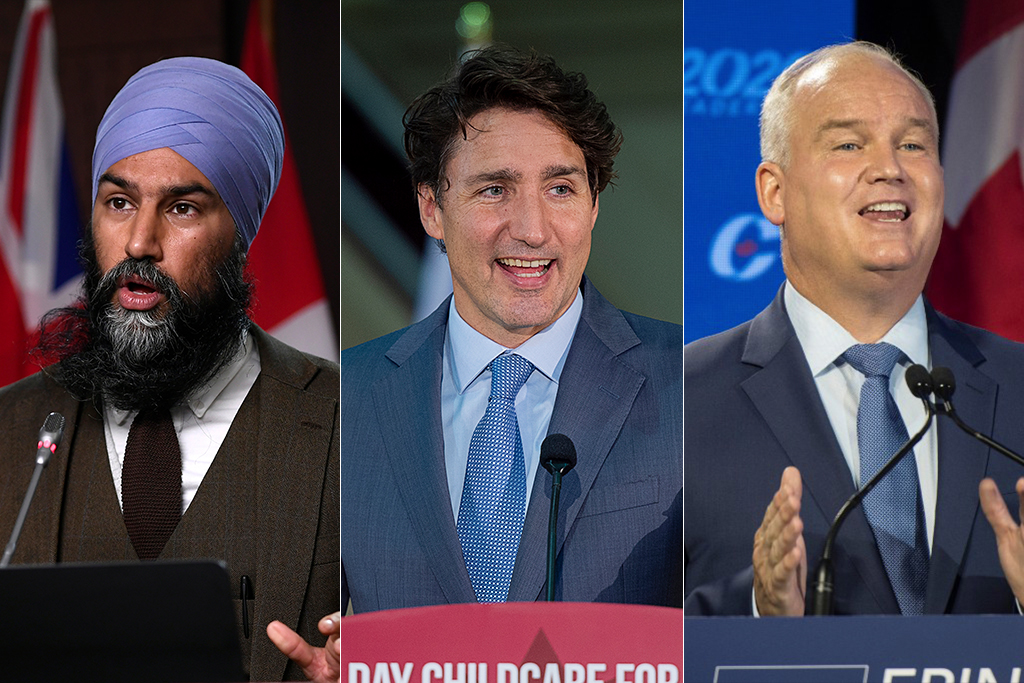
The Liberal government’s handling of COVID-19 is likely to dominate this year’s federal election campaign, now officially underway, but parties will also have to set out compelling and workable plans for the post-pandemic recovery that restores economic growth and employment.
With voters heading to polling places on Sept. 20, here’s an early look at what the election call means for the innovation economy.
Talking Point
As a COVID-19-tinged federal election gets underway, tech groups say parties’ plans for post-pandemic recovery should promote growth in cutting-edge industries. The incumbent Liberals are running on their innovation programs and policies laid out over the last four years. The Conservatives and NDP have both made early proposals for encouraging startups and promoting skills.
What tech wants the parties to talk about
Innovation-economy groups say the next government should prioritize policy and spending for the tech sector to boost growth as the country exits the pandemic.
Procurement is one major focus—the federal government is the country’s largest buyer, spending some $23 billion annually on goods and services. “We really push the government to leverage its [technology] purchasing as an economic lever,” said Michele Lajeunesse, senior vice-president of government relations and policy at industry association Technation.
The Liberal government launched the Canadian Digital Service, an in-house development shop, in July 2017; and after the 2019 federal election, promised to establish a centre of expertise on tech-project implementation. But Technation wants the government to “adopt a ‘buy-not-build’ mindset to modernize procurement,” said Lajeunesse.
The Council of Canadian Innovators, which represents scale-ups, wants the government to prioritize domestic tech companies in its buying decisions. “Whose ideas are we using?” said executive director Benjamin Bergen. “For us, [it should be] Canadian-owned ideas that are being commercialized, whether that be to update IT systems [or] how we fix things in our health-care system around senior citizens.” Such firms will then be better placed to sell to foreign customers, Bergen said.
Lajeunesse, whose members include the domestic subsidiaries of major IT multinationals, cites the spending from contracts that flows to such firms’ partners. “Big tech floats all boats,” she said.
The CCI previously lobbied the federal government to create an immigration program so fast-growing firms could bring in highly skilled foreign workers. The Liberals introduced the fast-track Global Skills Strategy in June 2017, and none of the other parties have suggested changing or eliminating it.
Bergen’s group has also pushed the government to maintain the favourable tax treatment of employee stock options; the Liberals ultimately introduced a cap that took effect in July. The parties should consider the difference in tax rates between the U.S. and Canada to ensure we remain “competitive,” said Bergen. He also repeated a longstanding CCI call for parties to put forward strategies for governing and commercializing IP and data domestically.
Foresight Canada, an accelerator in cleantech, told The Logic that Canada can lead a green revolution, “but there needs to be an investment in effective programs and networks that support the efficient ideation, commercialization and scale-up of companies developing innovative solutions that accelerate the path to net-zero.”
Vice-president Elizabeth Thorsen said Foresight would like to hear the parties’ plans for de-risking investments in cleantech, supports for displaced workers in “traditional industries” and cutting greenhouse-gas emissions from the energy sector to zero by 2050.
One big question for the leaders she offered is about depoliticizing the climate-change fight: “How will you gain bipartisan support in creating Canada’s innovation roadmaps and supports to meet net-zero goals?”
The Liberals have the advantage of the apparatus of government to produce detailed plans for economic growth after the pandemic, and their 2021 budget laid several elements out. It included child-care funding so more parents—particularly women—can work outside the home; several provinces have already signed on. The budget also put nearly $2.5 billion over five years into skills training, and allocated billions on everything from helping businesses digitize operations to building new trade infrastructure.
At the end of July, they extended pandemic support—including the Canada Recovery Benefit and Canada Emergency Wage Subsidy—to Oct. 23, “to deliver support to those who need it, heal the wounds of the pandemic recession, and build a strong recovery that leaves no one behind.” It’s an acknowledgment that the COVID-19 pandemic’s uncertainties are still with us, leaving many employers on thin ice and some would-be workers without options.
The Conservatives would take “immediate action to help the hardest-hit sectors, helping those—including women and young Canadians—who have suffered the most,” and provide “incentives to invest in, rebuild, and start new businesses,” while winding down pandemic-aid programs and moving toward a balanced budget.
In the lead-up to the election call, O’Toole said a Conservative government would:
- Complete the extension of broadband internet access to all corners of the country by 2025—five years sooner than the Liberals
- Create a funding program to help employers train workers
- Cut taxes on revenues that companies make from patented technologies developed in Canada
- Extend the “flow-through” share structure allowed for mining companies to tech startups
- Reform the federal scientific research and experimental development (SR&ED) program
- Create a Canadian Advanced Research Agency with $5 billion in seed money over five years.
The New Democrats, like the other two large parties, promise to create over a million new jobs. They say they’ll do so by increasing workplace standards for people with essential jobs, spending on infrastructure and “helping Canadian workers make products that people want and need, and that will better position us to fight the climate crisis and build the economy of the future.”
Leader Jagmeet Singh had fiercely criticized the Liberals’ plans to end pandemic support in September 2021 as “cruel and callous.” He’s also called for a permanent tax on the “ultra-wealthy,” which the NDP defines as families with holdings of more than $20 million, and a separate corporate tax targeting “pandemic profiteering.”
Specifically, that would double taxes—from 15 per cent to 30 per cent—on companies with revenues of at least $10 million whose 2020 profits were more than their average between 2014 and 2019. A parliamentary budget office report estimated that would mean $7.9 billion in revenue for the federal government.
Ahead of the election call, the NDP promised:
- A new investment-attraction agency to replace the Liberal-established Invest in Canada, training and reskilling programs
- A Crown corporation to ensure broadband internet access for all residents
- To “ensure that internet giants like Facebook, Google and Amazon pay their fair share of taxes.” The Liberal government’s digital-services tax is scheduled to take effect in January 2022.
- To “launch a Canadian startup culture” focused on commercialization and highly skilled workers. It did not provide any details.
Big promises on Big Pharma
“We have to prepare for the possibility of a future COVID,” said Andrew Casey of BIOTECanada, the association for Canada’s biotech industry. “We’re not out of this one yet. But let’s assume that the technology is going to get us there. We have to think about COVID-30 or -42 or whatever, and figure out what we need to do to address gaps that became very apparent during the current crisis.”
That preparation can be part of revitalizing the economy as the pandemic wanes—building up Canada’s capacity to make vaccines and medicines by attracting large multinationals that produce cutting-edge products.
Doing so is linked to whether the federal government wants a public drug-insurance system and what form it might take, Casey noted, and to some of the broader problems in health care that the pandemic put in focus.
“There is an industry bringing solutions there. And if you’re developing those internally and you’ve got trade arrangements and deals in place, then you’re now becoming a huge generator of economic benefits, because you’re producing not only for Canada, but for the global population,” he said.
The COVID-19 pandemic focused attention on Canada’s lack of vaccine research and production capacity. Canadian facilities do produce vaccines, including for tetanus, diphtheria and influenza, but couldn’t retool for COVID-19 vaccines—and especially not those devised by Pfizer-BioNTech and Moderna, which use new mRNA technology.
In the midst of the pandemic, the Liberals spent $1.2 billion to upgrade Canada’s bio-manufacturing capabilities, including up to $415 million to expand a Sanofi vaccine factory in Toronto. Their last budget included a further $2.2 billion for a bio-manufacturing and life-sciences strategy, and the government earlier this month announced a major deal to have Moderna make mRNA-based pharmaceuticals here.
The Conservatives have their own set of specific promises, including to make “Canada one of the best jurisdictions in the world for pharmaceutical research and development as well as production of vaccines and medicines.” The party says it will encourage pharmaceutical research, shifting away from Canada’s pre-pandemic focus on producing older-generation generic drugs, and put “in place a sector strategy to grow the sector in a well thought-out way rather than just handing out money.”
They also promise to fund basic scientific research in infectious disease and pathogens, including best practices for infection control, and to develop “new and novel high-containment laboratory capabilities.” The Conservatives say they would work with the United States to strengthen North American supply chains for pharmaceuticals while reinstating protectionist tariffs on personal protective equipment because “a strong domestic manufacturing industry for PPE is a pillar of pandemic readiness and ongoing resiliency.”
The New Democrats want a Crown corporation to make vaccines and critical medicines, and have called on the Liberals to help suspend patents on COVID-19 vaccines. They’ve also promised to reshore PPE production by buying from Canadian suppliers to replenish public stockpiles.
The bills the election kills
When Parliament is dissolved, all the unpassed legislation on its agenda is discarded, so newly elected MPs get a clean slate. That means some bills the Liberals have insisted are very important will either have to start over or never become law.
Bill C-10, which would bring streaming TV services under the jurisdiction of the Canadian Radio-television and Telecommunications Commission (CRTC), is one such example. The House of Commons sent Bill C-10 to the Senate in late June, just before the summer break, from which it never returned. It would have allowed the CRTC to impose Canadian content requirements on providers like Netflix and Amazon Video, and made promoting Indigenous voices one of the for the national broadcasting system’s objectives.
Numerous senators said they had problems with some or all of its elements and in their own last hours before a summer recess, the chamber voted to send the bill to be studied by a committee that didn’t meet.
Bill C-11, enacting new requirements for how companies use data and consumers’ rights over it, died a similar procedural death. In April, the Conservatives tried to send the bill to the House of Commons’ industry committee for study; the Liberals wanted it to go to the committee on access to information, privacy and ethics. In the end, it went to neither and was never discussed again.
And just under the legislative wire in June, the Liberals introduced Bill C-36, a crackdown that would have made online hate speech a discriminatory human rights violation, and that would allow the Canadian Human Rights Commission to investigate alleged cases. The House of Commons quit for the summer hours after Justice Minister David Lametti presented the proposed law for the first time.
Also vaporized with the election call were numerous private members’ bills with economic or tech implications, including:
- C-231, stopping the Canada Pension Plan Investment Board from investing in businesses that have violated human, labour or environmental rights, engaged in corruption, or produced weapons
- C-243, giving the government the power to limit the fees payment-card networks could charge merchants
- C-248, requiring that boards of Crown corporations have at least as many women as men
- C-272, restricting copyright protections for software that restricts consumers’ right to repair devices they buy, which had made it further than most private members’ bills by being sent for committee study
- C-299, requiring broadband internet providers to publish their services’ quality metrics and typical speeds at peak times
- C-302, forcing pornography producers or distributors to ascertain that nobody depicted in it is a minor and to get written affirmations from the participants that they’re OK with the material being distributed
- C-318, ordering the government to produce a detailed strategy for promoting renewable energy
- S-225, creating a central body to collect money from digital platforms and distribute it to Canadian news organizations.