OTTAWA — As policymakers and antitrust regulators in the U.S. and Europe pursue massive online platforms and device makers over their business practices and acquisitions, Canada’s major federal parties are promising new measures to prevent Big Tech from quashing domestic competition.
Skip to content

News
Parties promise competition crackdown on Big Tech, but details scarce
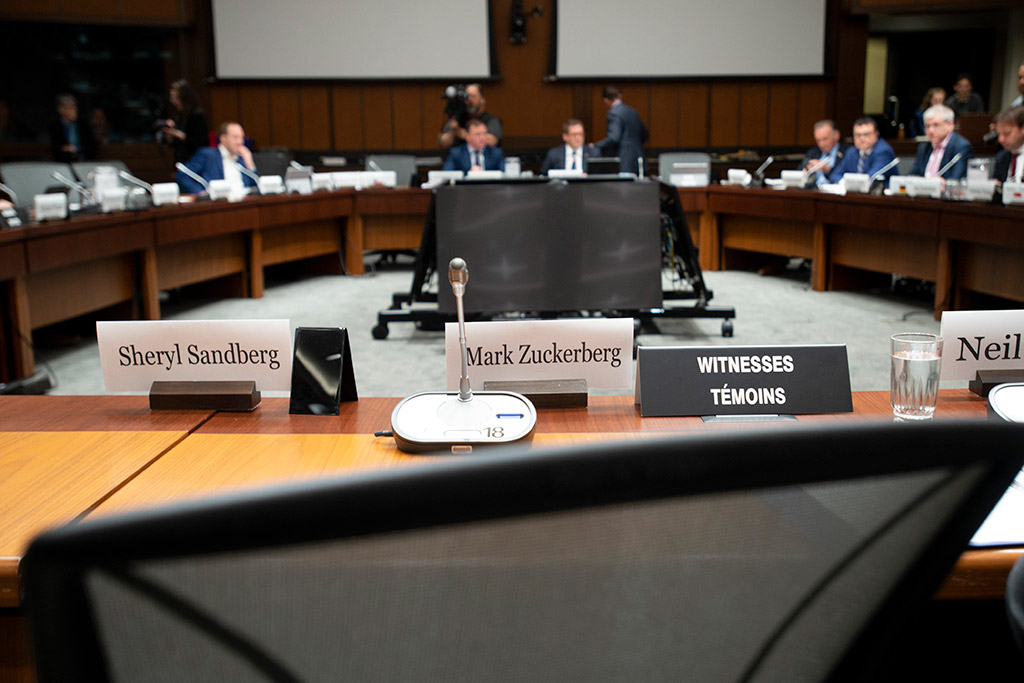
Empty chairs for Facebook CEO Mark Zuckerberg and COO Sheryl Sandberg, who did not attend the meeting of the International Grand Committee on Big Data, Privacy and Democracy in Ottawa in May 2019. Photo: The Canadian Press/Adrian Wyld
OTTAWA — As policymakers and antitrust regulators in the U.S. and Europe pursue massive online platforms and device makers over their business practices and acquisitions, Canada’s major federal parties are promising new measures to prevent Big Tech from quashing domestic competition.
In the years after first taking office in late 2015, the incumbent Liberals tried to attract investment and jobs from large foreign tech firms, touring their local and California offices and sharing stages with their top executives. They have since taken a more adversarial stance.
Talking Point
The major federal parties are promising to crack down on Big Tech, pledging new measures to ensure competition in the digital economy. Canada’s antitrust legislation needs updating to reflect the ways online platforms accumulate power and use data, but foreign tech giants shouldn’t be the only focus of reforms, experts say.
In May 2019, then-innovation minister Navdeep Bains unveiled a high-level digital charter of regulatory-principles regulation, including promising to “ensure fair competition in the online marketplace” to help domestic businesses grow and protect consumers. In a linked letter, he also instructed the Competition Bureau to consider the effectiveness of its current legislation and enforcement powers, as well as the impacts of “digital transformation” and “data accumulation, transparency and control.”
The bureau did not directly answer questions from The Logic about whether Bains’s letter triggered a formal review, citing the ongoing election. Spokesperson Sophie Paluck-Bastien said the bureau has “been having regular meetings at the working level” with policy officials at Innovation, Science and Economic Development Canada. Commissioner Matthew Boswell “is eager to ensure Canada’s competition legislation is fit for the digital age and fosters competitive markets,” she said, citing reforms in Australia, Germany, New Zealand, the U.K. and U.S.
The Liberal election platform closely mimics the digital charter, promising legislation to “provide a clear set of rules that ensure fair competition in the online marketplace.” Party spokesperson Brook Simpson also cited the $96 million over five years allocated to the bureau in the April budget, partly for “the necessary digital tools for today’s economy.”
The Conservative and NDP platforms both suggest large foreign digital services currently have an unfair advantage over domestic broadcasters and media outlets.
“Despite the Liberals promising to take action, these web giants still don’t pay the same taxes or contribute to funding Canadian content in the same way that traditional media do,” the NDP campaign document states, promising unspecified action to address the discrepancy. Foreign digital platforms are already required to collect and remit sales tax, and some will be subject to a three per cent digital-services tax (DST) starting in January 2022; both were 2019 Liberal promises. The NDP did not directly address The Logic’s questions about which promises related to taxing Big Tech the incumbents had broken.
The Conservative platform promises a DST that appears identical to the one already set to take effect next year. A Tory government would also give publications IP rights over extracts of articles that appear on social media platforms, and enforce an arbitration process for negotiations between the two. The platform cites a similar policy in Australia, drafted by the country’s competition commission.
The Tories also pledge a broader antitrust focus on the digital economy. They propose a “technology task force within the Competition Bureau to examine whether dominance and anti-competitive behaviour of Big Tech is damaging to Canadian industry,” and to review “how algorithms and data” give such firms “an advantage over Canadian business.” The party did not respond to repeated requests for further details.
“Data is so crucial for firms to accrue market power,” said Vass Bednar, executive director of McMaster University’s graduate program for public policy in digital society. Take self-preferencing, the practice of a platform highlighting or listing first its own products and services. Bednar cited Amazon and its AmazonBasics private label. “Are they making inferences on price point and target market … based on the information they have by virtue of both owning and advertising on an online marketplace?” she said.
In July 2019, the European Commission launched a probe of Amazon’s use of third-party merchants’ data, and in November 2020 concluded that Amazon was “systematically relying” on that information to benefit its own retail business. Canada’s Competition Bureau initiated its own civil investigation in August 2020.
U.S. regulators are pursuing other tech giants over alleged antitrust violations. The Justice Department and 11 states are suing Google over its “monopoly” position in internet search. The Federal Trade Commission and 48 states have taken Facebook to court for “eliminating firms that presented competitive threats” by acquiring them, most notably Instagram and WhatsApp. “I don’t think we need to be replicating the cases [against] Big Tech that are currently going on [in other countries] right now—we will benefit from spillover effects,” said Bednar.
The Competition Act was passed in 1985, and has not been comprehensively reviewed since, according to Bednar, who called for the next government to “examine digital marketplaces and whether there are fundamentally new anti-competitive behaviors that are not properly articulated in our legislation.” None of the major federal parties addressed questions from The Logic about whether or how they would amend the act, or seek the breakup of Big Tech firms.
Bednar said she’s encouraged that the Liberal and Conservative platforms cite competition policy. But “we don’t have to dress this up as a Big Tech issue.” She cited domestic department-store chains’ rewards programs and grocery giant’s showcasing of private-label brands in online shopping as examples of issues that a refocused bureau could explore.
Earlier this month, the Toronto-based C.D. Howe Institute’s Competition Policy Council called for expanded rights for private complainants to bring cases, but argued against the bureau being given the ability to force businesses to disclose information for market studies, which regulators use to identify potential problems. The agency’s lack of such powers—available to its peers in other countries—weakens its ability to enforce rules in the digital economy, Bednar and Vivic Research principal Robin Shaban said in an April paper.
Facebook did not directly answer The Logic’s questions about the parties’ proposals. The company has “long supported efforts by Canadian policymakers on thoughtful internet regulation that preserves the benefits of the digital economy, while addressing potential harms,” said spokesperson Lisa Laventure. Google spokesperson Lauren Skelly said it “wouldn’t be appropriate for us to comment on political matters during an election campaign.” Amazon did not respond to a request for comment.



Loading...
Thanks for sharing!
You have shared 5 articles this month and reached the maximum amount of shares available.
CloseThis account has reached its share limit.
If you would like to purchase a sharing license please contact The Logic support at [email protected].
CloseGift the full article!
You have gifted 0 article(s) this month and have 5 remaining.
Recipients will be able to read the full text of the article after submitting their email address. They will not have access to other articles or subscriber benefits.
Photo: The Canadian Press/Adrian Wyld
Most Popular This Week




In-depth, agenda-setting reporting
Great journalism delivered straight to your inbox.
The Big Read
Alberta’s referendum is just the start of the turmoil
Briefing
EverWind plans $10B data centre and wind development in Nova Scotia
Canada ready to force Stelco to sell its Canadian operations, Joly says
Feds plan a 60 MW defence-oriented data centre for Ottawa
Best business newsletter in Canada
Get up to speed in minutes with insights and analysis on the most important stories of the day, every weekday.
Exclusive events
See the bigger picture with reporters and industry experts in subscriber-exclusive events.
Membership in The Logic Council
Membership provides access to our popular Slack channel, participation in subscriber surveys and invitations to exclusive events with our journalists and special guests.






