Ontario won’t suffer too badly from Donald Trump’s trade wars, its newly released provincial budget predicts, so the Progressive Conservative government will respond largely with traditional responses to economic trouble.
Skip to content

Special Report
Ontario opts for billions in spending to stave off the effects of Trump’s trade war
The province’s budget includes business supports, infrastructure spending and a critical minerals plan, but postpones balancing the books
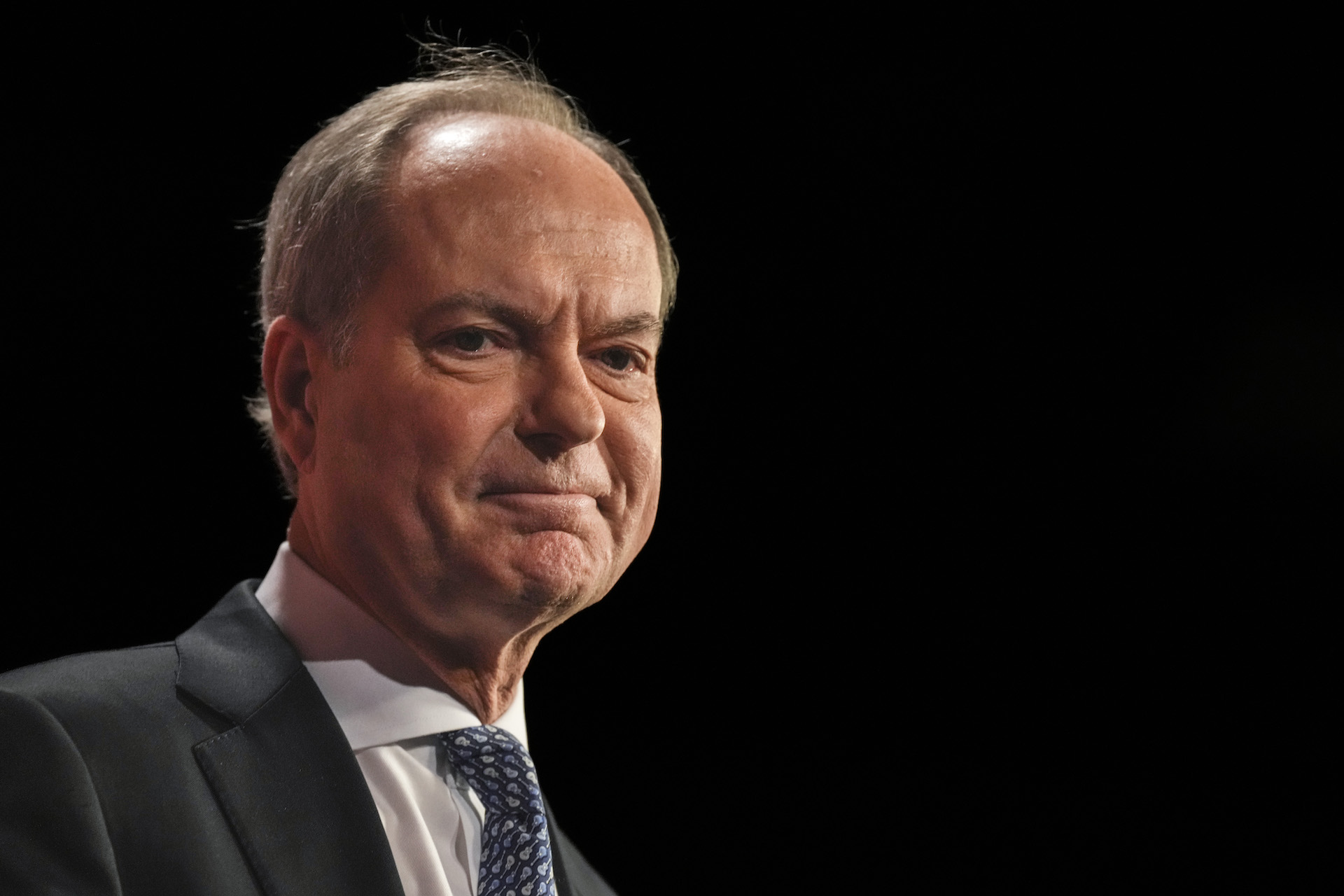
Ontario Finance Minister Peter Bethlenfalvy at the Queens Park Legislature in Toronto in November 2023. Photo: The Canadian Press/Chris Young
Ontario won’t suffer too badly from Donald Trump’s trade wars, its newly released provincial budget predicts, so the Progressive Conservative government will respond largely with traditional responses to economic trouble.
“The rapidly evolving trade policy landscape is already weighing on businesses and consumers around the world,” the government acknowledges in one of its budget documents, and Ontario is one of the Canadian jurisdictions most vulnerable to the U.S. president’s whims, but the province doesn’t expect the future will be terrible.
Talking Points
- The Ontario government’s new budget shows the province expects to take a hit amid the global trade strife U.S. President Donald Trump has touched off, but it believes economic growth will continue
- Finance Minister Peter Bethlenfalvy promises a deficit-financed infrastructure program to keep Ontarians working, with some extra attention for the province’s minerals sector
Projections from the finance ministry expect economic growth of 0.8 per cent in 2025 and one per cent in 2026. That’s less than half the growth rate estimated in last year’s budget, but with no lasting recession in the offing.
It expects Ontario corporations to lose money overall this year instead of turning a collective profit, for employment to be lower, for housing starts to be lower than previously forecast (though resale prices will dip slightly this year before rising again) and for the Canadian dollar to be weaker.
Newly elected Prime Minister Mark Carney is promising a radical departure from previous Liberal ways to pull off the greatest transformation of the Canadian economy since the Second World War.
Newly re-elected Premier Doug Ford’s Progressive Conservatives are counting on infrastructure investments—and temporary shields like a $5-billion “Protecting Ontario” account for “a variety of programs designed to support businesses affected by tariff-related disruptions, as needed”—to see Ontario through.
Related Articles

This year, Ontario plans to spend more than $33.3 billion on transit, highways, hospitals, schools and more, as part of a 10-year program that tops $200 billion.
If there’s an industry that is getting extra love from Queen’s Park, however, it’s mining. The government is accelerating its work on critical minerals, particularly in the northern Ontario “Ring of Fire.” That’s been a stated priority for the Tories since they were elected in 2018, with some better highway access the main thing they have to show for it.
One big-ticket item in the budget fulfills a Ford promise from his successful re-election campaign last winter: Ontario is revamping its $1-billion Aboriginal Loan Guarantee Program into a $3-billion fund renamed the Indigenous Opportunities Financing Program. It gives government backstops for private-sector financing of Indigenous groups’ investments in resource projects, aiming to share the projects’ proceeds and get those groups onside for things like new mines and power plants.
The government is moving the program from the Ontario Financing Authority, whose main job is managing the province’s debt, to the Building Ontario Fund, the provincial infrastructure bank, whose main job is to get projects off the ground.
Ontario is also promising to subsidize business investment in processing critical minerals through a $500-million fund, so that minerals mined in Ontario will be processed in the province rather than having to be shipped elsewhere.
On resource projects, said Finance Minister Peter Bethlenfalvy, the Ontario government agrees with Carney.
“Once we decide to do something, let’s do it fast,” he said. “You can’t wait 15 years for a permit for a mine. It can’t take forever to make a decision on a pipeline.”
The big picture:
The budget projects a $14.6 billion deficit in the 2025-26 fiscal year, and delays the government’s previous predictions about when it would balance the books. In the fall economic statement it released last October—days before Trump’s victory in the U.S. presidential election—it projected a $900-million surplus in 2026-27. Thursday’s budget predicts a more modest surplus beginning in 2027-28.
That’s in part because the government has forecast a weaker economy over the next three years compared to what it anticipated in the 2024 budget. Then, it expected real GDP to grow by 1.9 per cent this year. On Thursday, it cut that to 0.8 per cent.
However, the finance minister has also outlined two alternate scenarios—one where the province sees faster growth, and one where growth is slower than expected. In the slower growth scenario, this year’s deficit jumps to $17.1 billion, and the province is still wrestling with a $7.7 billion deficit in 2027-28. In the faster growth scenario, this year’s deficit shrinks to $12.3 billion, and the province books a $7.3-billion surplus in two years.
The budget justifies the overruns by pointing to “the levying of tariffs, and the threat to Canada’s national sovereignty, creating the need for investments in public services and business supports.” Lower borrowing costs mean the province is paying less interest on its debt than it budgeted for last year, and the debt-to-GDP ratio is 2.9 percentage points lower than in the last budget because of stronger GDP growth and a smaller deficit last fiscal year than expected.
“We’re trying to fortify and immunize Ontario as best possible,” Bethenfalvy told reporters Thursday. “I think we’ve got the right plan and the vision for not just dealing with the moment, but laying the groundwork for the future.”
The budget document says it demonstrates “levels of prudence” previously seen only during the 2008-09 financial crisis and the COVID-19 pandemic.
Open for business:
The government is pouring an additional $600 million into its $700-million “investment attraction agency,” the Invest Ontario Fund. The government uses the fund to incentivize businesses to move to the province, or to expand their operations there. In March, for example, it put $7.2 million towards a battery R&D centre German multinational Siemens is setting up in Oakville. The fund’s priorities will be life sciences, manufacturing and technology businesses.
Through Venture Ontario, the provincial venture capital investment agency, the government is allocating an additional $90 million in VC funding. It will give $50 million of that to venture funds that invest in artificial intelligence, cybersecurity and national defence, and the remaining $40 million to funds that invest in life sciences and biotechnology. The agency already manages over $500 million in assets. The budget also allocates $15 million over three years to “renew” the Life Sciences Innovation Fund, which makes venture co-investments in early stage companies in the sector.
Higher education and skills:
While Europe, for instance, is openly raiding the U.S. for researchers spooked by funding cuts and immigration arrests, Ontario is expecting to put less into higher education, with spending falling from $14.2 billion in 2024–25 to $12.8 billion by 2027–28. Ontario universities are already struggling with the results of a long provincially enforced tuition freeze, and colleges that relied on revenue from foreign students are suffering under new federal caps on study permits.
Despite the overall cut, the province’s budget does include some targeted spending, including $750 million over five years for more spaces in colleges’ and universities’ science, technology, engineering and math (STEM) programs, and a $75-million, three-year promise to fund post-secondary education in construction-related fields.
There’s also $207 million over three years for research infrastructure—university lab equipment, for instance—though at $69 million a year, that’s a cut from the annual average of $80 million the government says it’s spent since 2018.
Where there is more money is in training for the skilled trades. A $955-million boost to an existing $1.5-billion skills development fund was announced before the budget, and the budget follows through.
Bethenfalvy nevertheless said Ontario is “leaning into” its universities and colleges—citing $200 million in research funding announced last year—but that the provincial government doesn’t “control the foreign student numbers.”
Also noteworthy:
- The budget includes previously announced moves to extend and expand a tax credit for manufacturing investments, fund more primary health care, pay for municipal infrastructure that enables housing construction and cut the provincial gas tax and road tolls.
- Amid a bigger promise to crack down on crime, Ontario intends to create a special team of Crown prosecutors focused on cybercrime and cryptocurrency, to support police investigations and handle major cases.
- To try to boost domestic cannabis production, the Ontario Cannabis Store will start branding products with 75 per cent or more Ontario content as “Ontario grown.” The province also backs a federal step toward a single national excise stamp for cannabis, to knock down an internal trade barrier and help smaller producers sell across Canada.
- Fertility treatment, whose providers have been attracting significant private capital, will get a new provincial tax credit worth up to $5,000 a year on $20,000 worth of treatment expenses. It will apply on top of existing tax credits for medical expenses.
In response:
The Council of Canadian Innovators’s director of Ontario government relations, Skaidra Puodžiūnas, said the budget is a let-down for the scale-ups her organization represents, focusing too much on traditional “low value-add” sectors.
“We were encouraged to see some increased funding for Venture Ontario, but overall, the budget fell short of the transformational leadership this moment demands,” she wrote in a statement.
The Ontario Chamber of Commerce, meanwhile, worried that the budget’s historic levels of spending leave the government without money to tackle “urgent threats to our competitiveness, such as the crisis in postsecondary education,” even as it welcomed many of the things the province is spending money on, including infrastructure, manufacturing and skills development. Higher education needs more base funding, the chamber said: ”Few investments could do more to enhance Ontario’s competitiveness.”
The Canadian Federation of Independent Business welcomed cuts to expenses for small businesses, including returning surplus funds from the province’s workplace insurance program, but lamented that small businesses didn’t get a tax cut, or a program to compensate them for disruptions from all the construction the budget promised.
The Canadian Manufacturers and Exporters was pleased with the previously announced tax credit for manufacturing and the contributions to skills training and STEM programs in higher education. The group co-signed a letter last week with the associations representing universities and colleges in Ontario, saying future manufacturing will depend on a workforce educated in fields like robotics and AI.



Loading...
Thanks for sharing!
You have shared 5 articles this month and reached the maximum amount of shares available.
CloseThis account has reached its share limit.
If you would like to purchase a sharing license please contact The Logic support at [email protected].
CloseGift the full article!
You have gifted 0 article(s) this month and have 5 remaining.
Recipients will be able to read the full text of the article after submitting their email address. They will not have access to other articles or subscriber benefits.
Photo: The Canadian Press/Chris Young
Most Popular This Week




In-depth, agenda-setting reporting
Great journalism delivered straight to your inbox.
News
Cohere plans to acquire cyber startup Aisle and set up a new security division
Briefing
Banks should have kill switches, IDs for AI agents, says global finance watchdog
B.C. First Nations decry rushed consultations as Major Projects Office CEO promises to do better
Feds pledge $100M to back Nova Scotia’s plans for offshore wind farms
Best business newsletter in Canada
Get up to speed in minutes with insights and analysis on the most important stories of the day, every weekday.
Exclusive events
See the bigger picture with reporters and industry experts in subscriber-exclusive events.
Membership in The Logic Council
Membership provides access to our popular Slack channel, participation in subscriber surveys and invitations to exclusive events with our journalists and special guests.