Canadian Tire chief executive Greg Hicks coined a helpful description of the economy during his quarterly call with financial analysts this week.
“We are operating against a structurally uncertain macro backdrop, which has us laser-focused on controlling what we can control,” Hicks said, while explaining his decision to fire three per cent of Canadian Tire’s staff and take down an equivalent number of posts for unfilled positions.
Emphasis mine. When economists describe something as “structural,” they mean the condition is permanent, or at least semi-permanent. It’s part of the foundation on which they build their models of how the world will unfold. Those models are meant to dispel uncertainty, which the economics profession has tended to treat as temporary, like a cloudy day.
What happens when we can no longer count on seeing the sun?
Hicks was appointed CEO in March 2020, right at the beginning of the pandemic. The supply chains on which modern retail had been built collapsed. An epic recession was followed by a startling fast recovery that led to the worst bout of inflation in four decades. Interest rates, which many had concluded would stay permanently low, are now discussed as being “higher for longer.” That will be a new test for anyone running a business based on North America’s love of credit-fuelled consumption.
“We are operating with the assumption that there will be continued pressure on discretionary retail and credit metrics going forward,” Hicks said.
A day before Hicks updated investors on how Canadian Tire was coping with structural disorder, the National Business Book Award went to former Bank of Canada governor Stephen Poloz’s The Next Age of Uncertainty, which argues that “tectonic” forces—an aging population, technological change, growing inequality, rising debt and climate change—have begun to collide with each other, and will produce unpredictable results for years to come.
Poloz’s career was devoted almost entirely to public service. Yet he doubts governments will have many answers for what’s coming. Political polarization, which Poloz attributes to inequality, will make it difficult to achieve the kind of compromise that is necessary to enact game-changing policies. So, Poloz thinks companies will end up doing much of the heavy lifting—and will have to get better at risk management as a result.
If Poloz is right, then decisions made by people such as Hicks will come to matter as much as decisions taken by policymakers in Ottawa, Toronto, Edmonton and other government towns. Canadian Tire oversees 1,700 retail outlets and gasoline stations, and employs about 14,000 people full time and about 21,000 part time. Hicks isn’t the central-bank governor or the federal finance minister, but his decisions—and those of the leaders of Canada’s other big and fast-growing companies—will have a material impact on where the country ends up years from now.
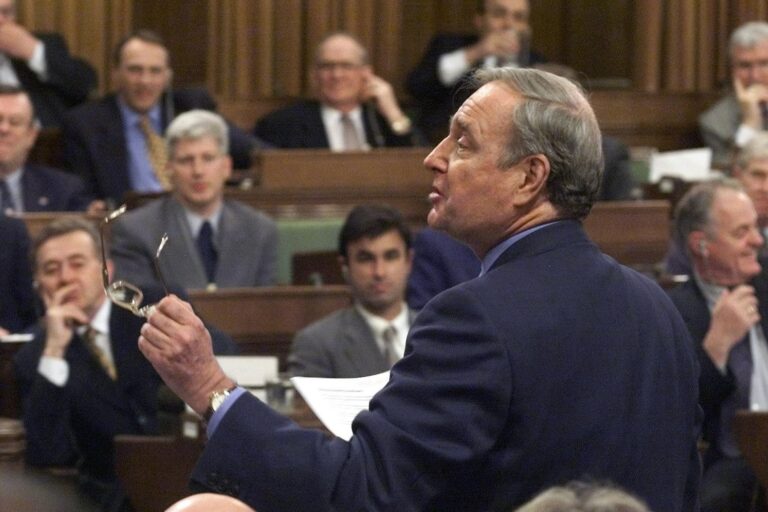
Former Bank of Canada governor Stephen Poloz in Ottawa in November 2022. Photo: The Canadian Press/Adrian Wyld
Hicks’s decision to fire hundreds of people ahead of the Christmas shopping season was a grim omen for what could be coming. But fewer job posts isn’t necessarily a bad thing. Interest-rate spikes of the magnitude we’ve experienced over the past couple of years typically cause a similar spike in unemployment. Bank of Canada governor Tiff Macklem said that might not happen this time because an unusually high number of vacancies would act as a cushion; employers would adjust to weaker demand by eliminating unfilled positions rather than actual workers.
That’s what Canadian Tire did this week, possibly limiting the number of jobs it might have cut otherwise. Hicks didn’t sound like someone who feels good about the economy’s near-term prospects. Customers are bringing fewer items to the counter, and those items tend to be “essential” purchases rather than discretionary. By combining its own data with broader household indicators, Hicks said he reckons that the combination of higher interest rates and highly indebted households has become a significant weight on consumption, especially in British Columbia and Ontario, the sites of the least affordable housing markets in the country.
“We are focused on controlling what we can control and that includes taking action to reinforce our resilience,” Hicks said.
One of the things that Hicks controls is how much to invest in the shift to the digital economy. He went out of his way to defend his Oct. 31 decision to repurchase Scotiabank’s stake in Canadian Tire’s financial-services arm for $895 million. Hicks acknowledged that he paid a “control premium,” but insisted that having unimpeded access to “first-party” data from the Triangle rewards program would be worth it. The company is using that information to establish direct relationships with its most loyal customers, which should allow it to execute more effective promotions.
Canadian Tire appears to be doing a lot of the right things. The company has taken control of its supply chain, and is on track to reduce the number of third-party logistics companies on which it depends from 15 to zero at the start of the year. It’s deploying artificial intelligence to ensure store layouts align with what customers like to buy. Chief financial officer Gregory Craig said Canadian Tire has invested more than $1 billion in the business since 2022, and would invest around $600 million in 2024. Craig said that’s a faster rate of investment than the company has done in the past.
Still, it’s not as aggressive as it could be. A CIBC analyst observed on the call that the target for 2024 is a cut from the previous estimate. But Canadian Tire opted to raise its dividend and allot an additional $200 million for repurchasing shares. The future might be structurally uncertain, but pleasing shareholders might be the one variable that will remain constant—and Canadian Tire’s share price is down some 20 per cent from six months ago.
The stock was little changed after the latest earnings report. Maybe Hicks should have stuck with his original investment plan and made his company even more resilient.
Kevin Carmichael is The Logic’s economics columnist and editor-at-large. He has spent more than two decades covering economics, business and finance for outlets including Bloomberg News, The Globe and Mail and the Financial Post, where he also served as editor-in-chief.