There are weeks when Scott Stevenson conducts as many as 50 job interviews.
The CEO of Newfoundland-based Spellbook, a platform that uses AI to read and improve legal documents, is on a hiring bonanza as it looks to roughly double its workforce to about 80 employees this year. In a fast-paced industry like AI, finding the right people is critical to the company’s growth plans.
“The amount of time we spend on recruiting is ginormous,” Stevenson told The Logic in an interview.
Talking Points
- Silicon Valley is in a talent war as tech giants vie for the best and brightest AI minds
- While the same scale of hiring hasn’t hit Canada, AI companies here face a number of hiring challenges amid a wider labour shortage and a lack of available engineers with applied AI experience
Spellbook’s hiring spree comes amid an industry-wide rush for AI-related talent. U.S. tech giants in particular have been poaching top researchers and engineers in a bid to ensure their technologies remain leading-edge.
Elon Musk recently announced Tesla was hiking AI engineers’ pay amid what he called “the craziest talent war I’ve ever seen.” OpenAI is reportedly awarding US$10-million pay packages to AI researchers. Google is offering special stock options. And Meta CEO Mark Zuckerberg has personally reached out to potential hires in an effort to snap them away from rivals.
The race for talent north of the border, according to a number of artificial intelligence CEOs and founders The Logic interviewed, appears more muted. But AI hiring is nonetheless on the rise. According to Indeed, a job search firm, 2.4 per cent of Canada’s job postings at the end of March 2024 included references to AI, up from 1.9 per cent a year earlier. Over the same period, 0.15 per cent of postings mentioned generative AI—a small proportion but up sharply from just 0.03 per cent in mid-2023.
At the same time, a tight labour market, growing AI competition globally and Canada’s emphasis on research-oriented artificial intelligence could pose challenges to Canadian companies looking to fill roles related to AI.
Calling all applied AI engineers
Spellbook is currently working to expand its platform so that it can interpret multiple legal documents at once. To do that, the company will have to bring on a variety of specialists including “AI tinkerers” who can fashion new products on top of existing AI technology.
People on the move:
- Dax Dasilva returned as CEO of Lightspeed, replacing Jean Paul Chauvet.
- Peter Aceto, former CEO of Tangerine as well as at CannTrust, joined Koho.
- Jake Lawrence left his role as CEO of Scotiabank’s capital markets business to join Power Corp. as CFO.
- General Motors appointed Kristian Aquilina as GM Canada’s president and managing director. He replaces Marissa West, who is now senior vice-president and president of GM North America.
- Intellectual Property Ontario named Dan Herman as CEO.
- Tim Deacon left the Ontario Teachers’ Pension Plan to become Sun Life’s CFO.
- Adrian Montgomery returned as interim CEO of Toronto’s Enthusiast Gaming, replacing Nick Brien.
- Bitcoin mining company Bitfarms is searching for a new CEO to replace Geoffrey Morphy.
- Former SkipTheDishes CEO Kevin Edwards joined Eirene Cremations—an online funeral arrangements startup—as chief operating officer.
- Top Hat CEO Joe Rohrlich and CRO Matt Schurk departed from the edtech firm. Its former CMO, Maggie Leen, was named CEO.
- MindBridge Analytics hired Stephen DeWitt, a former Silicon Valley executive, as chief executive.
- Alida, a Toronto-based customer-insights software company, appointed Efrem Ainsley as CEO after Ross Wainwright stepped down.
- Flashfood founder Josh Domingues stepped down as CEO and took on the role of executive chairman. He was replaced as CEO by Nicholas Bertram.
- Amazon hired Jacob Glick as head of public policy for Canada.
- Melika Carroll joined Cohere as leader of global government affairs and public policy.
Compiled by Sebastian Leck
“The skill sets that we need most are not necessarily the deep R&D machine-learning research,” Stevenson said. “For us, it’s actually looking for really open-minded, pragmatic engineers who are excited to use a brand new technology.”
That kind of talent is in short supply, he said, in no small part because of what he views as Canada’s long-time focus on academic AI, in particular fundamental AI research.
“There just are not many of those in Canada right now compared to the Bay Area.”
Fundamental research qualifications are valuable for employees at one of the few companies in Canada building AI from the ground up, but they are “actually not that helpful for most companies,” he said.
No unicorns needed
Nicole Janssen, co-founder and co-CEO of Edmonton-based AI software development firm AltaML, said her company has avoided the talent rush that has taken hold of Silicon Valley. Major U.S. tech companies are mostly vying for highly specific and sought after individuals who are proficient in areas like large language models popularized by the latest versions of ChatGPT.
“They’re looking for the unicorn that knows generative AI in a specific industry,” Janssen said.
That might involve, for example, finding someone who both understands generative AI and understands financial services—a skill set that Janssen said only a handful of potential hires might possess.
“For those people, the market is just insane.”
Rather than compete with mega-firms for those specialized individuals, AltaML has sought to develop similar talent by combining the know-how of several people. That might involve partnering a software engineer with, for example, a machine learning engineer who’s worked in a particular industry, she said.
By the numbers:
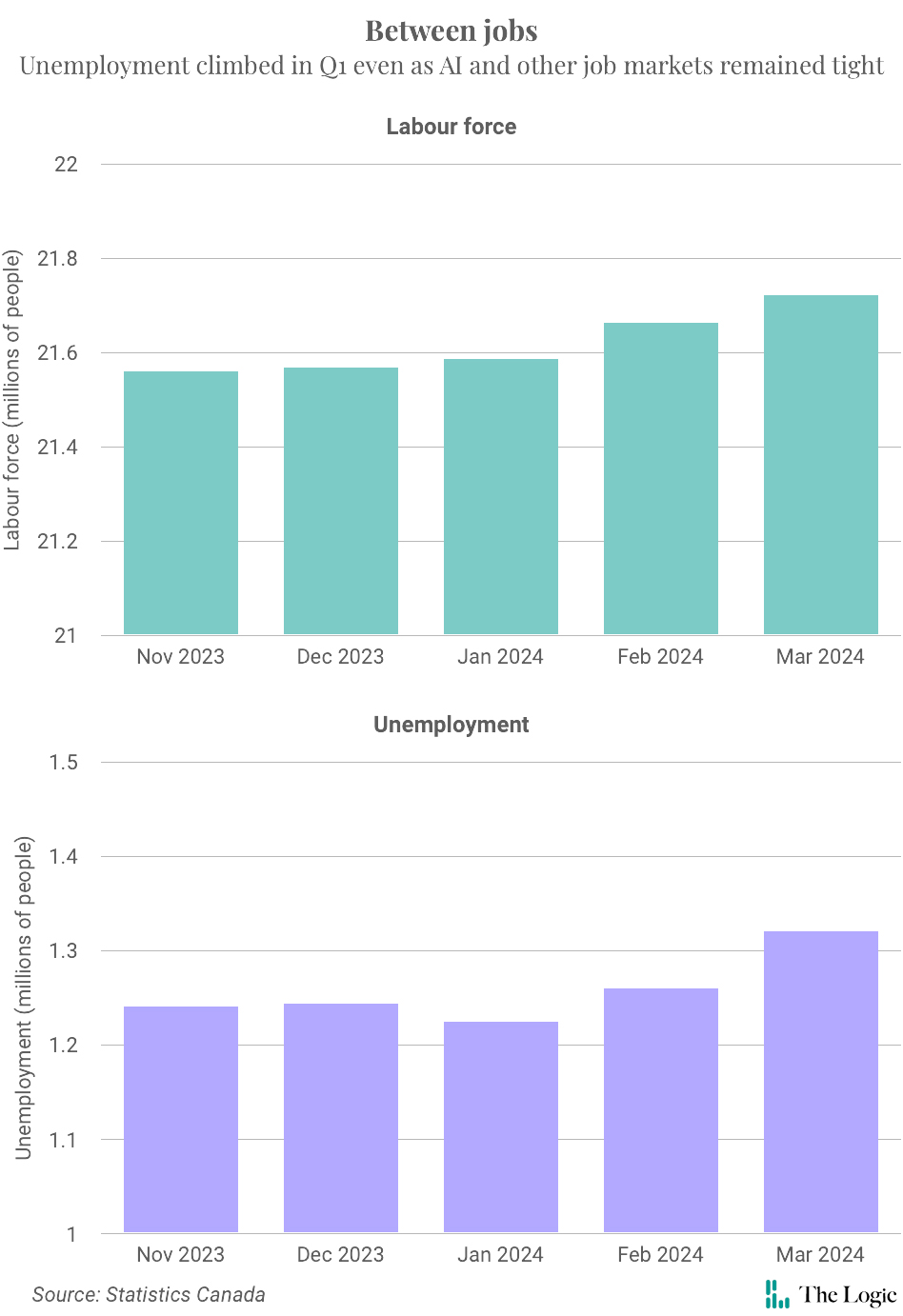
6% – Canada’s unemployment rate in the first quarter of 2024. It hit 6.1 per cent in March, the highest level since 2021, leaving around 1.3 million eligible workers unemployed.
$34.81 – The average Canadian hourly wage as of March. Salaries increased 5.1 per cent over the month following a 0.5 per cent increase in February, as tight labour markets continue to push wages higher.
6 – The number of consecutive months Canada’s employment levels have dropped. Employment rates dropped to 61.4 per cent in March 2024 as the labour market continues to show signs of cooling.
“Put them together as a team and together they’re excellent. And that’s been our approach to it.”
Tim Hewat, a Toronto-based partner at LHH Knightsbridge Executive Search, said finding the right AI talent is increasingly on the minds of business leaders as the technology becomes more prevalent.
“Every CEO would be focused on this, and they’d be looking for people who had a depth—not perfect, but a depth—of AI expertise, both at the technical level, but I would say more importantly, at the business level,” he said.
The ‘talent food chain’
Louis Têtu, CEO of Quebec City-based Coveo, said there “remains a lot of scarcity of talent” in Canada’s digital economy, including in AI. But it’s getting easier to hire in the industry compared to during the global pandemic, when demand for digital talent soared.
“We saw some crazy salaries happening because of the compounded effect of the digital shortage in the pandemic combined with scarcity of talent in AI,” he said.
Coveo, which provides AI-driven search, personalization and other capabilities to client websites, is among Canada’s largest employers in applied AI with around 750 employees globally. It counts major firms including Salesforce, Louis Vuitton, Zoom, Adobe and Dell among its clients.
When hiring, he said Coveo can use its relative heft and global reach to attract workers. The companies that secure the best talent, as with other industries, are those that offer superior pay and offer recruits a chance to work on leading-edge technologies.
“Talent is a food chain, so the most advanced and attractive company will hire from the other company that will then hire from the other company.”