Show me the money: Soaring wages clash with firms’ cost-cutting pressures
Talent Quarterly is The Logic’s regular series on employment trends.
Hiring new talent was once a simple enough task. Recruiters would interview their favourite candidates from a pool of applicants, negotiate a salary and begin the onboarding process.
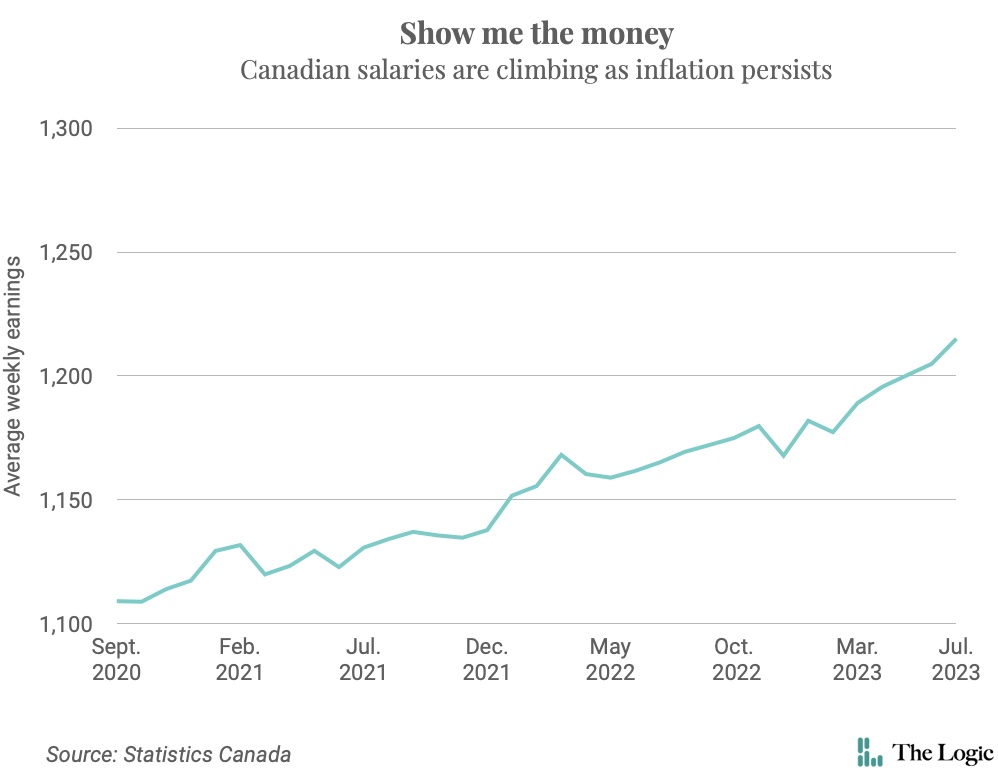
That role has become more challenging amid fast-rising wages—a trend that has persisted for most of the year but intensified in the third quarter. As businesses grapple with rising costs across the board, rapid wage gains are complicating hiring as companies buckle down on costs in an uncertain economy.
Special Report
Show me the money: Soaring wages clash with firms’ cost-cutting pressures
According to Robert Half’s 2024 salary guide, which surveys the tech sector’s hiring and labour trends, 58 per cent of managers said they expect to use more contract workers in the coming year. Photo: The Canadian Press/Christinne Muschi
Talent Quarterly is The Logic’s regular series on employment trends.
Hiring new talent was once a simple enough task. Recruiters would interview their favourite candidates from a pool of applicants, negotiate a salary and begin the onboarding process.
That role has become more challenging amid fast-rising wages—a trend that has persisted for most of the year but intensified in the third quarter. As businesses grapple with rising costs across the board, rapid wage gains are complicating hiring as companies buckle down on costs in an uncertain economy.
Talking Points
Average Canadian wages rose five per cent in the third quarter, outpacing inflation
Higher salary requirements are in turn complicating hiring efforts, as businesses look to trim costs
Recruiters expecting to find bargains in the talent pool amid dwindling private-sector investment levels are often surprised to find salary requests are well above company budgets, said Nathan Wawruck, vice-president at HR consulting firm Robert Half.
“It’s a bit of a reality check for people who are hiring,” he said.
Wages take off
Labour markets have been tight for some time, but new inflationary pressures have begun to bite more recently in the form of rising salaries. According to Statistics Canada, wages increased five per cent in the third quarter, significantly outpacing inflation. Average per-hour salaries leapt $1 in the three months from July to September alone, hitting $29.
People on the move:
Vancouver’s GeoComply, a geolocation and anti-fraud firm, appointed Lindsey Drake as CFO and Kelly Schaefer as chief human resources officer.
Crypto-trading platform firm Wonderfi appointed Dean Skurka as permanent CEO.
Toronto-based legaltech Dye & Durham appointed David Nash as chief product officer and Aaron Eichenlaub as chief revenue officer.
Michael Hill will lead OMERS Infrastructure as executive vice-president and global head of infrastructure.
Quebec’s Deep Sky, a carbon-capture firm, appointed Damien Steel as president and CEO. It also hired Phil De Luna as chief carbon scientist and head of engineering.
Colin McKay stepped down as the Canadian head of public policy and government affairs at Google.
Brian O’Callaghan was hired as CEO of AI drug-development startup Deep Genomics, replacing founder Brendan Frey.
Markham, Ont.-based VentureLab appointed Hugh Chow as CEO.
Toronto-based 1Password hired David Faugno as president and COO.
Neil Desai, formerly Magnet Forensics’s vice-president of corporate affairs, joined Viral Nation as executive vice-president of technology.
Ziad Hindo, CIO of the Ontario Teachers’ Pension Plan, will step down at the end of the year. Bruce Crane, meanwhile, was appointed executive managing director and head of the Asia-Pacific region, succeeding Ben Chan.
Hydro-Québec hired Maxime Aucoin, who was a CDPQ vice-president and former McKinsey consultant, as executive vice-president of strategies and finance, starting Oct. 10.
Wage growth was so buoyant that some economists expect it could take on an emphasized role in the Bank of Canada’s upcoming interest-rate decision on Oct. 25, potentially leading governor Tiff Macklem to return to monetary tightening after last month’s pause.
“Wages scream ‘hike’ to the Bank of Canada,” Scotiabank economist Derek Holt wrote in a research note earlier this month. The 64,000 jobs created in September—and the 40,000 jobs in August—are “certainly nothing to spit at,” Holt wrote.
According to the central bank’s own business outlook report released Monday, which surveyed over 700 business leaders throughout the quarter, wage increases are expected to continue climbing over the next 12 months, despite rising at a slower pace than last year’s peak.
Calling all cyber experts
According to Robert Half’s 2024 salary guide, which surveys the tech sector’s hiring and labour trends, 58 per cent of managers said they expect to use more contract workers in the coming year to sidestep the rising costs associated with paying full-time workers. Another 23 per cent are considering hiring people on an interim basis.
Cybersecurity workers received the largest pay bump, according to the study. Next up were cloud-computing experts, AI and machine learning experts and development opportunity engineers who specialize in making existing systems leaner and more efficient.
The clawback
September marked the eighth consecutive month where wage growth outpaced inflation, reversing a 23-month trend of lagging pay growth. With that, workers are finally beginning to make up for several years of above-average price increases in everything from groceries to lightbulbs.
“Workers are clawing their way back,” said David Macdonald, senior economist at the Canadian Centre for Policy Alternatives.
Still, it’s not clear how long that trend can continue. Even as some economists expect a Bank of Canada rate hike later this month to temper wage growth and broad-based inflation, real GDP growth has remained flat over the last 10 months, and “hints of cracks” are beginning to show in the labour market, Macdonald said—for example in the form of higher levels of part-time work.
A (modest) respite from high prices
But those cracks are hairline fractures. In an economy where inflation has fallen from its pandemic peak, employment levels have surged in the opposite direction, confoundingexperts.
“We’ve just seen dead-flat real GDP growth—the economy isn’t growing,” Macdonald said. “That hasn’t translated yet to the labour market.”
By the numbers:
60%: The number of Canadian job seekers willing to take a pay cut for flexible hours. A Harris survey found that work-life balance was a primary concern among candidates (79 per cent), followed by salary (77 per cent).
$244,500: The average annual salary of a chief information officer. According to Robert Half, CIOs performing in the top 50th percentile make an average $244,500, while those in the top 75th percentile earn $290,750.
0.6%: The employment increase for women aged 25–54 in September. That demographic had particularly high employment levels over the month, adding 37,000 new positions.
Prices for household goods and other services, he said, aren’t about to return to their pre-pandemic levels. Therefore, wage growth is the only way that workers’ purchasing power will catch up with the last few years of runaway prices.
“The question is whether economic growth starts to turn negative as a result of the impact of much, much higher interest rates, and whether workers ever manage to square that circle.”
It’s an (office) dog’s life
To combat rising salary pressures, many firms are opting for a more tailor-made approach to hiring.
“There’s literally no one-size-fits all,” Robert Half’s Wawruck said. “In the past, employers were like: ‘All right, here’s our company policy. Here’s our handbook. Take it or leave it.’ … That doesn’t really apply anymore—it’s [become] a lot more granular.”
“It pushes the burden onto the managers and onto the employers to really slow down and figure out what is each person’s unique set of circumstances,” he said.
There are various ways in which companies can adopt a more tailored hiring approach, including offering more flexible work hours or remote-work arrangements, Wawruck said. But it might also involve providing specific health benefits, or additional supports to help employees look after elderly family members.
In some cases, businesses have introduced more pet-friendly offices where employees can bring Fido to work, or the ability to leave the office during specific time slots to tend to their puppies and cats.
“A lot of people bought pets during the pandemic,” Wawruck said. “They’ve got dogs and cats at home that aren’t very independent because they’ve just been coddled so much.”
Recipients will be able to read the full text of the article after submitting their email address. They will not have access to other articles or subscriber benefits.
Great journalism delivered straight to your inbox.
News
Tech firms want AI models to create better versions of themselves
By
Murad Hemmadi
Briefing
Lightspeed cuts 250 jobs through layoffs and attrition
By Claire Brownell |
Oil tycoon Adam Waterous aims to build new Canadian energy player with US$1B fund
By Meghan Potkins |
Data centre infrastructure firms 3C and Datalec merge, plan Calgary expansion
By Catherine McIntyre |
Best business newsletter in Canada
Get up to speed in minutes with insights and analysis on the most important stories of the day, every weekday.
Exclusive events
See the bigger picture with reporters and industry experts in subscriber-exclusive events.
Membership in The Logic Council
Membership provides access to our popular Slack channel, participation in subscriber surveys and invitations to exclusive events with our journalists and special guests.