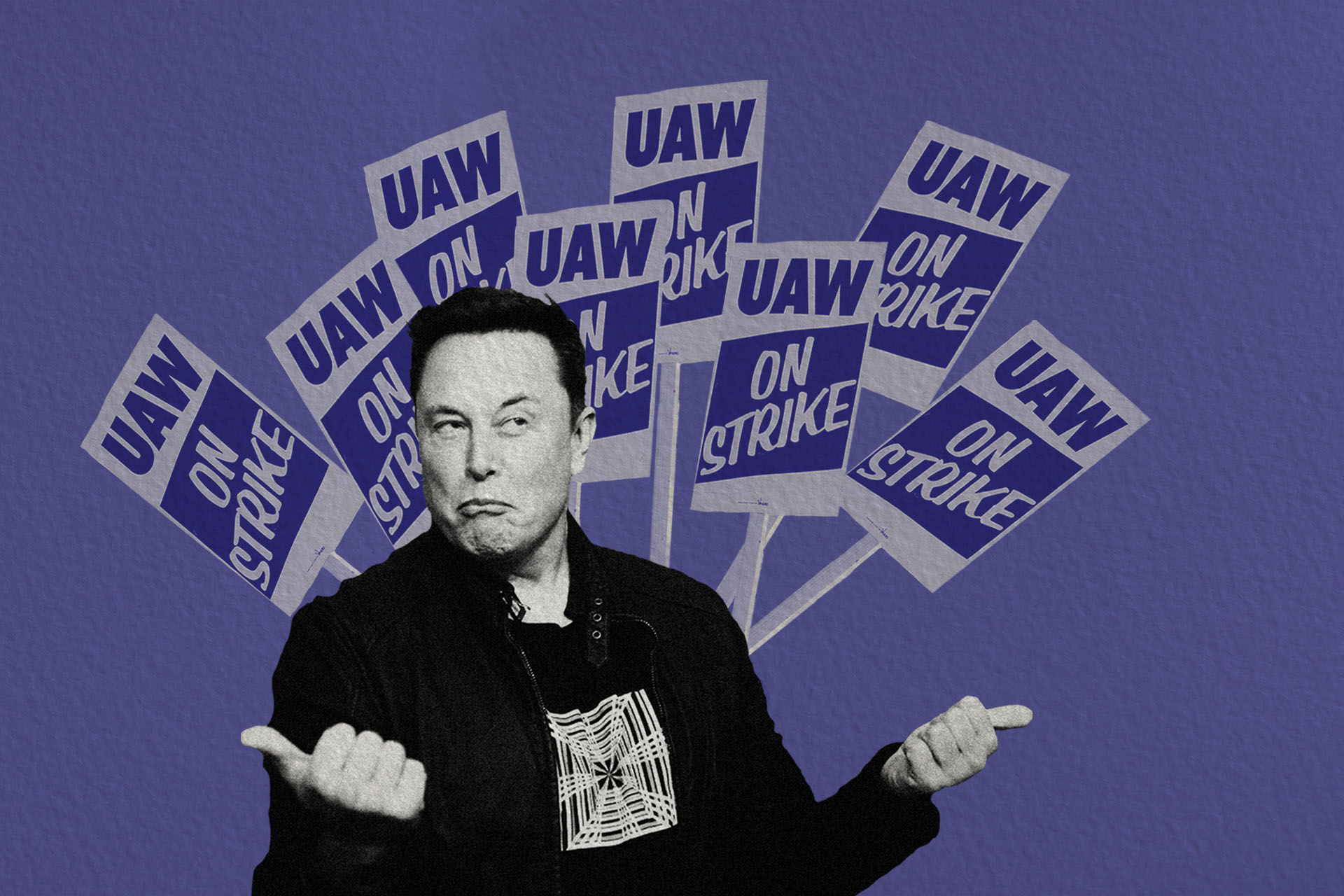
If you ask Wedbush Securities analyst Dan Ives, whatever the outcome of the tense negotiations between U.S. auto workers and Detroit automakers, there will be one big winner: Tesla.
Ford and General Motors face “a potential nightmare situation,” Ives wrote in a recent note, with the potential for a sweeping strike by the United Auto Workers that could put their EV transformations on hold just as they were beginning in earnest. Elon Musk and non-unionized Tesla, Ives wrote, will have “champagne now on ice.”
The state of play: Unifor, the union representing Canada’s auto workers, reached an evening deal with Ford this week that will avert a strike with Ford if the workers ratify it. The terms of the deal aren’t yet public, but it could serve as a template for General Motors and Stellantis and create a path for Ford to overhaul its Oakville, Ont., plant to make EVs.
South of the border, the United Auto Workers have set a noon Friday deadline to keep their current strike, which affects just one facility from each of the Detroit 3, from escalating. Ford warned the picketing UAW that they were harming the company’s chances of “beating non-union foreign automakers.”
The UAW has dismissed that argument, saying, “Most of these workers in those companies are scraping to get by so that greedy CEOs and greedy people like Elon Musk can build more rocket ships and shoot themselves in outer space.”
Why Tesla looms: Most of Tesla’s facilities aren’t unionized—and according to the U.S. National Labor Relations Board, some people in the company have made an effort to keep it that way.
The board found that Tesla managers illegally silenced workers from discussing pay at a Florida repair shop. The watchdog has previously found that Tesla violated workers’ right to wear union shirts, a decision on which judges heard an appeal earlier this month. Separate comments by CEO Musk, suggesting union workers would give up their stock options, are the subject of ongoing litigation.
Despite being a top choice for new engineering grads, Tesla also pays lower median wages. The company’s most recent proxy statement said its median pay was US$34,084 in 2022, including part-time employees. GM estimated its median pay was about US$80,034, while Ford estimated that it was about US$74,691.
There are some differences in how the companies calculated their “median” pay. However, analysts generally estimate that Tesla has lower labour costs, according to Robert Streda, who covers diversified industries as a senior vice-president at DBRS Morningstar.
“Ultimately, [labour]’s a small part of the overall production costs,” Streda said in an interview this week with The Logic. “That being said, it’s one of the few major categories that the [manufacturers] are still able to exert some control over.”
On the flip side: Does that mean that Tesla can swoop in with new cheap and plentiful EV options and win even more market share while the Detroit 3 negotiate with workers?
Streda said Detroit automakers have plenty of cash and inventory ready to protect their highest-volume products like pickup trucks and SUVs.
“I certainly don’t think any short-term interruption in supply is going to be enough to shift a potential customer away from their desired product toward another competitor,” said Streda.
Stephanie Brinley, an associate director of auto intelligence at S&P Global Mobility, said that after years of supply–chain shortages, there’s a cap to how much market share any one company can really steal from the Detroit 3. In other words, even if a non-union company like Tesla could convince a car buyer to switch their from a GMC Savana van, for example, they’d have to find a way to make enough cars to meet that demand.
Depending on how long the strike goes on, in the scheme of the decade-plus long transition from gas power to EVs, it’s “a blip,” she said.
Something to watch: Musk has praised the work ethic of auto workers in China, which has led the EV transition with lower-cost vehicles. It’s not clear how well those vehicles would translate to a North American market, but it could be motivation for North American automakers to keep their future costs in line.
“Unless they are particularly removed geographically, [non-unionized automakers] are going to ultimately have to match or … near match to what Unifor negotiates,” said McMaster University associate professor Greig Mordue, who formerly ran corporate planning and external affairs at Toyota Canada’s manufacturing division.
“Now we’re looking at a world where the Chinese manufacturers are ahead of the curve.”
Read Shift—The Logic’s authoritative weekly newsletter on automotive technology industry news—for more; and if you know someone who should be reading it, they can sign up here.