Linda Deneweth notices the difference every morning when she opens the Back Road Cafe. The little restaurant on Grand Marais Road in Windsor, Ont., has an old-fashioned two-door coach car emblazoned on its signage and menus, a nod to the nearby Stellantis assembly plant.
Skip to content
 Dave Cassidy, president of Unifor Local 444, speaks at a Labour Day event. Photo: Unifor | Handout
 James Panos, owner of Mr. Burger in Oshawa, Ont. on Sept. 24, 2021. Photo: Anita Balakrishnan/The Logic

Exclusive
The global chip shortage is creating a ‘perfect storm’ in Ontario’s beleaguered auto towns
The General Motors assembly plant in Oshawa hasn’t suffered as much from the chip shortage as some others in Ontario. Photo: The Canadian Press/Nathan Denette
Linda Deneweth notices the difference every morning when she opens the Back Road Cafe. The little restaurant on Grand Marais Road in Windsor, Ont., has an old-fashioned two-door coach car emblazoned on its signage and menus, a nod to the nearby Stellantis assembly plant.
For the past 32 years, a regular clientele has dropped in for burgers or spaghetti dinner. But the Back Road Special is breakfast—specifically, two eggs, homefries, bacon, ham, sausage and toast. The crew on the midnight shift at the plant would usually begin ordering at 6 a.m. Now, the days start slower at the cafe, with the plant idle most weeks due to the global semiconductor shortage.
Talking Point
As vehicles become more dependent on semiconductors, the ongoing chip shortage is impacting more and more people who depend—directly or indirectly—on Ontario’s auto industry.
“There was a time where my majority of the customers were the factory workers, and that’s gone,” Denewith said. She’d like to see the plant up and running again, she said, “not even for my restaurant.
“For them—for the workers—and for Windsor.”
From small parts suppliers to local haunts, people like Deneweth are part of an ecosystem built around Ontario’s auto industry. As cars have developed far beyond that two-door coach, semiconductors have become essential to their manufacture. But amid the COVID-19 pandemic, the industry was hit with a “perfect storm” that wiped out the supply.
When the shortage began, about 70 per cent of all automotive microcontroller chips were manufactured by Taiwan-based TSMC, according to IHS Markit, putting almost all the industry’s eggs in one basket. Their “just-in-time” business model meant automakers kept little in the way of stockpiles, McKinsey & Company found. As the pandemic descended in the first half of 2020, demand for new cars plummeted, and when it began to rebound, automakers weren’t confident enough to ratchet up their semiconductor orders.
Meanwhile, chipmakers shifted their focus to churning out chips for computers and other devices to meet demand spurred by home schooling and remote work, and the rollout of 5G. When automakers realized they needed more, manufacturers were already busy with other orders—and many chipmakers weren’t willing to invest in production capacity for semiconductors they consider outdated. Then, this year’s deep freeze in Texas shut down chip plants in the state. BlackBerry attributed recent disruptions in its auto business to fires in chipmakers’ plants and spiking COVID-19 cases in parts of Asia.
As a result, the world’s automakers have struggled to make vehicles, and could lose US$210 billion in sales.
It’s a global economic story, but in Ontario’s auto towns it’s a local one.
“When Windsor Assembly Plant is not running, the town is a ghost town,” said Dave Cassidy, president of Unifor Local 444, in an interview with The Logic.
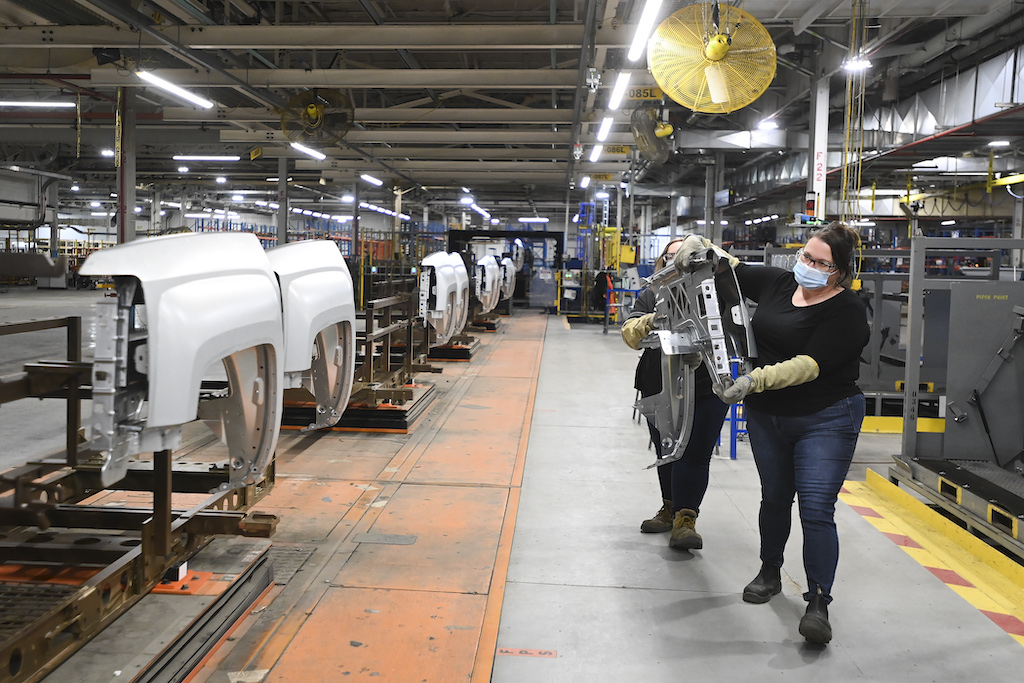
The normal rhythm for Windsor’s assembly plant is the sound of a new minivan rolling off the Stellantis assembly line every 48 seconds. Each Chrysler Pacifica, Grand Caravan or Chrysler Voyager minivan takes 27 hours to build, and puts food on the table for 4,398 workers.
This year, the factory floor has been all but silent for 26 weeks—that’s 3.7 million would-be working seconds for which each employee hasn’t known when their next paycheque will come.
Another Stellantis plant, in Brampton, Ont., has been idle for 11 weeks. General Motors said its plant in Ingersoll, Ont., has been “largely” down since February (as of September, many union workers there reported having worked just three weeks this year.) Ford has also faced widespread plant shutdowns, including in Canada, but did not provide The Logic with exact downtime numbers; spokeswoman Kelli Felker said she did not have information at that level of detail.
“Some of our newer members take this job, they buy cars and homes with the belief that their income will be X amount of dollars. Then something this unprecedented hits us,” said Cassidy.
“Thinking we’re working next week, they line up plans for babysitting, transportation, and then we hear from the company on Friday that you’re off Monday…. It affects a lot of people with their family life.”
Cassidy said Ontario plant workers are able to apply for employment insurance, and some more senior unionized workers receive a “top-up” under their collective-bargaining agreement. But in many plants, the workforce was already worn thin after buyouts and shift cuts. Now, some workers are training for potential second careers.
“They were reeling from a lot of unexpected downtime from COVID. This could not have come at a worse time,” said Cassidy. “I’ve been there 29 years. I mean, I’ve seen the auto industry’s peaks and valleys. And we are really in a valley here.”
In an online survey by VerticalScope from Aug. 31 to Sept. 21, nearly 45 per cent of respondents said the semiconductor shortage was affecting the availability of the vehicle they wanted to purchase. Auto sales fell 19.6 per cent in September, according to DesRosiers Automotive Consultants, which predicted a volatile market for months ahead with “the semiconductor issue clouded in uncertainty.”
Shah Fallahi, vice-president of 180-person Ontario auto supplier Global Plas, considered his business one of the lucky ones since a major client, Toyota, had a considerable cache of chips—that is, until a few weeks ago when it began suspending production at some plants. Global Plas hasn’t laid anyone off, but it has halved its daily workforce as it awaits guidance for the month.
“From an employee perspective, of course they are concerned. They don’t know what to do,” he said.
For Cassidy, the chip shortage is an example of the issues that come with outsourcing manufacturing.
“I’m really, really upset at the shortsightedness of these corporations,” he said. “They save a nickel to build overseas, when they could have spent a dime and built it right here in Canada.”
The uncertain fate of Ontario’s auto plants evokes a familiar feeling for James Panos, who owns Mr. Burger in Oshawa, Ont. The restaurant—which sits next to a tire shop, across from auto-glass, autobody, multiple auto-repair shops—has had to get creative to reach other customers in the past three years since GM last downsized the plant before reviving it last year.
So far, it seems the Oshawa plant is likely to be spared from the brunt of the chip shortage. GM said in May it would guard pickup trucks from the shortage and reopen the retooled Oshawa plant ahead of schedule. GM now tells The Logic that pickup production will begin there before the end of the year.
The pandemic and chip shortage has shown Panos that Mr. Burger can still thrive outside the shadow of the auto plant. But Panos, whose great-grandfather worked at GM and whose restaurant walls are decorated with licence plates and prints of vintage cars, can’t help but be happy on the days when lunch orders start trickling in from the plant again.
“This business was only supported by the auto plant for 20 or 30 years,” he said.
“I was able to pivot with GM closing, I was able to maintain the same amount of sales…. Now fortunately, GM’s been back for a few months now. And we are probably getting another five to six big large orders a week. It’s not what it was before … but we’ve been getting that extra business back.”



Loading...
Thanks for sharing!
You have shared 5 articles this month and reached the maximum amount of shares available.
CloseThis account has reached its share limit.
If you would like to purchase a sharing license please contact The Logic support at [email protected].
CloseGift the full article!
You have gifted 0 article(s) this month and have 5 remaining.
Recipients will be able to read the full text of the article after submitting their email address. They will not have access to other articles or subscriber benefits.
Photo: The Canadian Press/Nathan Denette
Dave Cassidy, president of Unifor Local 444, speaks at a Labour Day event.
James Panos, owner of Mr. Burger in Oshawa, Ont. on Sept. 24, 2021.
Most Popular This Week




In-depth, agenda-setting reporting
Great journalism delivered straight to your inbox.
News
National Bank CEO warns AI alone won’t give banks a lasting edge
Briefing
Canada and Ontario commit over $5B to support tariff-hit steel sector
Hackers will see cars as major targets in next 3 years, 83% of car-tech workers say
EA shutting down Edmonton studio BioWare
Best business newsletter in Canada
Get up to speed in minutes with insights and analysis on the most important stories of the day, every weekday.
Exclusive events
See the bigger picture with reporters and industry experts in subscriber-exclusive events.
Membership in The Logic Council
Membership provides access to our popular Slack channel, participation in subscriber surveys and invitations to exclusive events with our journalists and special guests.





