MONTREAL — In late December, Quebec’s cybersecurity minister, Éric Caire issued a ministerial decree against Chinese electronics companies Hikvision and Dahua. Not only did it prohibit Quebec’s public institutions from installing new Hikvision and Dahua telecommunications and surveillance tech. In ordering these institutions to dismantle geolocation, install firewalls and otherwise detach both companies’ existing equipment from the internet, Caire made explicit what he teased in the decree’s preamble: Hikvision and Dahua pose a significant security threat to the Quebec state.
Skip to content

 Shodan's online tool shows Dahua and Hikvision devices connected in and around Petawawa, Ont., the site of a major military base. Photo: Screenshot | Shodan
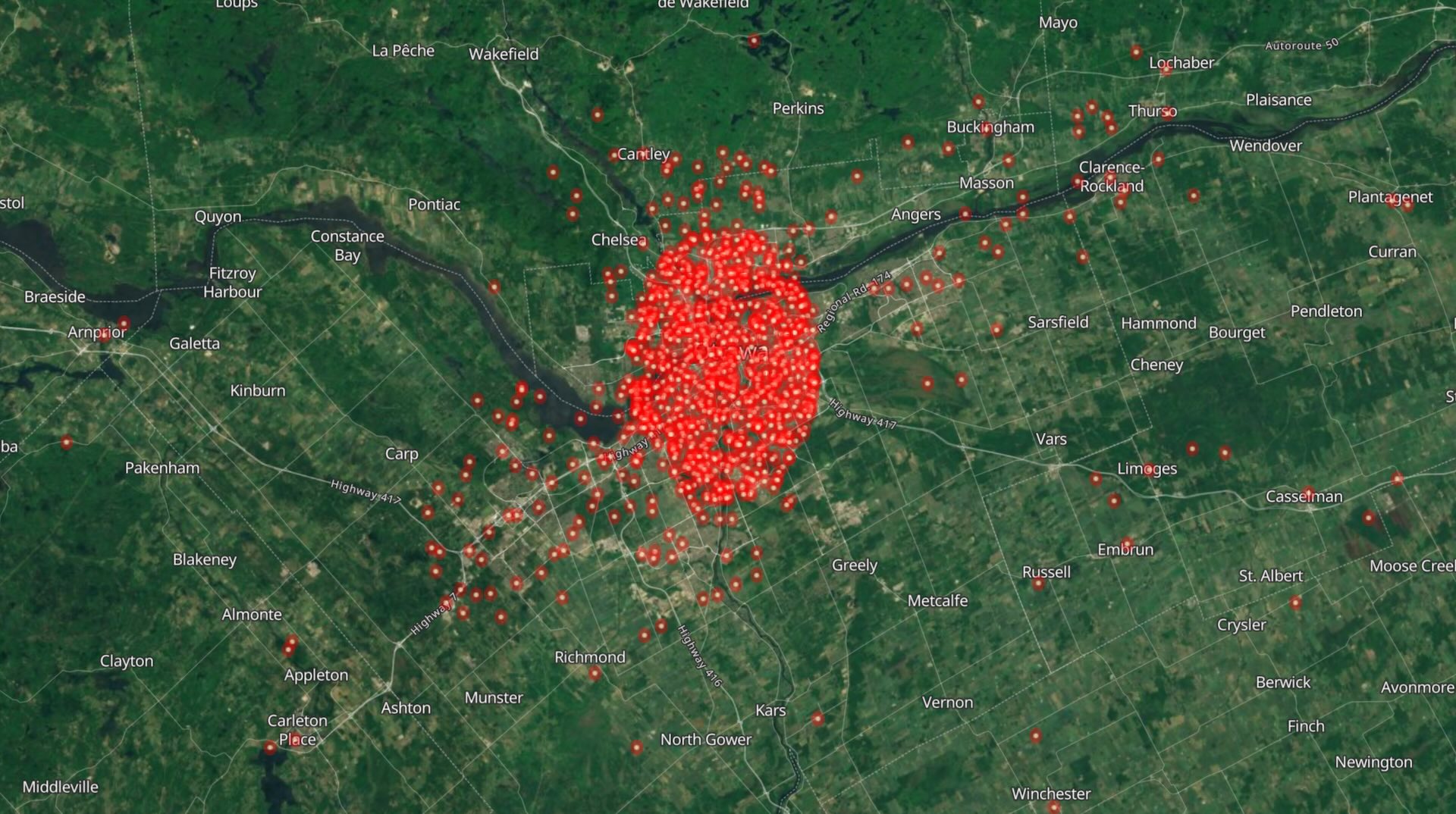 Ottawa has a heavy concentration of Dahua and Hikvision devices. Photo: Screenshot | Shodan

Commentary: Quebec Ink
Quebec has banned Chinese-made surveillance gear. Why won’t the feds?
An estimated 51,000 of the internet-connected devices are operating across Canada
A Chinese flag flies near a Hikvision security camera monitoring a traffic intersection in Beijing, Tuesday, Oct. 8, 2019. Photo: The Associated Press/Mark Schiefelbein
MONTREAL — In late December, Quebec’s cybersecurity minister, Éric Caire issued a ministerial decree against Chinese electronics companies Hikvision and Dahua. Not only did it prohibit Quebec’s public institutions from installing new Hikvision and Dahua telecommunications and surveillance tech. In ordering these institutions to dismantle geolocation, install firewalls and otherwise detach both companies’ existing equipment from the internet, Caire made explicit what he teased in the decree’s preamble: Hikvision and Dahua pose a significant security threat to the Quebec state.
The province’s ban, the first of its kind in Canada, follows similar prohibition of Hikvision and Dahua technology around the democratic world. Australia and the United Kingdom have both removed Hikvision and Dahua cameras from “sensitive” government sites. Ditto Taiwan’s government, India’s navy and the European Parliament, which voted to remove Hikvision cameras from its premises in 2021. In the U.S., the Federal Communications Commission banned the sale of Hikvision and Dahua products outright, along with those of Huawei, ZTE and Hytera Communications.
Related Articles


The reasons are simple and compelling. Hikvision and Dahua are inextricably tied to the Chinese government and its formidable intelligence-gathering operation. Both have enabled the Chinese government’s mass surveillance, subjugation and imprisonment of China’s Uyghur minority.
The ban is a particular concern for Hikvision, whose Canadian research and development centre is based in Montreal. Dahua, meanwhile, revealed last month it is selling its North American operations to a Taiwanese company in order to better do business in the U.S. Whether that will satisfy Washington and the other jurisdictions that have banned its equipment remains to be seen.
It’s business as usual for both companies, though, in the rest of Canada. Despite piles of evidence and precedent, the Liberal government has stayed conspicuously mum on the two companies. Far from banning Hikvision, the feds have asked the company to bid on a contract to install surveillance cameras at the Canada Border Services Agency port of entry in St. Stephen, N.B. As recently as last year, it solicited quotations to install its hardware in schools.
“As a Canadian, I am asked all the time why Canada is not taking U.S. warnings about Hikvision and Dahua seriously,” Conor Healy, the Toronto-born director of government research for IPVM, a Pennsylvania-based surveillance research group, told me. “I get this look of befuddlement, because this information has been communicated to the government. Canada is dragging its feet.”
The result of Canada’s inaction is plain, even shocking, to the eye. Searching for Hikvision and Dahua products on Shodan, an online tool that locates and maps internet-connected hardware, yields masses of red dots over the country’s population centres. There are Hikvision and Dahua devices near military bases, nuclear energy generating stations and one of the country’s busiest airports.
Those dots also blanket the city of Ottawa, including the downtown core and its many government buildings. All told, there are nearly 51,000 Hikvision and Dahua internet-connected devices in the country, according to Shodan data. Since the information is based on IP addresses, Shodan founder John Matherly cautioned against linking a given dot to a specific building. Still, he expressed amazement at the volume of cameras—in Ottawa in particular and Canada in general. “You could be sharing sensitive data with the Chinese government,” Matherly told me. “It’s a huge risk. I don’t understand why any government would take it.”
I reached out to the offices of federal Public Services Minister Jean-Yves Duclos and Treasury Board President Anita Anand. Neither provided comment. Hikvision Canada president Nicolás Zhang said in an emailed statement that the firm’s products are “subject to strict security requirements and are compliant with the applicable laws and regulations in each country and region we operate.” Dahua’s U.S. vice-president, Wayne Hurd, referred me to the company’s media relations department, which didn’t respond to a request for comment.
Like Huawei, both Hikvision and Dahua have made price their key selling point. Hikvision, the world’s largest manufacturer of video surveillance equipment, boasts of its “cost-effective video security system” and “affordable security tech.” The Hangzhou-based company often sweetens deals by offering soft loans to governments looking to purchase its equipment, according to a 2023 draft European Union study; so do Dahua and other Chinese tech providers. And the company’s ready access to Chinese manufacturing facilities meant it suffered fewer COVID-19-era supply chain constraints than, say, Sweden’s Axis Communications.
This cheap tech comes at a price. Hikvision is a subsidiary of the China Electronics Technology Group Corporation (CETG), a state-owned entity sanctioned by the U.S. government in 2021. Hikvision’s controlling shareholder is the People’s Republic of China.
Dahua, the world’s second largest manufacturer of video surveillance equipment after Hikvision, was co-founded by Fu Liquan, the company’s current president. In case you were wondering where Fu’s allegiances lie, consider this quote from a 2008 paper he co-wrote. “During the war era, one could contribute to the country by joining the army. During peaceful times, enterprises can serve the country through industry.”
What’s more, China’s National Intelligence Law compels all Chinese companies to “support, cooperate with and collaborate” with the country’s national intelligence efforts.
I asked Uyghur rights advocate Mehmet Tohti about the fallout from the use of Dahua and Hikvision’s technology. The problem is twofold, he said. In China, Hikvision and Dahua cameras serve as instruments of repression of the country’s estimated 12 million Uyghurs, whose forced imprisonment in labour camps is well-documented and profound.
Meanwhile, Tohti says those countries that use Hikvision and Dahua technology themselves become part of China’s surveillance apparatus. “Those companies are all somehow linked to the Chinese military, and they work for the future of the Chinese authoritarian system,” he told me. Tohti himself is living testament to China’s repression. Since 2016, he hasn’t been able to speak to his relatives in China. “All my family members, I don’t know if they are alive or dead,” he said.
Canada has highlighted China’s systematic abuse before, notably in a 2018 subcommittee report that documented testimony from a number of Uyghurs. What is most noteworthy, apart from the frankly sickening instances of repression and violence visited upon the witnesses, is the “unprecedented use of mass surveillance technology” the report says is required to sustain the persecution. Duly published, the document has mostly gathered dust under the Liberal government. “It’s simply a lack of political courage,” said Bloc Québécois MP and subcommittee member Alexis Brunelle-Duceppe told me.
If so, Quebec’s ban of Hikvision and Dahua is an antidote to cowardice. It is also a valuable precedent, showing that public institutions in this country don’t need cheap surveillance equipment subsidized by the Chinese government. In fact, they use it to their own detriment, and the detriment of others.
Martin Patriquin is The Logic’s Quebec correspondent. He joined in 2019 after 10 years as Quebec bureau chief for Maclean’s. A National Magazine Award and SABEW winner, he has written for The New York Times, The Guardian, The Walrus, Vice, BuzzFeed and The Globe and Mail, among others. He is also a panelist on CBC’s “Power & Politics.”



Loading...
Thanks for sharing!
You have shared 5 articles this month and reached the maximum amount of shares available.
CloseThis account has reached its share limit.
If you would like to purchase a sharing license please contact The Logic support at [email protected].
CloseGift the full article!
You have gifted 0 article(s) this month and have 5 remaining.
Recipients will be able to read the full text of the article after submitting their email address. They will not have access to other articles or subscriber benefits.
Photo: The Associated Press/Mark Schiefelbein
Shodan's online tool shows Dahua and Hikvision devices connected in and around Petawawa, Ont., the site of a major military base.
Ottawa has a heavy concentration of Dahua and Hikvision devices.
Most Popular This Week



In-depth, agenda-setting reporting
Great journalism delivered straight to your inbox.
Commentary
Carmichael: Macklem steels the Bank of Canada for a more shock-prone world
Briefing
Mackenzie Valley Highway project gets national-interest designation
Ottawa pumps $6.5B into Canada’s tariff-battered forest industry
Wealthsimple users slam cuts to perks and interest rates
Best business newsletter in Canada
Get up to speed in minutes with insights and analysis on the most important stories of the day, every weekday.
Exclusive events
See the bigger picture with reporters and industry experts in subscriber-exclusive events.
Membership in The Logic Council
Membership provides access to our popular Slack channel, participation in subscriber surveys and invitations to exclusive events with our journalists and special guests.