MONTREAL — Pierre Fitzgibbon, the most powerful minister in recent Quebec history, was also one of its most quotable. Contemporary politics is a world of polish and restricted access. Fitzgibbon got on the phone and hemorrhaged quotes. When he suddenly resigned as innovation and economic “superminister” last week, the journalist in me was grieved. No more hulking anachronism who liberally dropped F-bombs while steering a $590-billion economy.
Skip to content

Commentary: Quebec Ink
The ‘superminister’ who said the quiet part out loud
Pierre Fitzgibbon spoke truth to Quebecers about the cost of electricity. In politics, that’s not a winning play
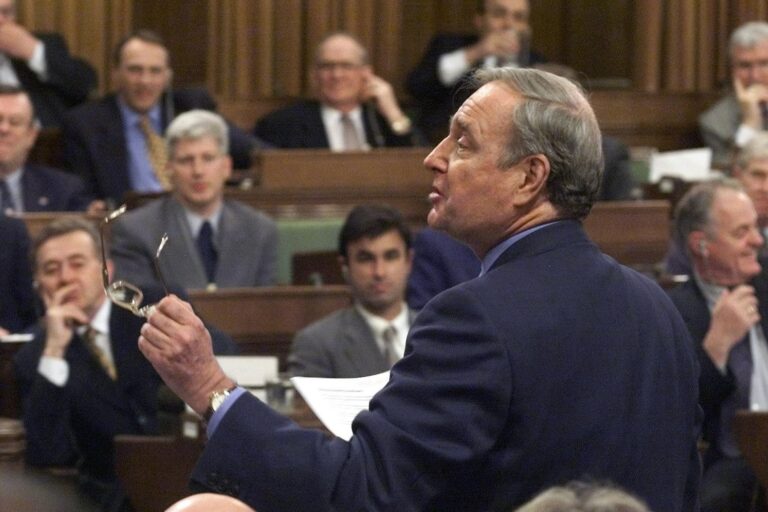
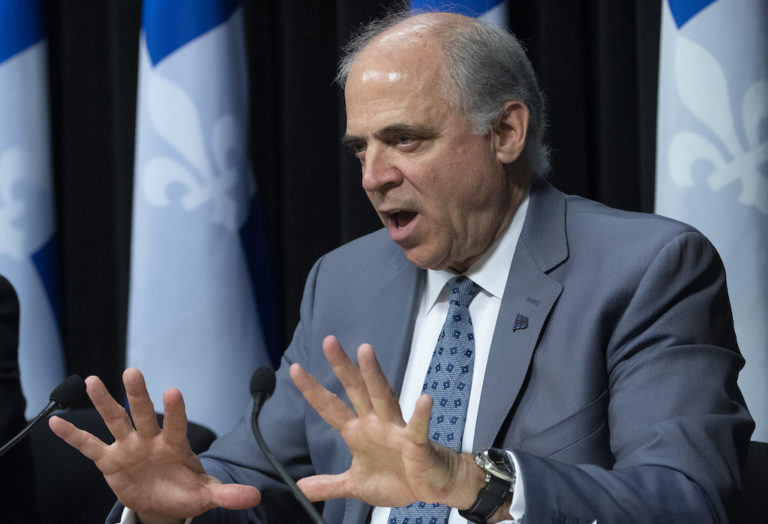
Pierre Fitzgibbon, left, and Quebec Premier François Legault at a news conference in September 2021 when Fitzgibbon was minister of innovation and economy. Photo: The Canadian Press/Jacques Boissinot
MONTREAL — Pierre Fitzgibbon, the most powerful minister in recent Quebec history, was also one of its most quotable. Contemporary politics is a world of polish and restricted access. Fitzgibbon got on the phone and hemorrhaged quotes. When he suddenly resigned as innovation and economic “superminister” last week, the journalist in me was grieved. No more hulking anachronism who liberally dropped F-bombs while steering a $590-billion economy.
His timing isn’t great. Fitzgibbon oversaw Hydro-Québec, and he leaves office just as he was in the midst of one of the biggest overhauls in its 60-year history. The hydroelectricity utility is investing as much as $185 billion to add 9,000 megawatts, equivalent to the output of three of its largest generating facilities, by 2035. Even that isn’t enough. Hydro-Québec has promised to become the first carbon neutral territory in North America—even as it exports green power to the U.S. To fulfill that pledge, Fitzgibbon said in June, it needs to double its current output within the next 25 years.
Officially, he left because his heart was no longer in the job. I’m sure this is partly true. Government can be an awkward fit for self-made millionaires like Fitzgibbon, who literally lost count of the number of ethics investigations he faced over his eight years in office. (His guess: eight. The actual number: six.)
But there is surely another unacknowledged reason behind his departure, and it has to do with that loose tongue. Fitzgibbon has long criticized Quebec’s low energy rates, the waste it encourages and the inevitability of much higher electricity costs in the near future.
Related Articles

He did so in the public square by questioning the mental acuity of people who heat solely with energy-hogging baseboards, and calling Hydro-Québec “sclerotic and limiting” for failing to secure new energy sources. He also did it legislatively, by tabling a bill allowing the utility to charge consumers more during peak hours, a non-revolutionary concept that neighbouring Ontario has lived with for decades.
That Quebecers waste energy isn’t in doubt. In saying it out loud, though, often with a rhino’s subtlety, Fitzgibbon ran afoul with a population long used to treating electricity as it does the water generating it. It also put him at odds with Quebec Premier François Legault, whose political fortunes depend heavily on keeping those rates low.
The result has been an almost comical pas de deux between Fitzgibbon and his boss. Legault swore consumer electricity rates would “never” exceed three per cent per year. Fitzgibbon predicted “significant increases” in as little as five years. Watching these professed lifelong friends go at it was to watch reality and political expediency collide, with politics winning out—at least in the short term. “Legault is a guy who likes to say, ‘I’m the boss,’” Liberal MNA Marwah Rizqy told me recently. “Fitzgibbon learned that he may be a superminister, but he isn’t the boss.”
Fitzgibbon probably didn’t help his cause. One of his signature initiatives was the development of Quebec’s EV battery sector. On paper, the goal of producing “the greenest and most responsible battery in the world” is at once a noble and lucrative pursuit, with $16.5 billion in announced projects and 10,000 jobs promised by 2030. In practice, it has meant outsized electricity allotments (along with billions in government-backed loans) for the likes of General Motors and Ford.
Preaching energy austerity while lending money and selling cheap power to some of the world’s biggest corporations hasn’t made for great optics. Not when the province faces an $11-billion budget deficit in 2024 and an expected electricity deficit by 2028. One politician with a weakness for trolling suggested Fitzgibbon’s reforms will force Quebecers to choose between running their dishwashers or dryers at midnight. Fitzgibbon responded with a public service video on energy conservation that began with him loading a dishwasher in the dark.
More seriously, these reforms will more than double electricity rates for small and medium-sized businesses in Quebec by 2035, according to a Canadian Federation of Independent Business study. “There was a lot of energy, a lot of investment for big companies, and it would have been great to see similar attention devoted to small and medium-sized businesses,” François Vincent, the federation’s Quebec vice-president, told me.
Fitzgibbon brushed off the criticism during a brief conversation I had with him after he stepped down. “You can demonize big business all you like, but making Quebec more wealthy compared to Ontario necessarily happens through big projects,” he said, adding that smaller businesses play a role as well. “Mr. Vincent, whom I respect, is a lobbyist. So we need to put things in context.”
It was the lone hint of snark during our conversation. His replacement, former immigration minister Christine Fréchette, had been named hours earlier, and the now-former minister already seemed nostalgic about what he was leaving behind. “It was extremely rewarding and motivating to think that I could influence the course of economic development in Quebec,” he said at one point.
They were gracious words. You might say he finally sounded like a politician.
Martin Patriquin is The Logic’s Quebec correspondent. He joined in 2019 after 10 years as Quebec bureau chief for Maclean’s. A National Magazine Award and SABEW winner, he has written for The New York Times, The Guardian, The Walrus, Vice, BuzzFeed and The Globe and Mail, among others. He is also a panelist on CBC’s “Power & Politics.”



Loading...
Thanks for sharing!
You have shared 5 articles this month and reached the maximum amount of shares available.
CloseThis account has reached its share limit.
If you would like to purchase a sharing license please contact The Logic support at [email protected].
CloseGift the full article!
You have gifted 0 article(s) this month and have 5 remaining.
Recipients will be able to read the full text of the article after submitting their email address. They will not have access to other articles or subscriber benefits.
Photo: The Canadian Press/Jacques Boissinot
Most Popular This Week




In-depth, agenda-setting reporting
Great journalism delivered straight to your inbox.
Commentary
Carmichael: Being boxed in will help Canada focus on what matters
Briefing
Rio Tinto gets nearly $165M in additional federal funds for Quebec aluminum
U.S. to lift tariffs on some Canadian products crucial to Maine: Collins
Carney warns of tech dependence after Starlink disruptions in Ukraine
Best business newsletter in Canada
Get up to speed in minutes with insights and analysis on the most important stories of the day, every weekday.
Exclusive events
See the bigger picture with reporters and industry experts in subscriber-exclusive events.
Membership in The Logic Council
Membership provides access to our popular Slack channel, participation in subscriber surveys and invitations to exclusive events with our journalists and special guests.






