SAGUENAY-LAC-SAINT-JEAN, QUE. — There are about 260 hectares of factory and office space at Rio Tinto’s Jonquière aluminum smelter in Quebec’s Saguenay region. The massive, white tent added a few hundred more square feet, albeit temporarily, for the show. Inside was dark and hot, with trippy hold music piping through giant speakers. In front of the stage, decked out in orange uniforms, dozens of Rio Tinto employees sat on folding chairs, chatting, fiddling with their phones and otherwise looking like extras from a Minions movie restively awaiting word from the podium.
Skip to content

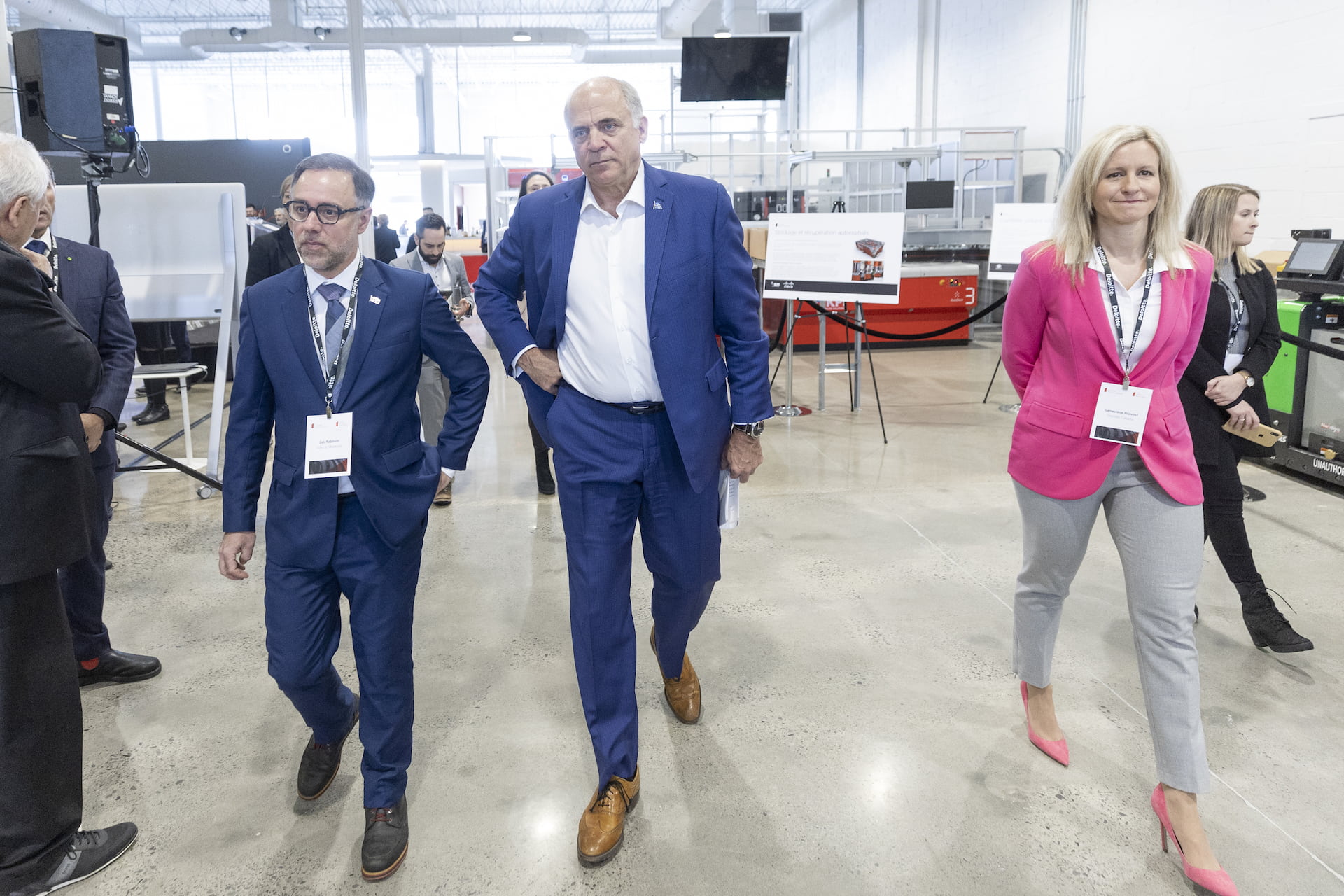 Fitzgibbon visits a smart factory in Montreal in January 2023. Photo: Marco Campanozzi/La Presse
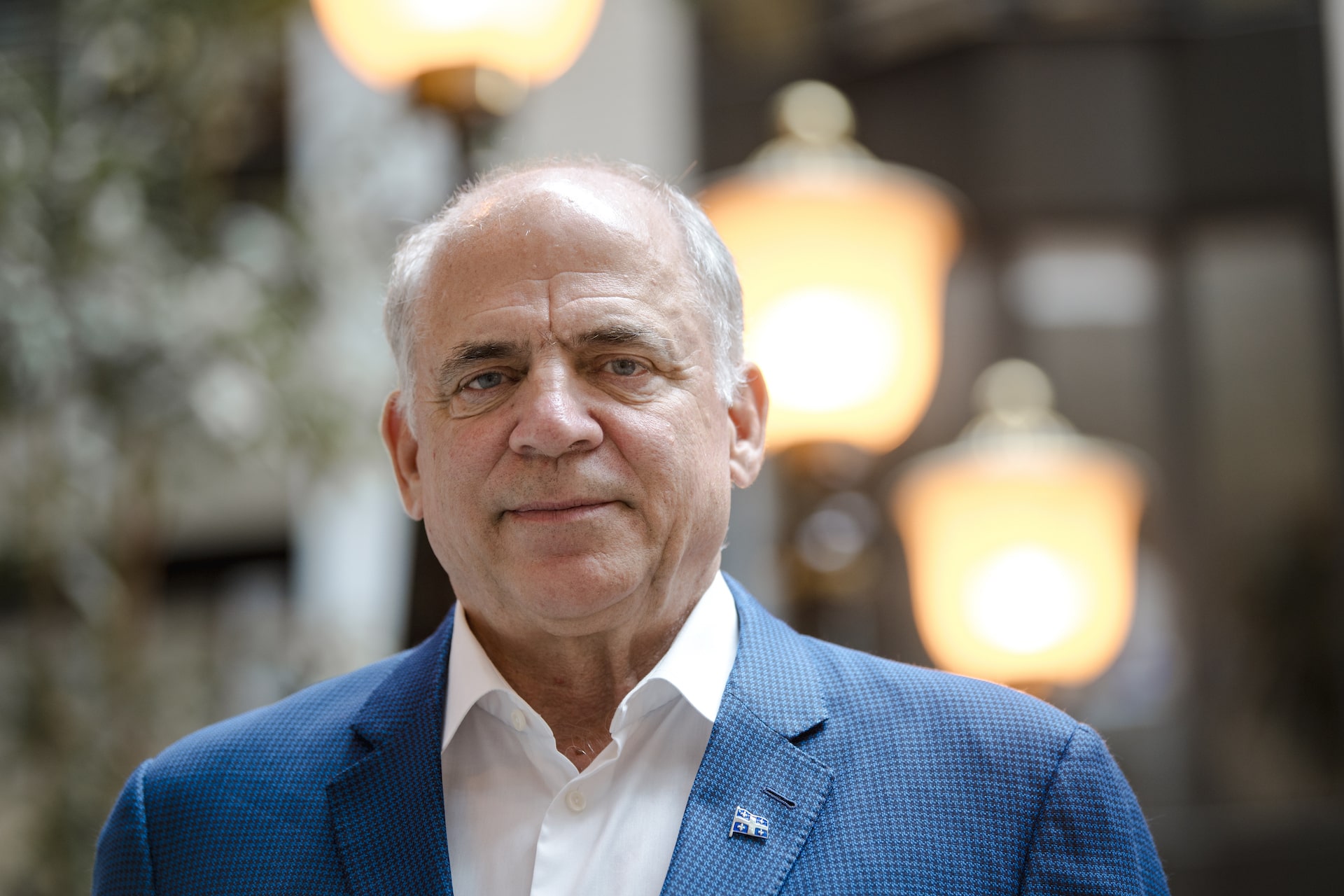 Fitzgibbon refers to himself, more or less jokingly, as a “ministre des bonbons,” a nod to his tendency to shower big, headline-making projects with government-backed largesse. Photo: Andrej Ivanov for The Logic
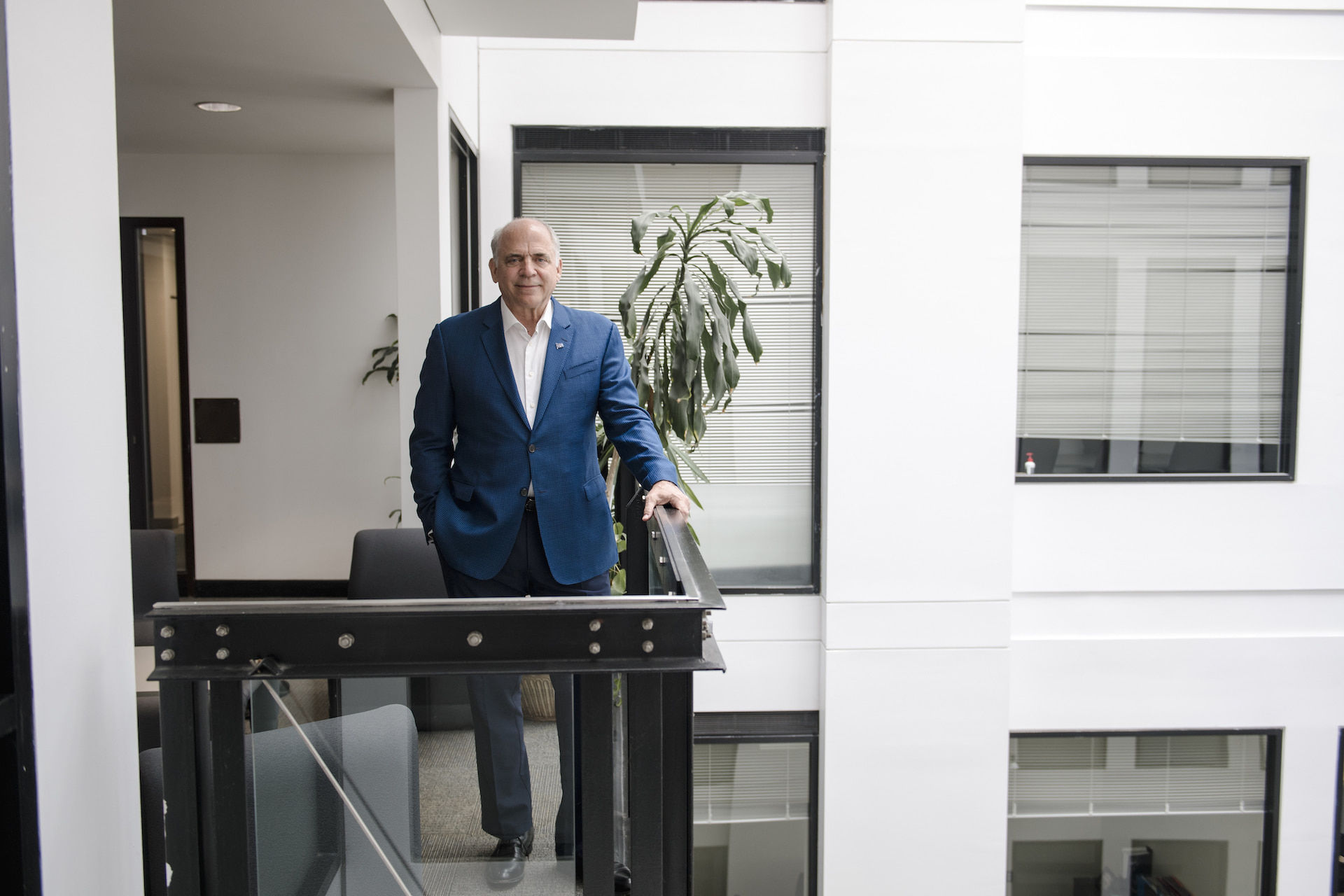 Fitzgibbon’s ambition has arguably made him Quebec’s most powerful minister in generations, a throwback to the likes of C.D. Howe or even an early-day René Lévesque. Photo: Andrej Ivanov for The Logic

The Big Read
Pierre Fitzgibbon is on a mission to supercharge Quebec’s economy—rules be damned
The province’s brash economic minister has little patience for politics. Will he stick around to see his ambition through?
Pierre Fitzgibbon at the World Trade Centre Montréal in July 2023. Quebec’s economy minister wants to attract the industries of a carbon-reduced future to the province, with Hydro-Québec at the core of his vision. Photo: Andrej Ivanov for The Logic
SAGUENAY-LAC-SAINT-JEAN, QUE. — There are about 260 hectares of factory and office space at Rio Tinto’s Jonquière aluminum smelter in Quebec’s Saguenay region. The massive, white tent added a few hundred more square feet, albeit temporarily, for the show. Inside was dark and hot, with trippy hold music piping through giant speakers. In front of the stage, decked out in orange uniforms, dozens of Rio Tinto employees sat on folding chairs, chatting, fiddling with their phones and otherwise looking like extras from a Minions movie restively awaiting word from the podium.
Announcements of billion-dollar investments tend to draw politicians of all levels and stripes, and this one was no different. Quebec Premier François Legault took about 10 minutes to announce Rio Tinto’s $1.4-billion smelter project, talk up Quebec’s green bona fides and name-check Saguenay-Lac-Saint-Jean no fewer than a dozen times—the region is a stronghold of his Coalition Avenir Québec (CAQ) government. Federal Innovation Minister François-Philippe Champagne said much the same in about the same time, though with fewer nakedly electoralist references and more self-deprecating jokes about his diminutive height.
Talking Points
- Pierre Fitzgibbon, Quebec’s brash economic minister, aims to attract the industries of a carbon-reduced future to the province, with Hydro-Québec at the centre of his vision
- The businessman-cum-politician shows little regard for realities of public life, such as parliamentary debate and rules of accountability
- Fitzgibbon has increasingly run up against those realities, as adversaries question his ethics, accountability and commitment to protecting Quebec’s francophone identity
Quebec Economic Minister Pierre Fitzgibbon was frugal by comparison. Uttered in a rapid-fire baritone, his four-minute spiel highlighted the novelty of the project, its sheer size and the production method’s reduced carbon output. He noted Quebec’s $150-million forgivable loan to Rio Tinto for the project—and promised he would be cutting a lot more cheques in the months and years to come.
“Get used to seeing me and François-Philippe together because we have a large number of critical announcements coming, much like the one we made this morning. Others will follow in other regions of Quebec,” he said. Within the hour, Fitzgibbon was bending his six-foot-two frame into the seat of a chartered turboprop. He was due in Montreal for a speech about energy transition and the signing of a joint declaration with the German government.
In a sense, Fitzgibbon is an anachronism—a brash, raw-money businessman-cum-politician for whom certain realities of politics, like budget constraints and ethics considerations, don’t seem to apply. He refers to himself, more or less jokingly, as a ministre des bonbons, a nod to his tendency to shower big, headline-making projects with government largesse. He has scuffled publicly with Quebec businessman Pierre Karl Péladeau, whose Journal de Montréal tabloid regularly depicts him as a corrupt spendthrift. The minister has said that he’d leave the second Legault no longer wanted him.
Yet it isn’t all bucks and bluster. By dint of his power and access to capital, Fitzgibbon has willed into being Quebec’s suddenly booming EV battery sector in the town of Bécancour northeast of Montreal, where Quebec-sourced minerals will be processed thanks to government funding and wads of private investment. The Bécancour play—projected to be worth $14 billion in GDP by 2030—is part of Fitzgibbon’s larger plan to transform Hydro-Québec into a global green-energy hub, in part by leveraging the utility’s bounty of cheap electricity to attract car-battery plants, green hydrogen producers and other burgeoning fixtures of our carbon-reduced future. This will necessarily mean more dams, wind farms, solar panels and, possibly, a return of nuclear power to the province.
Related Articles
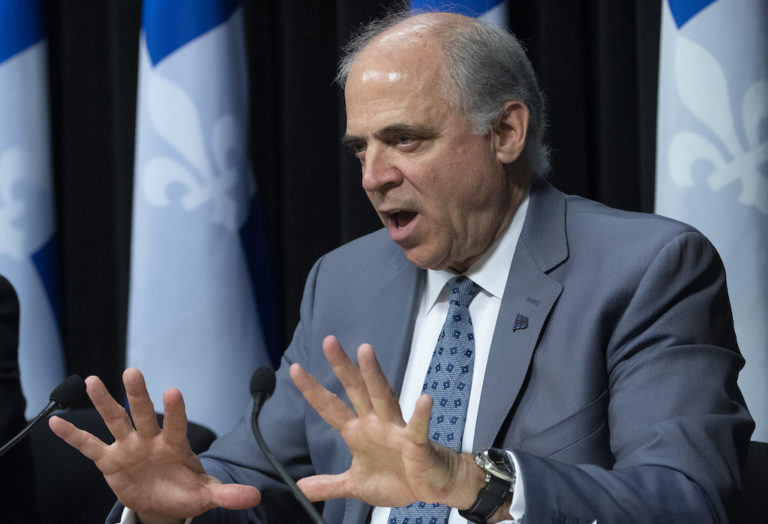
Fitzgibbon’s ambition has arguably made him Quebec’s most powerful minister in generations, a throwback to the likes of C.D. Howe, when the Liberal federal cabinet minister was industrializing the country’s heartland—or even early-day René Lévesque, wrestling Quebec’s hydroelectric might from the grip of private business. But public life is full of necessary inconveniences like debates over identity and rules of accountability, and on these fronts Fitzgibbon is proving an ever greater target to his adversaries. He has begun the job of reshaping Quebec’s economy. The question is whether he can survive its politics long enough to see his ambition through.
Fitzgibbon, who will turn 69 in November, entered politics in 2018. A lifelong businessman, he was the president and CEO of Atrium Innovations when the Montreal-based natural health-products manufacturer sold for $1.1 billion in 2013. He was the president of private equity firm Walter Capital Partners when Legault approached him to run in the 2018 provincial election.
The two graduated in 1978 from HEC Montréal, a business school and the academic training ground for much of Quebec’s corporate elite, and had remained friendly since. Legault promised him the economic file if Fitzgibbon won his riding and the CAQ won power. It took some convincing. Fitzgibbon disliked the idea of campaigning almost as much as the possibility that he’d win his seat while his party lost the election, leaving him stuck in opposition. “I’d have stayed. But let’s be honest, I would have been bored,” Fitzgibbon told me.
Fortunately for him, the CAQ beat the long-governing Liberals in a landslide. Legault, a longtime Quebec separatist, campaigned in part on the idea that separatism had become a dangerous distraction from pressing economic issues facing the province. His frequent anti-immigrant broadsides notwithstanding, Legault often professed his “obsession” with Quebec’s economy.
Until then, Fitzgibbon’s political activities had come by way of his wallet, as he had donated to both the CAQ and the Liberal Party of Quebec between 2011 and 2018. But his election and appointment to cabinet allowed him to focus on an obsession of his own: Hydro-Québec.
“Hydro-Québec is going to become the heart of energy transition for our government,” Fitzgibbon told me in that turboprop as we flew expanses of Quebec’s heartland en route to Montreal. “Hydro-Québec is an incredible force. It’s our Walmart. We need to make it bigger, even enlarge its scope, so that it can play an even bigger role.”
Expanding Hydro’s scope is a complicated undertaking. As recently as 2017, the utility said it wasn’t planning more major dams, as the province had a surplus of electricity. Now it says energy surpluses will be a thing of the past by 2027, and Quebec will need to find seven terawatt-hours by 2029 to meet demand.
Then there’s the matter of Quebecers themselves, many of whom treat cheap power as a birthright, their use of it verging on profligate. In our conversation, Fitzgibbon portrayed Quebecers who insist on heating their homes with notoriously inefficient electric baseboards as wasteful “Bolsheviks” hogging electricity the province could otherwise use to attract industry and generate wealth.
“Hydro-Québec is an incredible force. It’s our Walmart. We need to enlarge its scope so that it can play an even bigger role.”
Though he was lambasted for saying Quebecers should run their dishwashers at inconvenient hours of the night, Fitzgibbon says residents have to get used to conservation and dynamic electricity pricing. “We are very bad consumers of electricity,” he told me. “I’d go so far as to say that anyone who wants us to heat our homes with 100 per cent electricity is mentally ill.”
Hydro-Québec fell under Fitzgibbon’s purview when Legault added energy to his portfolio in October 2022. The same month, Hydro-Québec’s then-CEO Sophie Brochu told The Globe and Mail that she disagreed with the plan to offer discounted rates to attract industry, saying it could turn the utility into the “Dollarama” of electricity production. Brochu stepped down in January. (Fitzgibbon played down the antagonism between them—“Journalists amusing themselves,” he told me.)
Fitzgibbon is adamant that Hydro find new energy sources, and says the utility is too “sclerotic and limiting” to be able to do so. In the fall, he plans to introduce legislation to bring the utility further under his ministry’s control. “There are some who will leave Hydro-Québec because they will find it too sudden a change,” he said. Nevertheless, “the job of the future is Hydro-Québec.”
To that end, the Quebec government named Michael Sabia as Brochu’s replacement in May. Legault said the next Hydro-Québec CEO would be “development mode” and Sabia is certainly that. As chair of the Canada Infrastructure Bank, he preached the economic gospel of home retrofits, clean-power projects and other assorted green-tinted infrastructure plays.
Sabia’s signature project from his time as head of Quebec’s public pension fund manager is the Réseau express métropolitain (REM), a $7-billion-plus light rail network connecting Montreal with its suburbs. It’s what might be called a Sabian trifecta: a landscape-altering infrastructure project whose construction creates jobs, and whose operation aims to reduce the carbon footprint of its users. The REM, set to open to the public later this summer, was built via public-private partnership—an indication, perhaps, of how Sabia plans to build out Hydro-Québec’s future infrastructure.
On the day we spoke, Fitzgibbon was about to pitch to Sabia a solar-energy project in Montreal’s Saint-Laurent neighbourhood. Solar power is practically nonexistent in the province, mostly because it is expensive compared to the stuff churned from Quebec’s 668 dams. Wind power is also scarce, though less so, and Fitzgibbon says more wind farms are a priority. Nor has he ruled out nuclear power: “There are no nuclear projects today or in the near future, but I think we need to keep an open mind,” he said.
Critics have pounced on Fitzgibbon’s economic development strategy. Recalling Lévesque’s nationalization of hydroelectricity in the province, the opposition Parti Québécois demanded the government oppose any privatization of Hydro-Québec.
“It’s obvious that we are faced with a government of businessmen who serve businessmen and therefore have an obvious interest in using our low-cost electricity as a method of economic development,” Haroun Bouazzi, energy critic for the left-wing Québec solidaire party, told me. “This is true for companies that want to use our electricity today. This is also true for wind turbines. It’s true for all kinds of things where there are deals. That’s the main vision.”
That vision is rapidly taking hold. When I visited Bécancour recently, the sleepy burgh about 150 kilometres northeast of Montreal seemed to be bracing for a demographic storm. Shiny new apartment subdivisions erupted context-free between post-war bungalows, some of the upwards of 4,000 planned housing units. There will likely be more: Bécancour and its surrounding region expect 10,000 new workers to arrive over the next few years for the battery industry alone.
In the city’s industrial park, the metal skeletons of factories sit in patches of cleared forest. GM, in partnership with South Korean battery-materials producer POSCO, is setting up shop. So too are Ford, BASF, Nemaska Lithium and Nouveau Monde Graphite, among others, all to produce or recycle EV batteries.
“Being in parliament, being in a media scrum, you become very sensitive to what people think of you. We’re all human, after all.”
Legault at first wanted to build electric cars in Quebec. It was Fitzgibbon who convinced him that batteries, not rolling stock, were a more viable and valuable part of the supply chain. And it was Fitzgibbon who signed the flurry of deals to make sure those companies parked here, not just in competing battery-production facilities in the U.S.
Like him or not, were it not for Fitzgibbon, Bécancour would still be a roadstop. “There were a lot of the elements for battery production [in Quebec], but no one with the vision to go in that direction,” the entrepreneur and tech investor Alexandre Taillefer told me. “It’s very clear that there would be no such thing in Quebec were it not for his determination.”
Whenever Fitzgibbon flies around Quebec, the pilots know to keep the aircraft low enough so the minister can still receive texts. He was scrolling through a whack of them when I asked him about being the subject of several ethics investigations, the first of which was in 2019.
“There are eight of them,” he said, looking up from his phone.
“No, there were six,” Mathieu St-Amand, his press attaché, said.
“Six, six, yes,” Fitzgibbon said.
Fitzgibbon loves to make deals and sign cheques. What he doesn’t like (or, at least, professes to not care about) is what he has called the “aquarium of politics,” the six contretemps with Quebec’s ethics commissioner included.
In the fall of 2020, the second of those investigations found Fitzgibbon had breached Quebec’s ethics laws by not proactively disclosing the sale of his shares in a Montreal-based protein-supplement company. Quebec’s MNAs voted unanimously to censor Fitzgibbon as a result of the report. It marked the first time in Quebec’s parliamentary history the National Assembly had sanctioned a government minister. (Fitzgibbon abstained.)
Other aspects of politics clearly bother him. In 2019, making good on an election promise, the Legault government cut immigration levels by over 20 per cent on the grounds of protecting the French language. Fitzgibbon voiced his distaste for the move during a 2019 meeting with tech leaders, according to two sources who were there. Fitzgibbon told me at the time he didn’t recall doing so, and he is uncharacteristically diplomatic when he speaks publicly about language- or immigration-related matters, saying he agrees with his government’s restrictive laws on both.
In the same breath, though, he says he wants “flexibility” in their application, and has pleaded for an exception to Legault’s goal of limiting economic immigration to people from French-speaking countries. You can see why: South Korea is a dominant player in the EV market, and is investing heavily in the province. The country isn’t exactly brimming with francophones.
Finally, there’s Quebecor CEO Pierre Karl Péladeau, who has publicly attacked Fitzgibbon over the years. Behind the antipathy lies no shortage of personal and political differences—though on which Péladeau is acting at any given time is anyone’s guess. PKP, as he is known, is an avowed separatist and a former leader of the Parti Québécois, the CAQ’s political adversary. And Fitzgibbon, as the minister overseeing Investissement Québec, helped secure loans in 2020 for a collective of six regional newspapers. The move saved the papers from bankruptcy, but also kept them out of the hands of PKP, who wanted to buy them himself.
Coincidentally or not, the Journal de Montréal, a key part of Quebecor’s internet-wireless-media-publishing juggernaut, has been a critical chronicler of Fitzgibbon’s political career. In 2019, the paper chided him for not speaking any French while on an economic mission to Toronto. (“They fucking destroyed me,” Fitzgibbon told me.)
More recently, the paper has documented the costs of Fitzgibbon’s various business trips and trade missions, often on the front page and throughout Quebecor’s other media holdings. “When Pierre Karl decides you’re his enemy, you’re finished,” Taillefer, himself a target of Péladeau’s and the Journal’s coverage, told me. (Journal de Montréal editor Dany Doucet didn’t respond to a request for comment. Sébastian Ménard, publisher and editor-in-chief of Quebecor-owned Journal de Québec, told The Logic in an email: “To suggest that Mr. Péladeau influences our editorial choices in any way is absurd. Our newsrooms are independent and entirely free to cover topics they consider relevant and of public interest.”)
All of which is to say, politics presents a lot of downsides for a relatively private, independently wealthy, soon-to-be septuagenarian whose ego went mostly unchallenged in the private sector. “Politics intimidated me. Being in parliament, being in a media scrum, you become very sensitive to what people think of you. We’re all human, after all,” he told me.
Then again, Fitzgibbon’s political career has been undeniably charmed. As ministre des bonbons, he is in charge of selling green power to a world that is increasingly thirsty for it. He has so far weathered a degree of controversy that has felled Quebec politicians in the past. Those six ethics investigations? Three absolved him of wrongdoing. In politics as in baseball, there are worse batting averages. And despite all its scapegoating of newcomers, the CAQ is increasing immigration levels in the province. It’s exactly what Fitzgibbon wanted.
After the Montreal speech, the minister is ushered into a room with a German trade representative to sign a joint statement in support of further research and innovation projects between the two governments. It’s a stilted affair of frozen smiles and performative signatures; Fitzgibbon’s staff had to convince him to do it in person, and not by Zoom. Then it was off to the airport en route to the Paris Air Show, to sell Quebec a bit more.



Loading...
Thanks for sharing!
You have shared 5 articles this month and reached the maximum amount of shares available.
CloseThis account has reached its share limit.
If you would like to purchase a sharing license please contact The Logic support at [email protected].
CloseGift the full article!
You have gifted 0 article(s) this month and have 5 remaining.
Recipients will be able to read the full text of the article after submitting their email address. They will not have access to other articles or subscriber benefits.
Photo: Andrej Ivanov for The Logic
Fitzgibbon visits a smart factory in Montreal in January 2023.
Fitzgibbon refers to himself, more or less jokingly, as a “ministre des bonbons,” a nod to his tendency to shower big, headline-making projects with government-backed largesse.
Fitzgibbon’s ambition has arguably made him Quebec’s most powerful minister in generations, a throwback to the likes of C.D. Howe or even an early-day René Lévesque.
Most Popular This Week



In-depth, agenda-setting reporting
Great journalism delivered straight to your inbox.
Commentary
Carmichael: Canadian ignorance about India is a strategic weakness
Briefing
Aritzia shares pop after earnings rise 204%
First Nation in Alberta goes to court over fast-tracked oil pipeline
Chinese EV maker Geely Auto Group to launch in Canadian market in 2027
Best business newsletter in Canada
Get up to speed in minutes with insights and analysis on the most important stories of the day, every weekday.
Exclusive events
See the bigger picture with reporters and industry experts in subscriber-exclusive events.
Membership in The Logic Council
Membership provides access to our popular Slack channel, participation in subscriber surveys and invitations to exclusive events with our journalists and special guests.