News
Poilievre pitches critical-mineral stockpile as leverage in trade talks with the U.S.
The Conservative leader laid out his plan to deal with the United States in carefully chosen words, but finally called out Donald Trump by name

Conservative Leader Pierre Poilievre outlined his plan for dealing with U.S. President Donald Trump in a speech Thursday to a Toronto business audience. Photo: The Canadian Press/Chris Young
Listen Now
0:00
Conservative Leader Pierre Poilievre insists Canada has the leverage it needs to establish free trade with the U.S., despite President Donald Trump’s vociferous dedication to his tariff agenda.
In a speech to the Economic Club of Canada in Toronto, Poilievre offered several ways he thinks Canada could achieve the upper hand—most notably by building a stockpile of critical minerals it can use in trade negotiations with the U.S. and other countries.
Meanwhile, at another downtown hotel, Dominic LeBlanc, the federal minister responsible for trade between those two countries, was giving an update on the talks to the Canadian Club Toronto.
Related Articles
Trump is not a four letter word
Back in January, in a speech he gave after passing his party leadership review, Poilievre was careful not to name the U.S. president. In Toronto, he called Trump out explicitly, even as he argued for Canada to respond less emotionally to the president’s punishing tariffs.
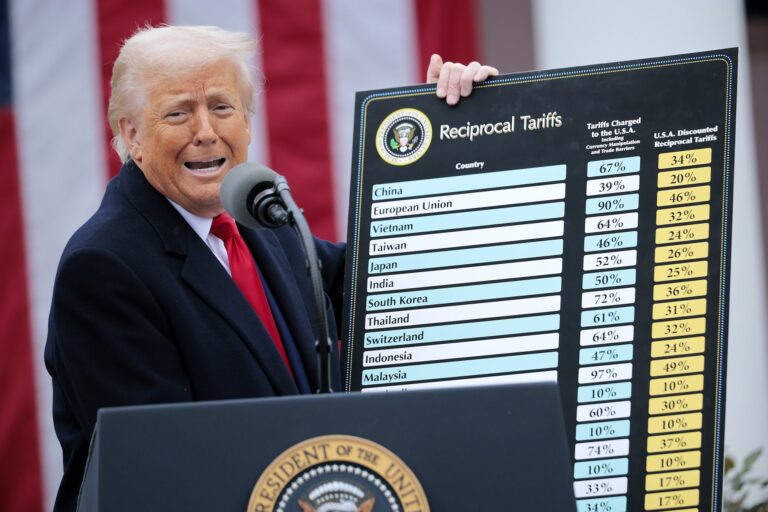
“President Trump has sought to overturn the trading system that previous American presidents had championed and even created. Some of this correction, in fairness, was overdue. But it missed the target by going after countries like Canada, who were not the problem,” Poilievre said.
Trump was wrong to decry Canada’s trade surplus with the U.S., he said, wrong to ignore the contributions of Canadians on battlefields where they fought alongside the U.S. military and wrong to say Canada could ever be the 51st state.
The goal
A good deal with the U.S. would mean tariff-free access to the American market, Poilievre said. That means putting an end to steel, aluminum, auto and lumber tariffs and a full exemption to Buy American rules, he said.
That’s a tall order, considering that earlier this week U.S. Trade Representative Jamieson Greer said any trade pact with Canada will include tariffs. Even Finance Minister François-Philippe Champagne said it’s “pretty well understood” that there will be a price associated with shipping goods south.
A pitch for quid pro quo
To strengthen Canada’s position, Poilievre suggests stockpiling energy and critical minerals, which the U.S. could access in exchange for lifting tariffs on Canadian goods. Similarly, he said, the amount of money Canada spends on its military in the U.S. could be directly tied to market access for Canadian firms.
The Conservative leader also called for a new auto pact with the U.S., which would have Canada agree to keep Chinese-made vehicles out in exchange for access to the U.S. vehicle market. (Last month, Canada agreed to drastically reduce tariffs on a limited number of electric vehicles made in China, which were previously subjected to 100 per cent duties.)
“Americans have made it clear that they do not want Canada to become a back door entry point for China,” Poilievre said. “What I would say to the Americans is that we will keep Chinese automobiles out if you let Canadian automobiles in.”
Trump has repeatedly said the U.S. doesn’t want or need Canada to be part of its auto industry, despite the highly integrated supply chains. Just last week, he accused Canada’s auto industry of “ripping off” the U.S.
Poilievre’s idea is grounded partly in the Conservatives’ oft-stated reluctance to partner with China. Poilievre said that, while he’s keen in general on diversifying Canada’s trade relationships, including with India, Canada can’t trade its partnership with the U.S. for one with China.
“Not all partners are interchangeable,” he said, adding that China’s government has “kidnapped our citizens, stolen our technology, interfered in our elections and pushed fentanyl into our streets.”
Some of the Tory leader’s plans aren’t far off from central tenets of the government’s agenda, including speedier approvals for megaprojects, like a pipeline from Alberta to the West Coast, and faster military procurements.
Other ideas have been mainstays of Poilievre’s policy for years, including eliminating the industrial carbon tax and repealing what he describes as “anti-development” laws, including the Impact Assessment Act for major projects.
An overhaul of Canada’s tech scene
Poilievre reiterated his plan to boost digital sovereignty by keeping domestic IP from falling into the hands of other countries, and reducing Canada’s reliance on foreign providers.
“Canada must never assume that foreign powers will maintain service or even permit continued operational access to critical technologies,” he said.
He called on the government to overhaul its subsidies and tax policies to make sure anyone who takes subsidized IP offshore pays the government back for its contributions.
A seat at the table
Ottawa is unlikely to take Poilievre up on most of his ideas, though the Liberals and Conservatives have struck a more co-operative posture of late. Regardless, the Conservative leader wants to see all parties come together ahead of the review of the United States-Mexico-Canada Agreement (USMCA). He suggested a working group, in the same spirit as the Team Canada approach the Liberals took to renegotiating the North American Free Trade Agreement under Justin Trudeau.



Loading...
Thanks for sharing!
You have shared 5 articles this month and reached the maximum amount of shares available.
CloseThis account has reached its share limit.
If you would like to purchase a sharing license please contact The Logic support at [email protected].
CloseGift the full article!
You have gifted 0 article(s) this month and have 5 remaining.
Recipients will be able to read the full text of the article after submitting their email address. They will not have access to other articles or subscriber benefits.