When Leslie Byberg started her career at the Ontario Securities Commission, Facebook was still just a twinkle in Mark Zuckerberg’s eye. More than two decades later, she has a tough new assignment: leading a team that will serve as the regulator’s early warning system for threats that AI, decentralized finance and other technologies pose to Canada’s investors and capital markets.
Skip to content

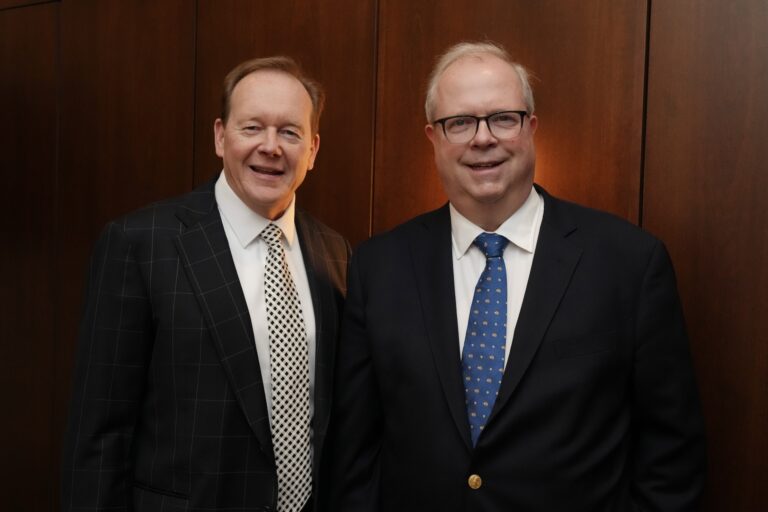
 “I told Leslie the other day that I wanted her job,” said OSC board chair Kevan Cowan (left, pictured in May with CEO Grant Vingoe). “I think it's one of the best jobs in capital markets.” Photo: The Canadian Press/Chris Young

News
OSC’s new tech czar is on the lookout for threats to investors
From AI to DeFi, Leslie Byberg’s team is tasked with monitoring emerging technologies—and potentially regulating them
Leslie Byberg, the Ontario Securities Commission’s new executive vice-president of strategic regulation: “This role gives me the opportunity to leverage all the things I’ve learned.” Photo: Christopher Katsarov Luna for The Logic
When Leslie Byberg started her career at the Ontario Securities Commission, Facebook was still just a twinkle in Mark Zuckerberg’s eye. More than two decades later, she has a tough new assignment: leading a team that will serve as the regulator’s early warning system for threats that AI, decentralized finance and other technologies pose to Canada’s investors and capital markets.
Byberg’s strategic regulation team has been scanning the horizon since April. The idea is to tackle threats early, before they get out of hand—a lesson the regulator learned from its experience trying to rein in crypto-trading platforms. Though it began cracking down on them in 2021, hundreds were already operating in Canada with little regulatory oversight.
Talking Points
- Leslie Byberg, appointed the Ontario Securities Commission’s executive vice-president of strategic regulation in April, is leading a new team of roughly 65 people that aims to identify and respond to cutting-edge technology
- The team’s responses could range from putting out research reports to implementing sweeping new regulatory regimes, she said in an interview with The Logic.
In an interview with The Logic, Byberg said it’s a dream job.
“I’m really quite excited about what we’ve put together here,” Byberg said. “This role, in many ways, gives me the opportunity to leverage all the things I’ve learned.”
Byberg’s appointment as executive vice-president of strategic regulation at Canada’s largest securities regulator comes 21 years into an OSC career, one that has included overseeing major divisions such as corporate finance and market regulation, and acting as interim director of enforcement. Her new role is part of a broader shakeup the OSC rolled out in advance of the May release of its strategic plan for the next six years. Byberg and Sonny Randhawa, who were previously both executive directors at the regulator, saw their titles change to executive vice-president and their responsibilities shuffle.
At a launch event for the plan in downtown Toronto in May, OSC board chair Kevan Cowan said Byberg’s mandate is “one of the things I’m most excited about.”
“I told Leslie the other day that I wanted her job. I think it’s one of the best jobs in capital markets,” he said.
Related Articles
Byberg’s team of roughly 65—largely pulled from existing staff, with plans for a few new hires—includes researchers, economists and experts in the study of human behaviour. The OSC’s innovation office, which launched in 2021 and serves as a resource and testing ground for companies working in cutting-edge areas, falls under her purview.
In its strategic plan, the OSC said it is responding to “an environment of accelerated change that is challenging the traditional model of regulation.” Securities regulators oversee the legislation that defines what constitutes an investment, what rules must be followed by people issuing and selling investments and who is allowed to buy them—all of which has become vastly more complicated thanks to the internet. Meme stocks, decentralized crypto exchanges and AI-designed investment portfolios were all the stuff of science fiction to the authors who wrote the Ontario Securities Act in 1990.
In 2021, the OSC and other Canadian securities regulators responded to the explosion of crypto-trading platforms by developing an entirely new oversight regime, demanding operators either comply with it or exit the country under threat of enforcement. Initially resisted by the industry, the regulators’ actions professionalized the sector and have been praised by major global firms like Coinbase and Kraken.
Byberg said the strategic regulation group could respond to emerging issues with a similarly sweeping novel regime—or with something as simple as a research report. Her team includes a thought leadership outfit, which she said she hopes will “be an influential voice for the OSC, a voice that gets into the conversations early.”
Her team is there to encourage innovation, not stamp it out, Byberg said. As an example of the type of initiative people can expect from the group, she cited a series of pilot projects announced in May that aim to make it easier for angel investors, early-stage startups and non-accredited investors to participate in capital raises.
Lori Stein, a lawyer at McCarthy Tétrault who has extensive experience working with the OSC on behalf of crypto-trading firms and other fintech clients, said she’s had positive experiences with the regulator amid its renewed commitment to get ahead of emerging issues. She was pleased that OSC management attended a recent meeting with a client working on cutting-edge technology at an earlier stage in the approval process than usual.
Being thoughtful and deliberate is important, but not so much so that “by the time the OSC is comfortable with some piece of fintech, it’s already become obsolete,” Stein said. “It does seem that what they’re trying to do is get decision-makers around the table earlier… I think that’s a much more effective way to regulate.”
Byberg said she hopes she’ll hear from companies who aren’t sure how their new tech products fit into securities regulations. “I would love for them to talk to us,” she said. “This will help us understand from those who are living it.”
Andreas Park, a finance professor at the University of Toronto, said the OSC may have some work to do convincing tech companies that’s a good idea. “When you come [in] as a firm, it needs to be a safe space, so that there’s no backlash,” he said. “The fintech firm has to trust the regulator that when they come to them with an innovative idea, they’re not immediately seen as suspicious.”
Asked about her personal views on technology, Byberg said she is neither a techno-skeptic nor a techno-cheerleader. “I’m always an optimist,” she said. “But I’m a pragmatist in that I understand sometimes there are downsides.”
Byberg said she’s looking forward to conversations with startups, investors, academics and others who will help her team figure out how to minimize those downsides and maximize the upsides of technology.
“The space that we’ve created in the team is going to allow us to think much further ahead,” she said. “There’s so much we could be doing.”



Loading...
Thanks for sharing!
You have shared 5 articles this month and reached the maximum amount of shares available.
CloseThis account has reached its share limit.
If you would like to purchase a sharing license please contact The Logic support at [email protected].
CloseGift the full article!
You have gifted 0 article(s) this month and have 5 remaining.
Recipients will be able to read the full text of the article after submitting their email address. They will not have access to other articles or subscriber benefits.
Photo: Christopher Katsarov Luna for The Logic
“I told Leslie the other day that I wanted her job,” said OSC board chair Kevan Cowan (left, pictured in May with CEO Grant Vingoe). “I think it's one of the best jobs in capital markets.”
Most Popular This Week




In-depth, agenda-setting reporting
Great journalism delivered straight to your inbox.
Commentary
Carmichael: Being boxed in will help Canada focus on what matters
Briefing
Rio Tinto gets nearly $165M in additional federal funds for Quebec aluminum
U.S. to lift tariffs on some Canadian products crucial to Maine: Collins
Carney warns of tech dependence after Starlink disruptions in Ukraine
Best business newsletter in Canada
Get up to speed in minutes with insights and analysis on the most important stories of the day, every weekday.
Exclusive events
See the bigger picture with reporters and industry experts in subscriber-exclusive events.
Membership in The Logic Council
Membership provides access to our popular Slack channel, participation in subscriber surveys and invitations to exclusive events with our journalists and special guests.






