Skip to content

News
Canada is weighing Trump’s reaction as it writes new online safety laws, minister says
Marc Miller is alive to the threat of trade retaliation, but says Ottawa will only bend so far to U.S. pressure on internet regulation
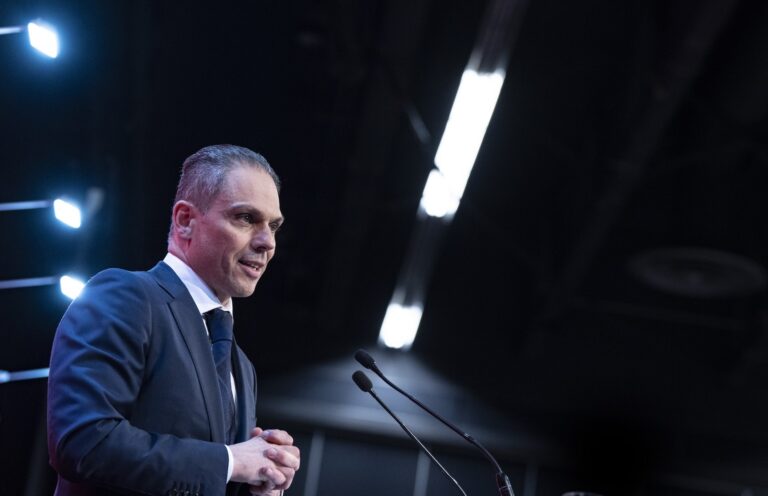
Identity and Culture Minister Marc Miller is expected to introduce new online harms legislation in the coming months. Photo: The Canadian Press/Spencer Colby
OTTAWA — The federal minister in charge of internet regulation said it would be “careless and naive” not to consider President Donald Trump’s reaction to Canada’s upcoming online safety legislation, in light of upcoming trade talks with the U.S.
That doesn’t mean the White House will decide what kind of regulations the government will impose on American platforms, Identity and Culture Minister Marc Miller said in an interview with The Logic. Still, Miller made it clear he’ll be crafting the Liberal government’s latest bid to set internet guardrails with one eye on Washington—an acknowledgement that Trump’s willingness to fight regulation of America’s Big Tech companies with trade retaliation is affecting Ottawa’s calculus.
Talking Points
- Identity and Culture Minister Marc Miller said he’s watching how U.S. President Donald Trump has reacted to other countries that have regulated content on American platforms as he prepares to reboot elements of the previous government’s online harms bill
- Miller told The Logic he hasn’t ruled out a social media ban for children, but said that alone won’t be enough to make the internet safe for vulnerable Canadians
“We have to look at it, but it absolutely can’t dictate what Canada plans to do to protect vulnerable Canadians,” he said.
Miller, who got the portfolio late last year, plans to reboot elements of the previous Liberal government’s defunct online harms bill. Though the minister wouldn’t give a timeline, the new legislation is expected within the next few months.
The previous bill would have established a digital safety commission to enforce new rules governing content that appears on online platforms. It was designed to target child pornography, bullying, non-consensual sexual content and content that incites violence, hatred and terrorism.
Related Articles

In preparation, Miller said, he’s watching how other countries have approached online safety, and how the U.S. has reacted. The short answer is: not kindly.
The State Department recently banned former European commissioner Thierry Breton, the architect of the EU’s Digital Services Act, from the U.S., as well as five other Europeans that Secretary of State Marco Rubio described as “agents of the global censorship-industrial complex.” U.S. Trade Representative Jamieson Greer, meanwhile, threatened the union with fees and penalties over “discriminatory” action against U.S. service producers. The State Department also threatened the U.K. with punitive measures after its communications regulator, Ofcom, launched an investigation into Elon Musk’s X platform creating sexualized deepfakes for users.
Trump’s administration also took aim at two Canadian internet regulation laws, the Online News Act and the Online Streaming Act, labelling them as irritants ahead of the renegotiation of Canada’s trade pact with the U.S. and Mexico.
“We’re not oblivious to the fact that large American companies do have access to the administration, and colour a lot of the views coming out of the White House when it comes to the way they’re behaving,” Miller said.
Ottawa caved to the White House’s first backlash against Canada’s Big Tech regulations in June, when Finance Minister François-Philippe Champagne cancelled a proposed digital service tax at Trump’s behest.
Ottawa is willing to be “flexible” on the Online News Act and Online Streaming Act in light of the evolving trade negotiations, Miller said, but the U.S. can’t dictate terms, and there are some lines the government cannot cross.
“The purpose of the act is still very much a live one,” he said in reference to the Online News Act, which requires Meta and Google to pay publishers for the news content that appears on their platforms. “We do have to protect news providers from the new reality that they’re operating in.”
Miller hasn’t made a final decision about what will be included in the new online safety bill, either, he said, but he has not ruled out a social media ban for children like those adopted or under consideration in other countries. Australia pioneered the model last year; France’s National Assembly passed a similar ban on Tuesday; and the United Kingdom recently announced it is looking at one.
That wouldn’t be enough to keep harmful content off the web though, Miller said. “A simple ban, with doing nothing else, would be overly simplistic and probably wouldn’t achieve the goal that we’re trying to achieve, which is to make sure kids are safe, physically, emotionally and mentally,” he said.
What’s more, heavy regulation akin to the U.K. or EU’s could prove contentious in Parliament, where the Liberals are still two seats shy of a majority. Though Conservative MPs have said online protections for children are long overdue, they opposed the previous government’s bill over concerns that it could restrict speech and create unnecessary and unaccountable bureaucracy. Last year, Conservative MP Michelle Rempel Garner rejected the idea of a regulator similar to Ofcom, and tabled her own version of the bill.
“Online protections are needed and warranted, but, putting it mildly, an expensive and ubiquitous regulator with unfettered powers to expand its scope and to police all manner of speech may not be the winner that initial proponents of Ofcom and its proposed Canadian equivalent thought it would be,” Rempel Garner said in a post on X the day she tabled the bill.
Miller said he’s willing to work with the Tories, and even adopt elements of Rempel Garner’s bill, if it means the minority Parliament passes the bill. Still, instituting a regulator could be a sticking point.
Miller acknowledged that regulatory bodies can be “burdensome,” and sometimes “miss the mark,” but said the alternative might force victims to challenge giant American platforms on their own.



Loading...
Thanks for sharing!
You have shared 5 articles this month and reached the maximum amount of shares available.
CloseThis account has reached its share limit.
If you would like to purchase a sharing license please contact The Logic support at [email protected].
CloseGift the full article!
You have gifted 0 article(s) this month and have 5 remaining.
Recipients will be able to read the full text of the article after submitting their email address. They will not have access to other articles or subscriber benefits.
Photo: The Canadian Press/Spencer Colby
Most Popular This Week




In-depth, agenda-setting reporting
Great journalism delivered straight to your inbox.
News
National Bank CEO warns AI alone won’t give banks a lasting edge
Briefing
Canada and Ontario commit over $5B to support tariff-hit steel sector
Hackers will see cars as major targets in next 3 years, 83% of car-tech workers say
EA shutting down Edmonton studio BioWare
Best business newsletter in Canada
Get up to speed in minutes with insights and analysis on the most important stories of the day, every weekday.
Exclusive events
See the bigger picture with reporters and industry experts in subscriber-exclusive events.
Membership in The Logic Council
Membership provides access to our popular Slack channel, participation in subscriber surveys and invitations to exclusive events with our journalists and special guests.





