Skip to content

News
Mila’s Hugo Larochelle says academia can do what industry won’t to advance AI
Yoshua Bengio’s successor says collaborations between computer scientists and researchers in fields like ecology and health care can expand AI’s impact
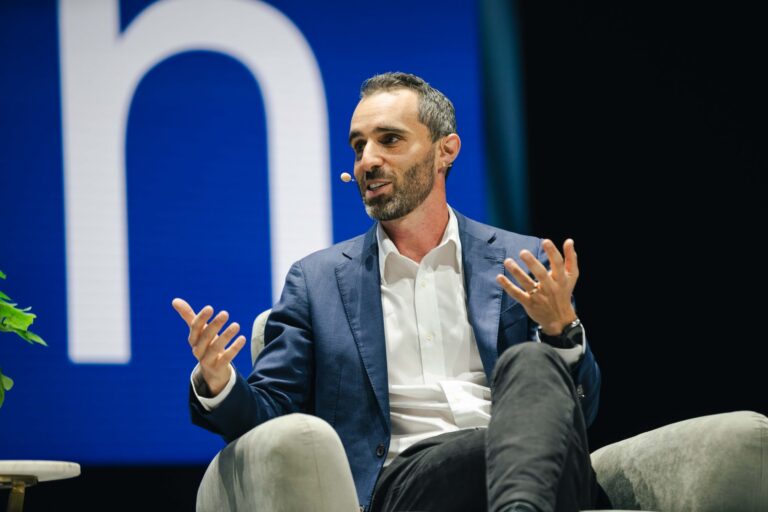
Hugo Larochelle previously worked at Google leading teams of AI researchers that worked on new learning techniques, navigation for internet balloons and analyzing birdsong. Photo: All In/Handout
MONTREAL — Mila’s new scientific director says academic researchers still have a significant role to play in advancing AI—and making sure it is used to tackle major social and environmental challenges.
“We want to be a leader in how we think about the development of AI,” said Hugo Larochelle, who assumed scientific leadership of the Montreal institute in September. He took over from Yoshua Bengio, his former doctoral supervisor and a deep learning pioneer.
In his new role, Larochelle is encouraging more professors and students to focus on a type of research he calls “AI and x.”
Talking Points
- Mila’s new scientific director Hugo Larochelle is a former Google research leader and student of predecessor Yoshua Bengio. He takes over Bengio’s role as the tech industry pours billions of dollars into AI.
- Academic researchers can help fill in some of the gaps that tech giants won’t pursue, and help apply AI to fields like healthcare and the environment, Larochelle says
Larochelle subscribes to the theory that innovation results from bringing together people with different expertise, and getting them to explore where those ideas intersect. Mila’s size—over 1,500 researchers are affiliated with the institute—helps with that task. Its approach is to complement its deep learning expertise with researchers in biodiversity, chemistry, medicine and other fields.
Larochelle has also been applying this to his own work. Alongside PhD student Mélisande Teng, he’s worked with Université de Montréal ecologist Etienne Laliberté on vision models to analyze the species and number of trees in a given forest based on drone footage. The AI system could be used to monitor forests planted to sequester carbon, a field beset by fraud concerns.
Related Articles


Tracking what’s happening on the ground could give projects more credibility, and attract more financing to nature-based solutions to climate change, Larochelle said. Laliberté has used Mila’s entrepreneurship program to launch a startup called Rubisco AI to commercialize the AI-based forest-monitoring technology.
The fact that AI is finding uses in fields like ecology marks how far the technology has come from Larochelle’s early days working on deep learning. As graduate and doctoral students in the early 2000s, he and his peers had to build models from scratch and come up with the fundamental technical breakthroughs that made them actually work. “Now, AI is much easier to use,” Larochelle said. Today’s researchers can often make a lot of progress by collecting specialized data on, say, trees or proteins, and feeding it into an open-source or commercial system.
Mila isn’t the only organization working in this way. In Edmonton, Amii and the University of Alberta have created 20 new faculty positions for researchers applying AI to fields like health and energy. “People who are bilingual, who have a foot in two different domains, are going to be really core drivers of the impact of AI,” said Amii CEO Cam Linke.
Many industrial AI labs are now focused on scaling models that use the transformer architecture—the “T” in ChatGPT—with ever more data, and on turning them into commercial products. Tech giants are spending billions of dollars to attract top researchers and equip them with huge quantities of compute in an attempt to push the technology forward.
Larochelle said academic researchers can help fill in gaps that are receiving less industry attention, like techniques that use much less energy to train AI models, or systems that are capable of learning continually. “There’s a number of things that are core, scientific foundational ingredients that we still don’t have,” he said. “Academia still has a role to play in terms of carving a path towards that.”
Non-profit and university labs can also focus on applying AI to areas that may not immediately become big business, like health care or the environment, he said.
Larochelle himself recently swapped industry for academia, joining Mila after nearly a decade at Google. In November 2016 he opened the Montreal office of the tech giant’s Brain AI unit and led research efforts there following its merger with DeepMind in April 2023.
Over time, Google became more resistant to publishing its research and collaborating with academia, an understandable outcome of the growing commercial competition in AI, Larochelle said. It was partly this “misalignment” with his interest in open scientific exchange that persuaded Larochelle to move to Mila.
Many other Canadian AI researchers have headed to Silicon Valley to chase the big money that tech giants or venture capitalists can offer. The AI boom has only accelerated that trend. However, the industrial labs of Google, Meta and other firms have also brought AI talent to Montreal or helped keep it there, Larochelle said. Some of those people move on to local firms, launch their own startups, or teach at local universities.
Larochelle cited star AI researchers Joelle Pineau, who joined Toronto-based Cohere after six years at Meta, and Marc Bellemare, who left Google Brain to co-found Montreal-based pharma AI startup Reliant AI. “I wouldn’t be surprised if we started seeing more and more examples of that,” Larochelle said.
Mila’s scientific director is tasked with determining who gets to be affiliated with the organization, and with encouraging collaboration between researchers. Larochelle will also help out with fundraising, and weigh in on programs to create startups around the technology the institute develops. He’s keen to promote AI literacy and responsible adoption of AI. Canada can be “leaders in a different way than the path that’s going to be carved out by Silicon Valley,” Larochelle said.
Bengio’s shoes are big ones for Larochelle to fill. He’s one of the faces of Canadian AI, with policymakers at home and abroad regularly seeking his advice on the technology. Larochelle, a former student of both Bengio and fellow pioneer Geoffrey Hinton, represents the next generation of leadership at Canada’s AI institutes. It’s still early days, but he’s getting more comfortable with the parts of the job that involve media interviews and counselling policymakers. “I’ll go where I’m invited, and I’ll try to answer these questions,” he said.



Loading...
Thanks for sharing!
You have shared 5 articles this month and reached the maximum amount of shares available.
CloseThis account has reached its share limit.
If you would like to purchase a sharing license please contact The Logic support at [email protected].
CloseGift the full article!
You have gifted 0 article(s) this month and have 5 remaining.
Recipients will be able to read the full text of the article after submitting their email address. They will not have access to other articles or subscriber benefits.
Photo: All In/Handout
Most Popular This Week




In-depth, agenda-setting reporting
Great journalism delivered straight to your inbox.
News
Ottawa is softening its ban on stablecoin yield
Briefing
Rio Tinto gets nearly $165M in additional federal funds for Quebec aluminum
U.S. to lift tariffs on some Canadian products crucial to Maine: Collins
Carney warns of tech dependence after Starlink disruptions in Ukraine
Best business newsletter in Canada
Get up to speed in minutes with insights and analysis on the most important stories of the day, every weekday.
Exclusive events
See the bigger picture with reporters and industry experts in subscriber-exclusive events.
Membership in The Logic Council
Membership provides access to our popular Slack channel, participation in subscriber surveys and invitations to exclusive events with our journalists and special guests.






