Skip to content

Canada's Business and Tech Newsroom

  • Professional Subscription
  • Partnerships & Advertising
  • Licensing & Syndication
Log In Subscribe
Welcome,
  • My Account
  • Log Out
  • Business
  • Tech
  • National
  • The Big Read
  • Briefings
  • Commentary
Search
Log In Subscribe
Welcome,
  • My Account
  • Log Out
News

U.S. to force long-term visitors from Canada to register as Trump ramps up trade war

Canadian snowbirds and tourists on longer visits to the United States will have to register with the U.S. government within 30 days, under an executive order President Donald Trump signed on his first day in office.

News

U.S. to force long-term visitors from Canada to register as Trump ramps up trade war

Plus, Ontario suspends its U.S. electricity surcharge amid jostling over tariffs on steel and aluminum

By David Reevely, Joanna Smith and Aimée Look
A shot of a U.S. border crossing booth with a car pulled over with a border guard at the window. The back of a black pickup truck with a canopy is visible in the foreground as the driver waits for their turn.
Canadian visitors planning to stay in the United States for more than 30 days will soon be required to register with the U.S. government. Photo: The Canadian Press/Darryl Dyck
Mar 11, 2025
A A
A Small A Medium A Large
Share

Gift

Share

Canadian snowbirds and tourists on longer visits to the United States will have to register with the U.S. government within 30 days, under an executive order President Donald Trump signed on his first day in office.

It was one in a series of tit-for-tat threats and moves on Tuesday in the escalating trade war between the U.S. and Canada. Here’s what you need to know:

Privileged no longer

The Department of Homeland Security posted a draft of its plans for enforcing the registration order for visitors.

The official point of the order is to deal with “an unprecedented flood of illegal immigration into the United States.” It emphasized the penalties faced by illegal migrants in the U.S.: no matter how somebody entered the country, being in the U.S. without registering as an “alien” is itself a federal crime.

Whoever the targets are, however, Canadians are likely to feel the brunt.

Related Articles
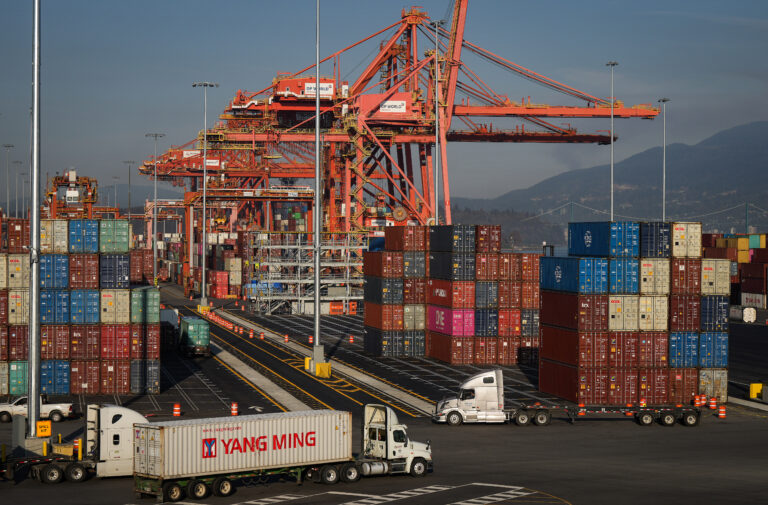
A truck carries a cargo container at the Port of Vancouver Centerm container terminal as others are stacked under gantry cranes.

Feds announce $5B for businesses to survive tariffs and find new trading partners

By Joanna Smith
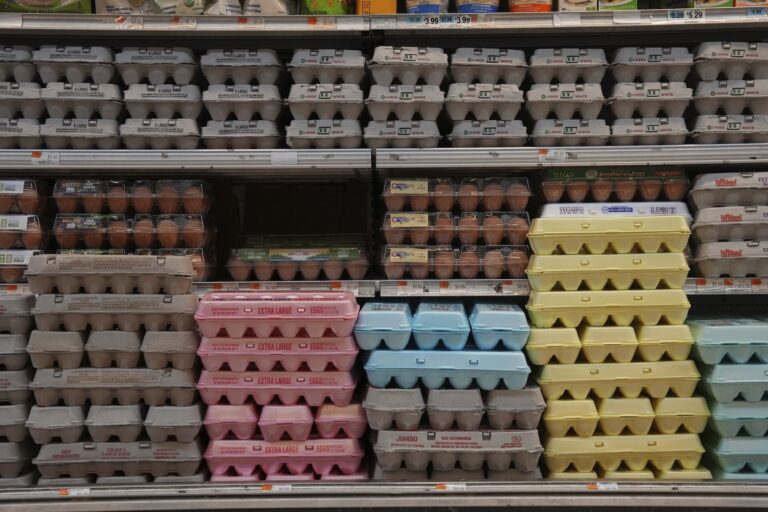
Eggs cartons on a shelf in a grocery store in New York.

The U.S. is making more seizures of illegal eggs than fentanyl at its Canadian and Mexican borders

By Laura Osman and Aimée Look
A close-up of a red label reading "Canadian grown produce" attached to a shelf in front of Prince Edward Island Russet potatoes.

Canada should turn the trade war into a food fight, new analysis shows

By Laura Osman

Most legitimate visitors to the United States are registered automatically, including anyone who gets a visa before travelling and has it checked at an entry point, and those who get so-called I-94 forms, which are routinely issued at airports and seaports. It wasn’t immediately clear what the implications are for Canadian students at U.S. universities.

The big exception: Canadians crossing into the U.S. by land for purposes that don’t require visas, who get waved through after quick chats with border officers. They are generally allowed to stay in the U.S. for six months, but not without formally reporting their presence.

Under long-standing rules, such visitors were always supposed to register. A version of the requirement dates back to a 1940 law requiring non-citizens to go to post offices to record personal details and submit to fingerprinting. Millions did so then.

Enforcement, however, has been lax—so much so that the U.S. Citizenship and Immigration Service doesn’t even have a form or process for registering yet. The draft plan suggests an online form, with no need for fingerprinting, will be enough for Canadian visitors.

Now, says the U.S. government, “no alien will have an excuse for failure to comply with this law.” 

Metals and electricity

Trump also threatened Tuesday to double incoming tariffs on Canadian steel and aluminum in response to Ontario upping the cost of its U.S. electricity exports—a retaliatory move the province later agreed to suspend in favour of talks about renewing the continental trade deal. Later in the day, Trump reversed his stance and told reporters he was reevaluating the threat, and would “probably” back down on doubling the steel and aluminum tariffs. 

Ontario Premier Doug Ford had applied a 25 per cent surcharge to electricity exports to the U.S. on Monday—adding $10 per megawatt-hour to the cost for about 1.5 million homes and businesses in Michigan, Minnesota and New York state. That had Trump saying he would soon declare “a National Emergency on Electricity within the threatened area” and increase the tariffs on Canadian steel and aluminium to 50 per cent.

On Tuesday afternoon, though, Ford and U.S. Commerce Secretary Howard Lutnick posted a joint statement on social media saying the two politicians—one the leader of a subnational government and the other a member of the U.S. federal cabinet—had a “productive conversation about the economic relationship between the United States and Canada.”

The statement did not mention steel or aluminum, but said Lutnick agreed to meet Ford in Washington on Thursday alongside U.S. Trade Representative Jamieson Greer to discuss a renewed United States-Mexico-Canada Agreement (USMCA) before April 2, which is when Trump has said he will end the partial reprieve on broad-based tariffs for Canada and Mexico. The joint statement also said Ontario agreed to suspend its surcharge on U.S. electricity exports in response.

Trump announced last month he would restore and increase national security tariffs on all foreign steel and aluminum, imposing 25 per cent duties on both. Those tariffs, scheduled to take effect Wednesday at 12:01 a.m. EDT, remove an exemption Canada has had since 2019.

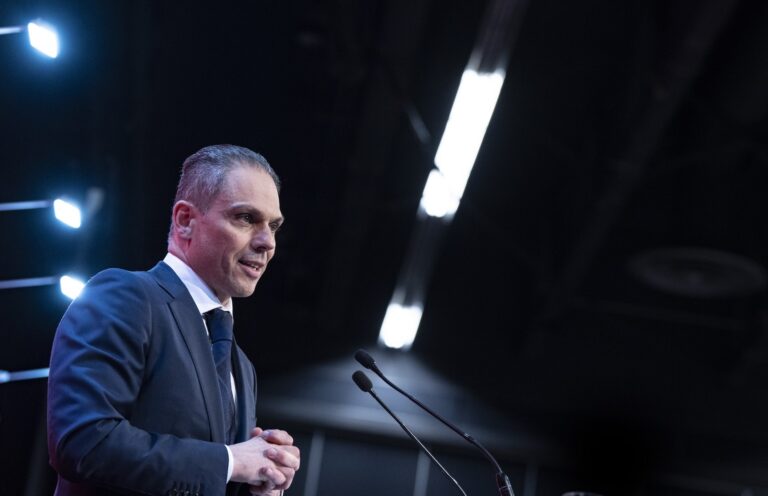
Conservative Leader Pierre Poilievre called on Ottawa to retaliate with 50 per cent tariffs on both metals from the U.S. “These attacks will only harden our resolve,” he wrote.

Newly elected Liberal Leader Mark Carney, who is set to be the next prime minister, said on social media his government would keep retaliatory tariffs in place “until the Americans show us respect and make credible, reliable commitments to free and fair trade.” 

Market volatility   

A three-week-long stock sell-off extended through Tuesday, suggesting investors have started to question the so-called “Trump put,” the idea that if the markets sink too deeply, the president will adjust his policies. 

The “Trump put,” is a spinoff of the “Fed put,” the notion that the federal reserve will insert stimulus if the economy drops too much, and stems from the idea that options are used in a portfolio to limit downside. Treasury Secretary Scott Bessent rejected the idea, telling CNBC on Friday, “There’s no put.”

“The Trump call on the upside is, if we have good policies, then the markets will go up.”

That hasn’t necessarily played out. The U.S. dollar has dropped more than 4.7 per cent since the start of January, the biggest yearly fall in its value since the 2008 recession. It fell 0.57 per cent over the day on Tuesday to 4:20 p.m EDT.

Meanwhile, the S&P 500 dropped 0.76 per cent Tuesday, after having its worst daily fall of the year Monday. The tech-heavy Nasdaq fell 0.18 per cent, while the blue-chip Dow Jones Industrial Average dipped 1.14 per cent on markets close Tuesday. The VIX, a measure of market volatility, has risen 13.99 per cent over the past five days, to 26.70. A value of over 30 is typically considered highly volatile.
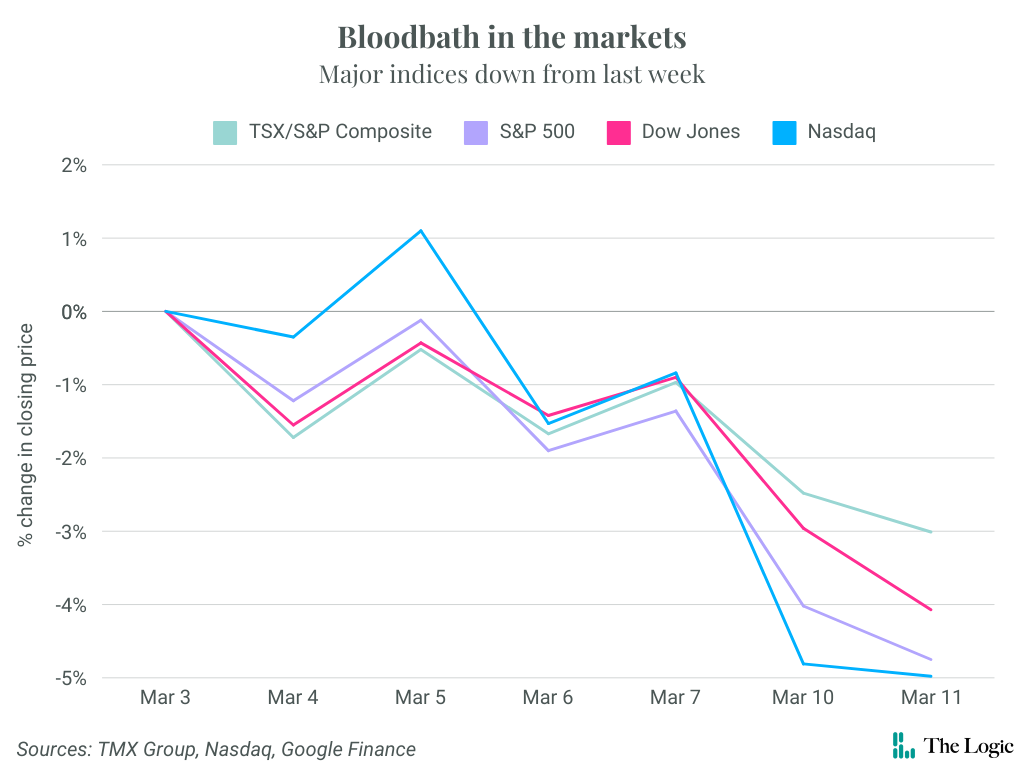
In Canada, the S&P/TSX composite index—which tracks the largest equities on the Canadian stock exchange—lost 0.54 per cent during the trading day. 

The U.S. administration seems “to be writing off significant economic and market disruption as just part of the process,” Robert Kavcic, a BMO senior economist wrote in a note Tuesday afternoon. Though the disruptive nature of tariffs “could be overestimated” by the markets, National Bank analyst Jocelyn Paquet wrote in a note, but “this additional layer of uncertainty is added at a time when the U.S. economy appears vulnerable, making the situation more worrying.” 

Gift the full article

Trump’s trade strategy has become too unpredictable, thus losing “some of its effectiveness,” CIBC Research Central’s Ian de Verteuil wrote in a note Monday. Though the U.S. was initially headed for a soft landing, RBC’s chief economist Frances Donald wrote in a note Tuesday, a  few “yellow flags” in economic indicators have popped up and threaten to upend the economy.

#Canada-U.S. trade #economy #tariffs #trade #U.S.-Canada relations

Loading...

Thanks for sharing!

You have shared 5 articles this month and reached the maximum amount of shares available.

Close
This account has reached its share limit.

If you would like to purchase a sharing license please contact The Logic support at [email protected].

Close
Want to share this article?

Upgrade to all-access now

Close
Gift the full article!

You have gifted 0 article(s) this month and have 5 remaining.

Copy link and gift
Copy Link
Email to a friend
Send Email
Gift on Social Media

Recipients will be able to read the full text of the article after submitting their email address. They will not have access to other articles or subscriber benefits.

A shot of a U.S. border crossing booth with a car pulled over with a border guard at the window. The back of a black pickup truck with a canopy is visible in the foreground as the driver waits for their turn.

Photo: The Canadian Press/Darryl Dyck

Most Popular This Week

A diptych showing Mark Carney on the left, and CIBC CEO Harry Culham on the right.
News

Diversifying trade requires banks to take bigger risks, official advised Carney before CIBC meeting

By Joanna Smith
The image shows the inside of Toronto Stadium on a sunny day. The rows of seats are empty; an empty green field is visible.
News

Toronto and Vancouver aren’t getting a World Cup bookings boom

By Chaimae Chouiekh
A yellow ambulance is pictured outside of a hospital in Montreal. A red sign in the foreground reads, “Urgence / Emergency.”
Commentary: Quebec Ink

Quebec just found out what not having digital sovereignty really means

By Martin Patriquin
An image of Mark Carney standing in front of a red podium with the words "AI for All / L'IA pour tous." He is wearing a suit and tie. In the background, people wearing scrubs and white coats are visible.
Special Report

Canada’s new AI strategy sets lofty goals for adoption and growth

By Murad Hemmadi and Laura Osman

In-depth, agenda-setting reporting

Great journalism delivered straight to your inbox.

An image of Tiff Macklem standing in a dimly-lit hallway, wearing a blue suit and glasses. He is clasping his hands in front of him and looking ahead.
Commentary

Carmichael: Tiff Macklem can’t save you

By Kevin Carmichael

Briefing

Canada to publish list of imports at risk of being made with forced labour

By Joanna Smith   |   Jun 12, 2026

TMX Group acquires RAFI Indices for $683M

By Anita Balakrishnan   |   Jun 12, 2026

Ikea invests in Toronto food startup NS/TX Industries’ US$10.5M fundraise

By Catherine McIntyre   |   Jun 12, 2026

Best business newsletter in Canada

Get up to speed in minutes with insights and analysis on the most important stories of the day, every weekday.

Exclusive events

See the bigger picture with reporters and industry experts in subscriber-exclusive events.

Membership in The Logic Council

Membership provides access to our popular Slack channel, participation in subscriber surveys and invitations to exclusive events with our journalists and special guests.

Recent Popular Stories

Commentary: Quebec Ink

Quebec just found out what not having digital sovereignty really means

By Martin Patriquin   |   Jun 8, 2026
A yellow ambulance is pictured outside of a hospital in Montreal. A red sign in the foreground reads, “Urgence / Emergency.”
News

OMERS investment chief departs for Singapore’s Temasek

By Chaimae Chouiekh   |   Jun 10, 2026
The Big Read

We found every data centre in Canada

By Murad Hemmadi, David Reevely, Aleksandra Sagan, Chaimae Chouiekh, Martin Patriquin and Catherine McIntyre   |   Apr 8, 2026
Four vertical slices of aerial view photos. From left, a building in downtown Toronto housing several data centres, a picture of the Albertan wilderness where the proposed Wonder Valley data centre would go, a lit-up QScale data centre in Quebec, and a data centre at a Hydro-Quebec dam.
News

Diversifying trade requires banks to take bigger risks, official advised Carney before CIBC meeting

By Joanna Smith   |   Jun 9, 2026
A diptych showing Mark Carney on the left, and CIBC CEO Harry Culham on the right.
News

Canada’s surprise plan to buy Saab command jets leaves competitors seeking answers

By David Reevely   |   May 29, 2026
A closeup of a scale model of a jet covered in pixellated camouflage, with sensor equipment attached to the top of its fuselage. There are civilians and uniformed military personnel milling in the background.
The Big Read

ApplyBoard faces a reckoning as Canada’s immigration boom turns into a bust

By Claire Brownell and David Reevely   |   May 27, 2026

Canada's most influential executives and policymakers are reading The Logic

  • CPP Investments
  • Sun Life Financial
  • C100
  • Amazon
  • Telus
  • Mastercard
  • bdc
  • Shopify
  • Rogers
  • RBC
  • General Motors
  • MaRS
  • Government of Canada
  • Uber
  • Loblaw Companies Limited
logic-logo

Canada's Business and Tech Newsroom

100% human-crafted journalism

Newsroom

  • News Tips
  • AI Policy
  • Editorial Disclosures
  • Story Pitches

Company

  • About Us
  • Terms of Service
  • Privacy Statement
  • Corporate Information

Contact

  • Contact Us
  • Advertise
  • FAQs
  • Work at The Logic

© 2026 The Logic Inc. All Rights Reserved.

Trusted by leaders

Error

Account creation failed.

Please email us at [email protected].

Create Account

[wppb-register form_name=”cozmo-registration-form-for-modal”]

I do have an account
Login
or

[wppb-login]

I don’t have an account