Troubled EV bus and truck manufacturer Lion Electric is selling its innovation centre in Mirabel, Que., for $50 million to repay debts. Aéroport de Montreal, the city’s airport authority, will purchase the facility, which currently houses Lion’s prototyping laboratories.
Skip to content


News
Lion Electric lays off half its staff and sells major facility as crisis deepens
The Quebec electric vehicle firm has also had its warrants delisted by the New York Stock Exchange as its share price tanks
A Lion Electric school bus is assembled at the company’s assembly plant in St-Jérôme, Que. Photo: The Canadian Press/Christinne Muschi
Troubled EV bus and truck manufacturer Lion Electric is selling its innovation centre in Mirabel, Que., for $50 million to repay debts. Aéroport de Montreal, the city’s airport authority, will purchase the facility, which currently houses Lion’s prototyping laboratories.
News of the sale was swiftly followed by the New York Stock Exchange announcing it will delist Lion’s warrants on Dec. 17. That decision comes after the firm failed to appeal its decision to remove a class of its warrants for “abnormally low” selling price. The move suggests little hope that the warrants, which gave investors from its public offering the right to buy shares for US$11.50 apiece, will have value. Lion’s stock closed at about 52 cents in Toronto Friday after rising 8.3 per cent.
Talking Points
- The collapse of Lion Electric, one of the few Canadian automakers to compete with global giants, would deal a significant blow to Quebec and Canada’s ambitions to be a global EV leader
- There may be hope yet for Lion, in the form of investment from Mach Capital, which is reportedly conducting due diligence on an investment in the firm
Negotiations over Lion’s mounting debts seemingly reached an impasse this week after the company was granted a 16-day relief period on a Nov. 30 debt deadline. On Dec. 1, it temporarily laid off 400 employees, over half its remaining staff, and paused work at its Illinois factory. The company now runs on a skeleton crew of about 20 per cent of the staff it had just two years ago.
The Caisse de dépôt placement du Québec, the province’s public pension fund manager, has invested $15 million in Lion since 2022. Spokesperson Jean-Benoît Houde said the Caisse was continuing to work with Lion to “analyze options.” Lion Electric vice-president Patrick Gervais declined to comment.
The total collapse of Lion, now more likely than ever, would be a significant blow to Canada’s ambitions to be a global EV leader. As such, a lot is at stake—both financially, as the recipient of public funding, and symbolically, as one of Canada’s flagship cleantech companies that was generating homegrown intellectual property in the highly competitive electric-vehicle sector.
Lion has generated a lot of excitement in recent years, said Ben Sharpe, senior policy analyst at Atlas Public Policy, a think tank. After years of flagging influence in the global automotive industry, Canada was at a crossroads, he said, and EVs were viewed as a potential boon. So, he said, the Canadian government’s support of the sector was heartening.
Related Articles

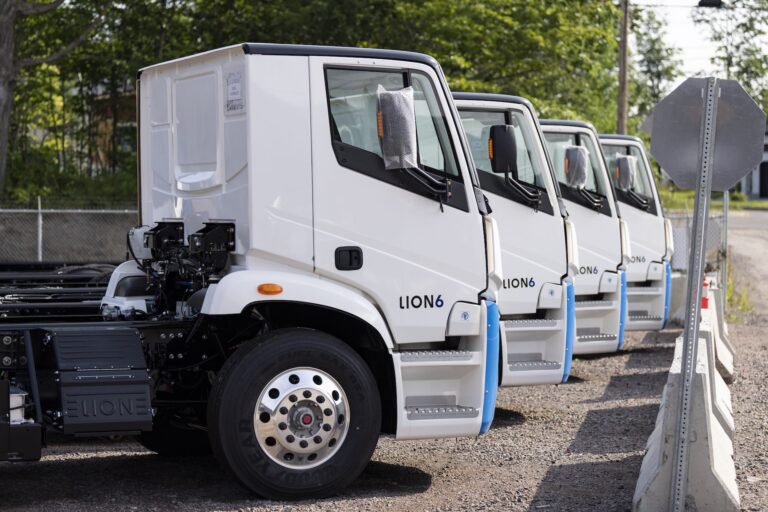
Lion’s core product, electric school buses, were particularly easy to get behind. “Cleaning up the air around schools for kids—you’d be hard-pressed to find folks that aren’t in favour of that,” said Sharpe.
Lion got another major win when it booked an order from Amazon during the height of the pandemic’s e-commerce boom. But the company has struggled to turn momentum into profit. Amazon ended up putting in a similar, much larger order for electric delivery trucks with Rivian—though Gervais told The Logic in October that the company’s partnership with Amazon is ongoing.
There may be hope yet for Lion. Mach Capital, an investment arm of the Quebec-based real estate firm Groupe Mach, is reportedly conducting due diligence on an investment in the firm. Both Mach and Quebec’s economy minister, Christine Fréchette, would reportedly like to see other investors pile in before they pull the trigger on additional funding.
Earlier this year, NFI, one of the only other independent Canadian automakers and a rival bus maker, came back from the brink of its own financial collapse with help from federal and provincial funding. But Lion has struggled to get access to federal funding for its buses. Documents obtained by The Logic through access-to-information requests show hundreds of pages of emails between Lion and the federal government as the company tries to understand why it has been caught up in delays in the transit funding program.
Lion, like many EV firms, is heavily subsidized, receiving a combined $100 million from the federal government and Investissement Quebec. Canadian schools and transit systems have ordered another 1,250 electric buses as part of the federal government’s Zero Emission Transit Fund. But the company says the government has only approved 200 so far. Meanwhile, the feds have to date only paid out $30 million of its funding to Lion, with $15.5 million of that conditional loans.
Part of the conditions of these loans, Lion has said, is that it maintains a workforce in Quebec, and conducts research and development in the province. The federal government did not answer questions about whether the company remains on track to meet those targets.
“Lion Electric is one of the pioneers of the electric vehicle industry in North America. However, we are aware of the challenges facing the company, and we are always sensitive when it comes to job losses,” said Audrey Champoux, a spokesperson for Innovation Minister François-Philippe Champagne.
“We are in close contact with the Quebec government as well as with the company, and we will continue to monitor the situation closely,” Champoux added.



Loading...
Thanks for sharing!
You have shared 5 articles this month and reached the maximum amount of shares available.
CloseThis account has reached its share limit.
If you would like to purchase a sharing license please contact The Logic support at [email protected].
CloseGift the full article!
You have gifted 0 article(s) this month and have 5 remaining.
Recipients will be able to read the full text of the article after submitting their email address. They will not have access to other articles or subscriber benefits.
Photo: The Canadian Press/Christinne Muschi
Most Popular This Week




In-depth, agenda-setting reporting
Great journalism delivered straight to your inbox.
News
Brookfield’s new CEO flexes the firm’s soft power with its $50B Canadian bet
Briefing
AI is pushing insurers to become asset managers, Canadian CEOs say
Trump administration faces lawsuit over 50% tariffs on Canadian goods
Canada-U.S. trade war to reduce real GDP by 1.4% over 2024 levels after five years: PBO
Best business newsletter in Canada
Get up to speed in minutes with insights and analysis on the most important stories of the day, every weekday.
Exclusive events
See the bigger picture with reporters and industry experts in subscriber-exclusive events.
Membership in The Logic Council
Membership provides access to our popular Slack channel, participation in subscriber surveys and invitations to exclusive events with our journalists and special guests.





