Johnson & Johnson is closing its life sciences incubator in Toronto, nine years after the global health-care conglomerate struck a partnership with MaRS Discovery District and the University of Toronto to support early-stage life sciences companies through the centre.
Skip to content


News
Johnson & Johnson is closing its JLabs innovation centre in Toronto
University of Toronto will manage the incubator while it finds a new partner to replace the health-care giant
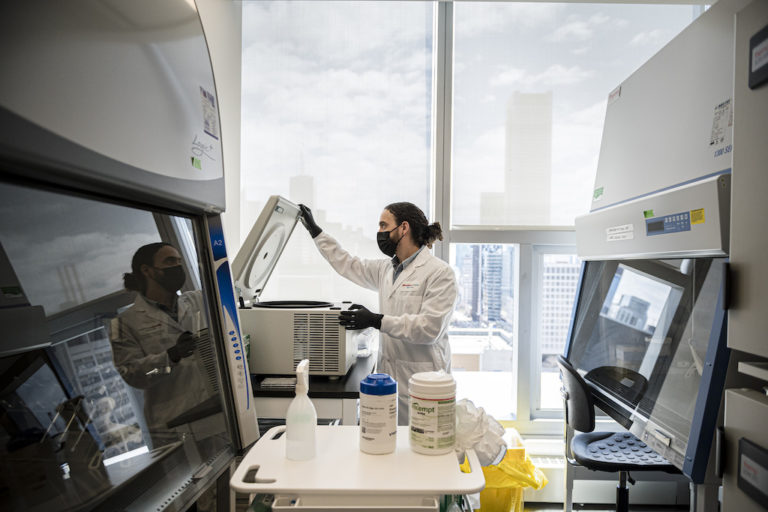
A scientist works at the JLabs incubator at MaRS in Toronto on May 4, 2022. Photo: Christopher Katsarov Luna for The Logic
Johnson & Johnson is closing its life sciences incubator in Toronto, nine years after the global health-care conglomerate struck a partnership with MaRS Discovery District and the University of Toronto to support early-stage life sciences companies through the centre.
The company told member startups a few weeks ago that it will leave the space at the end of the year. The University of Toronto and MaRS are looking for a new partner to take over from JLabs, MaRS CEO Grace Lee Reynolds told The Logic. Until then, University of Toronto will manage the incubator, which serves about 30 startups, said Leah Cowen, University of Toronto vice-president of research and innovation, and strategic initiatives. “The lab is vital to advancing discovery and innovation in Canada and the University of Toronto will keep it thriving until a new partner can be found,” said Cowen.
JLabs opened in Toronto in 2016, its first incubator outside the U.S. Startups could apply for membership to the 40,000-square-foot space, giving them access to specialized lab facilities, office space and Johnson & Johnson’s network of mentors, researchers and investors. A press release announcing JLabs’ expansion to Toronto described the centre’s role as “providing emerging companies with many of the advantages of being in a big company, without the capital investment.”
Talking Points
- Johnson & Johnson is closing its life-sciences incubator at the MaRS innovation hub in Toronto, nine years after launching
- The incubator helped ease a major shortage of lab space in Toronto, and gave startups access to Johnson & Johnson’s network of mentors, researchers and investors
In exchange, Johnson & Johnson would get early exposure to startups with which it could potentially partner or acquire. The company says it has more than 350 deals or partnerships with companies across its 11 JLabs centres globally.
“It’s been amazing for us,” said Christine Allen, CEO of drug development startup Intrepid Labs, the second of Allen’s companies that has been part of JLabs. “They’ve helped us engage with global investors, and you become part of this community.” Allen said being vetted to join JLab also validated her companies’ technology to outsiders. “That helps, even with raising money,” she said.
Politicians and industry leaders celebrated JLabs’ Toronto expansion as a vote of confidence in the city’s medical research and life science sector, with the Ontario government committing $19.4 million to help build the incubator. “It helped position Toronto as this world class centre for life sciences and biotech,” said Allen.
Related Articles

Johnson & Johnson did not say why specifically JLabs is closing its Toronto innovation centre. Spokesperson Angelique Navarro said the company “routinely evaluates our innovation strategy and adjusts our approach in the markets we operate to ensure we are delivering the greatest impact to patients.”
Endpoint News first reported that the city is one of three locations JLabs is leaving, along with Houston and Washington, D.C. Navarro did not say whether Johnson & Johnson will close other incubators. “We remain committed to accelerating early-stage innovation with partners through strategic collaborations, our global incubation program and venture investments across vibrant life science ecosystems,” she said.
JLabs is a rare source of lab space for early-stage biotech ventures in Toronto. Despite its presence, the city has had a major lab space shortage that has hobbled biotech startups’ ability to grow. The highly specialized facilities are expensive to build and rent, and most real estate investors steer clear of labs because they’re traditionally riskier than other property assets. More lab space is slated to come to market in Toronto, however, as demand increases. MaRS has 700,000 total square feet of bespoke lab space.
“This lab space has played a vital role in advancing Canada’s health innovation ecosystem by supporting dozens of early-stage ventures with the infrastructure, resources, and networks needed to develop breakthrough technologies,” Lee Reynolds told The Logic by email. “Canada needs more of this kind of support, not less,” she said. “All levels of government should treat lab infrastructure as a strategic investment in scientific progress, economic growth, and the future of our health system.”
Allen said Johnson & Johnson assured her the JLabs facility would remain available to her company and other member startups, and that existing members can still get benefits from being part of the JLabs network.



Loading...
Thanks for sharing!
You have shared 5 articles this month and reached the maximum amount of shares available.
CloseThis account has reached its share limit.
If you would like to purchase a sharing license please contact The Logic support at [email protected].
CloseGift the full article!
You have gifted 0 article(s) this month and have 5 remaining.
Recipients will be able to read the full text of the article after submitting their email address. They will not have access to other articles or subscriber benefits.
Photo: Christopher Katsarov Luna for The Logic
Most Popular This Week




In-depth, agenda-setting reporting
Great journalism delivered straight to your inbox.
News
Adam Waterous proposes massive crude exports to Asia by rail through northern B.C.
Briefing
Rivals may be ‘horrified’ to realize how exposed their investments are to AI, Aviva CIO warns
Shopify, Sequoia co-lead US$200M investment in online-selling platform Whop
Amid revenue gains, 1Password bets on tools to protect data from AI agents
Best business newsletter in Canada
Get up to speed in minutes with insights and analysis on the most important stories of the day, every weekday.
Exclusive events
See the bigger picture with reporters and industry experts in subscriber-exclusive events.
Membership in The Logic Council
Membership provides access to our popular Slack channel, participation in subscriber surveys and invitations to exclusive events with our journalists and special guests.







