Skip to content


Analysis
Foreign investment in Canadian securities has plunged 60% so far this year
Meanwhile, Canadian investors ramped up their investments abroad, driving the largest net capital outflow since the pandemic
An index screen at the TMX Market Centre in downtown Toronto is photographed on Friday, November 11, 2022. Photo: The Canadian Press/ Tijana Martin
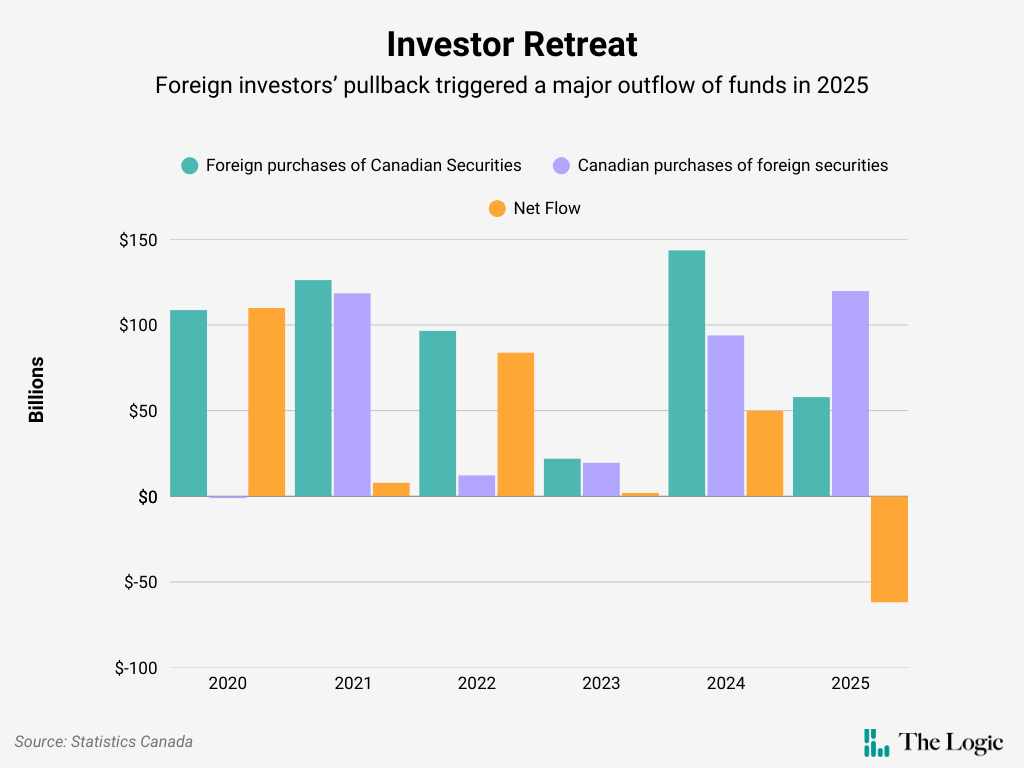
Foreign investors have sharply pulled back from Canadian securities, driving a 60 per cent drop in acquisitions to $58 billion in the first nine months of this year compared to the same period last year, as tariff uncertainty and trade volatility weighed on market sentiment.
Most of the decline happened in the first half of the year, when international investors sold $22.36 billion worth of Canadian securities. However, sentiment shifted in the third quarter, as more than $80 billion flowed into the market—marking Canada’s first quarterly inflow of 2025, per Statistics Canada data.
Talking Points
- Foreign investment in Canadian securities dropped 60 per cent in the first nine months of the year compared to the same period last year, while Canadian investors increased their holdings of foreign securities by 27 per cent to $120 billion over the period
- Together, these flows produced a net outflow of nearly $62 billion—the steepest since the pandemic and a stark reversal from last year’s $50 billion inflow
In an interview, John Zechner, chairman of investment management firm J. Zechner Associates, said the renewed foreign interest shows that Canada still attracts investors seeking higher yields with relatively lower risk, despite the U.S.-led global trade war.
“The impact of the tariffs haven’t been as bad as some people expected, and that’s showing up in the economic data, being a little bit better than expected into the back half of this year,” Zechner said. He added that rate cuts on both sides of the border, along with the Liberal government’s pivot under Prime Minister Mark Carney toward financing megaprojects, may also have reassured some investors.
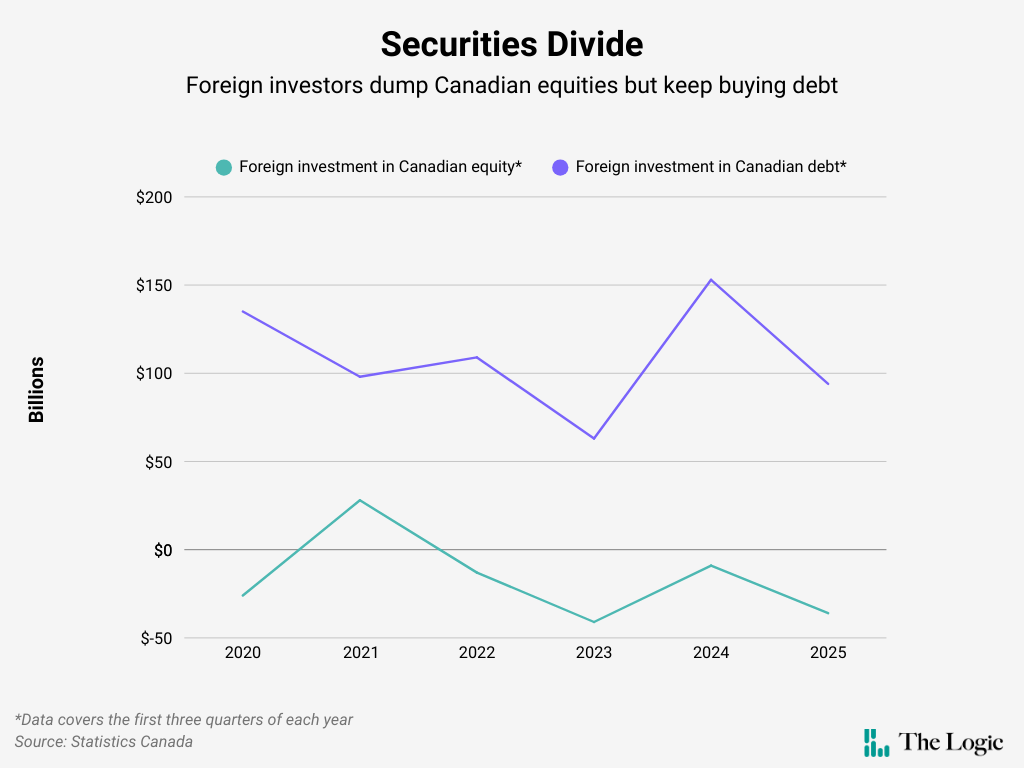
Most of the foreign money that did stay in Canada went into bonds. Investors bought about $93 billion worth of Canadian debt in the first three quarters—roughly 60 per cent of which went into corporate bonds, according to Statistics Canada data, with the remainder made up of government bonds.
Tiago Figueiredo, a macro strategist at Desjardins, said the surge into Canadian debt reflects investors’ view that Canada is “in a better fiscal position relative to other countries.” He added that many buyers now want exposure to Canadian issuers without taking on the risk associated with the Canadian dollar, which has also fuelled demand for U.S.-dollar bonds issued by provinces and corporations.
Related Articles


Economists are also keeping a close eye on Canada’s government debt. Desjardins deputy chief economist Randall Bartlett warned in a note to clients ahead of the federal budget that while a downgrade to Canada’s triple-A credit rating isn’t imminent, it should not be “taken for granted.”
“Canada’s debt is at an inflection point,” Bartlett said in an October interview. If the economic boost from national projects falls short, or if a U.S. “shock” hits Canada’s economy, the country’s debt dynamics could worsen, he said.
Although foreign demand for Canadian debt remained quite strong, there has been a broader retreat from Canadian equities. That pullback has persisted despite the S&P/TSX Composite outperforming the S&P 500 index this year, powered by historic rallies in gold and a rebound in bank stocks. Canada’s equity benchmark is up 26 per cent so far this year and on track for its strongest gain since 2009, according to S&P Global Market Intelligence. Yet international equity flows to Canada have been negative for four consecutive years, with outflows deepening to $36 billion this year through September, nearly four times last year’s net selling for the same period.
Aaron Young, executive director of client portfolio management at CIBC, told The Logic that global investors are stepping back because Canada’s equity market is relatively small and dominated by a few sectors, mainly financials and commodities. He added that it also lacks the high-growth technology stocks that have driven strong returns in other markets.
“If you’re looking to play something like AI, Canada’s not going to be your first stop,” Young said.
At the same time, Canadian investors were largely unmoved by the Buy Canadian movement spurred by the trade war. Instead, they increased their holdings of foreign securities by 27 per cent to $120 billion in the first three quarters, with 93 per cent of those purchases flowing into the U.S. market, according to Statistics Canada data.
“While Buy Canadian makes a lot of sense, there’s just certain exposures, certain sectors, certain parts of the economy that you’re not going to get as meaningful an exposure to if you were to just blindly follow the ‘buy Canada’ approach,” said Young.
Figueiredo cautioned that rising Canadian demand for U.S. equities doesn’t necessarily mean domestic stocks are being overlooked. Canadians may simply be broadening their portfolio exposure, both at home and abroad, he said.
Similarly, Zechner said Canadians have been globalizing their portfolios for decades, as regulatory limits on foreign holdings were gradually lifted beginning in the 1980s and the U.S. grew to dominate global equity markets.
“Everybody’s been slowly globalising over a period of time to get more exposure, more diversity [on] different industries,” Zechner said. However, he warned that if Canadians keep flocking to U.S. equities, it could eventually weigh on valuations in the country’s stock market.
“If money goes out, Canadians [may] become the only buyers of Canadian stocks, and those buyers have become fewer, and you’ve got no offset on the other side, so it just means lower prices,” Zechner said.
Foreign money leaving and Canadians investing more abroad defined this year’s capital-flow picture. The country posted a net outflow of nearly $62 billion in the year to September, the steepest since the pandemic and a sharp reversal from the $50 billion inflow recorded over the same time last year.
Economists interviewed by The Logic didn’t see this net outflow as alarming, with Figueiredo noting that the real concern is Canadians putting more of their money into U.S. equities.
“If this AI theme doesn’t really play out, or if these AI data centre infrastructure projects don’t play out, then Canada ends up being a bit more exposed than they would have otherwise,” Figueiredo said.



Loading...
Thanks for sharing!
You have shared 5 articles this month and reached the maximum amount of shares available.
CloseThis account has reached its share limit.
If you would like to purchase a sharing license please contact The Logic support at [email protected].
CloseGift the full article!
You have gifted 0 article(s) this month and have 5 remaining.
Recipients will be able to read the full text of the article after submitting their email address. They will not have access to other articles or subscriber benefits.
Photo: The Canadian Press/ Tijana Martin
Most Popular This Week




In-depth, agenda-setting reporting
Great journalism delivered straight to your inbox.
News
A tech firm born from post-Brexit trade chaos sets its sights on Canada
Briefing
Dozens of Canadian researchers join chorus of scientists calling for a global AI oversight
TC Energy strikes deal with Indigenous groups for ownership stake in Coastal GasLink pipeline
Canada’s Tailscale taps Google Moonshot alum to lead sovereign AI push
Best business newsletter in Canada
Get up to speed in minutes with insights and analysis on the most important stories of the day, every weekday.
Exclusive events
See the bigger picture with reporters and industry experts in subscriber-exclusive events.
Membership in The Logic Council
Membership provides access to our popular Slack channel, participation in subscriber surveys and invitations to exclusive events with our journalists and special guests.





