OTTAWA — Daniel Breton has been working with and advocating for electric vehicles for more than 20 years, and even he’s dismayed by how confusing it can be to pay to charge one.
Skip to content

News
How 38-year-old rules on electricity sales hold back Canada’s next generation of EV chargers
They’re getting an overhaul, but federal restrictions don’t allow charger owners to bill for the power they transfer
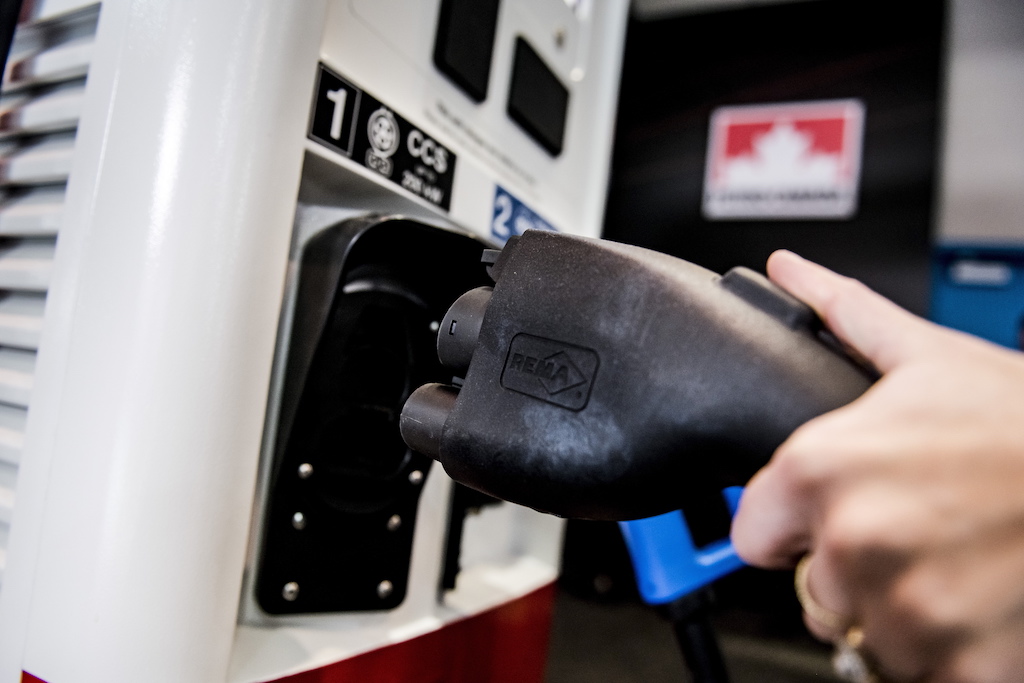
One of Petro Canada’s Level 3 electric-vehicle charging stations on display at the Canadian International Auto Show in Toronto in 2019. Photo: The Canadian Press/Christopher Katsarov Luna
OTTAWA — Daniel Breton has been working with and advocating for electric vehicles for more than 20 years, and even he’s dismayed by how confusing it can be to pay to charge one.
The former Quebec environment minister has been CEO of Electric Mobility Canada since 2020. Wherever he goes, he makes a point of trying out different charging networks, and his phone is a thicket of payment apps.
Talking Points
- Paid EV chargers in Canada typically bill for the time a vehicle is plugged in, not the energy it gets, thanks to antiquated rules written for electricity meters in buildings
- Newer vehicles and chargers have growing differences in how quickly they transfer power, and the old rules make the business case for cutting-edge fast-chargers all but impossible
“You go to this network and say, ‘Well, if you are a member, and you have the app, you will pay, let’s say, 50 cents per minute, and if you’re not a member, then you pay a more expensive fee.’ And then you go to another network, it’s the same fee for everyone. You go to a third network, it’s a different system,” he said. “When you go to a gas station, it’s pretty clear [how much you’re paying]. When you go to a fast charger, it’s not that clear.”
A major reason: It’s illegal, for now, for someone who operates an EV charger to just bill users for the power they transfer. Chargers are allowed to provide power for free, or for flat fees. Or they can bill for the amount of time a vehicle is connected, which is how most commercial ones currently operate. Those limitations make the marketplace confusing and advanced fast chargers hard to justify on financial terms, according to people in the industry.
“There needs to be some improvement and making sure that it becomes a lot more standardized, and charging per kilowatt-hour will standardize everything,” Breton said.
The standards for how you can charge for electricity are set by the Electricity and Gas Inspection Act, from 1985. Clearly, it was written with household and business electricity use in mind. Regulations under the act assume that each meter will be attached to a single power-purchaser’s account, with a name and address associated with it.
“The rules around electricity metering haven’t been updated in 40 years,” said Michael Powell, the vice-president of government relations for Electricity Canada, which represents electrical utilities. This is a problem, he said, for a country that officially wants 1.4 million zero-emissions vehicles on the road by 2026—just a few years away—and 4.6 million out there by 2030.
Related Articles
There’s a revolution happening in how we use electricity and fuel our vehicles, and regulation isn’t keeping up, Powell said.
The idea that some random customer might come up to a metered outlet to charge something, tap a credit card to pay and then leave is totally foreign to the rules.
Billing by time is a flawed proxy for the amount of energy a charger transfers to any given customer, said Frédérique Bouchard, a public-affairs manager at Flo, a Quebec-based company that sells chargers and operates a charging network.
“Say you drive a Mach-E, which tends to be able to draw out a very good power capacity that my 2012 Volt, say, cannot take,” she said. “You’ll be able to charge in 20 minutes and … mine will take four hours. For the same capacity delivered, I will be charged way more than you.”
Some charger providers make closer approximations by billing differently for different charger settings, but that’s still a kludge. As the variety of electric-vehicles increases, the relationship between charging time and the energy transferred will diverge even more.
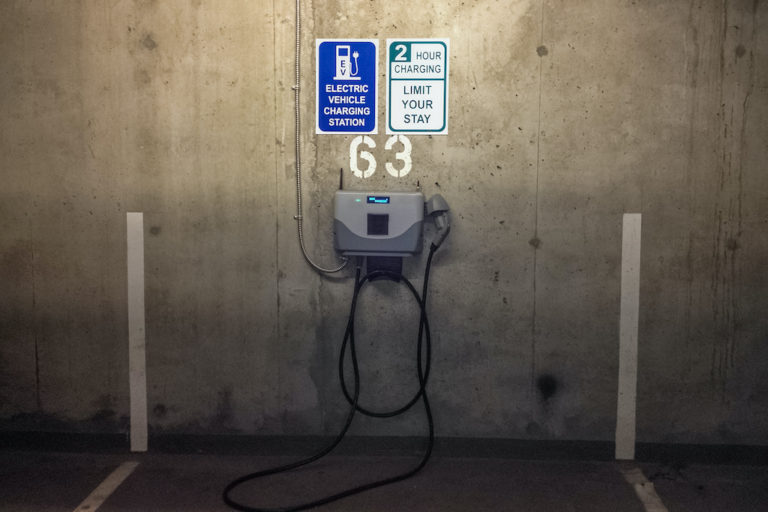
A Level 1 charger, the equivalent of an ordinary household outlet, delivers around two kilowatts of electricity, about the amount of juice a hairdryer consumes. These are common for home charging, where users can plug in their cars for hours at a time.
Level 2 chargers pump much faster, but also have a wider range of charging rates—2.5 to 19.2 kilowatts.
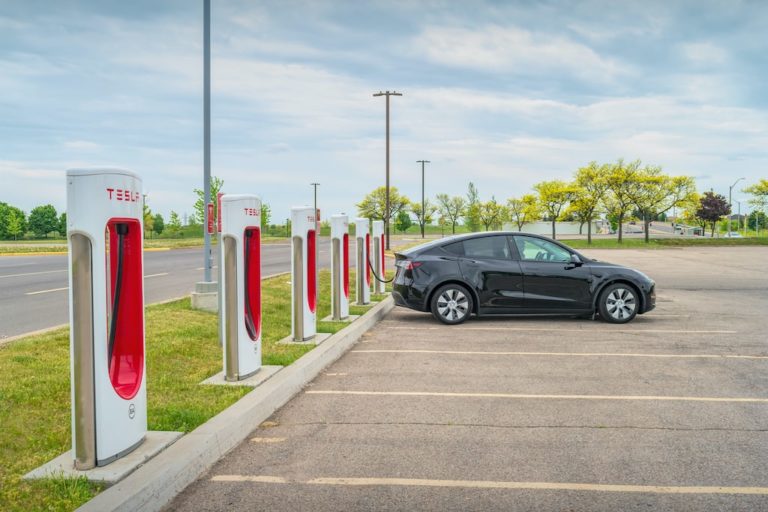
Level 3 chargers are even faster than that. They’re a big category, but Petro-Canada, for instance, boasts that it has fast chargers that deliver up to 350 kilowatts. They’re commercial-scale devices, the closest thing yet available to a gasoline pump’s speed and convenience in the EV world.
At that level, the workarounds no longer work well. Beyond being unfair, the mismatch between the large amount of power a charger dispenses and the small amount of money the owner can bill interferes with the economics.
“When you’re trying to build a business case for charging infrastructure deployment, part of that business case is looking at the fees you would charge,” said Moe Kabbara, director of electrification at The Transition Accelerator, a charity trying to solve problems that get in the way of a greener economy.
Building a business case for a charger—especially if you’re a small operator, maybe thinking about adding one to your strip-mall parking lot—is very difficult with the current rules inadequate and the future rules uncertain.
To this point, the electric-vehicle market has catered largely to early adopters, he said. They’re motivated to overcome obstacles, like dealing with a rainbow of charger-network apps, or having to go farther to find a charger on the network they favour. Later adopters are going to want to charge as easily as they can pump a tank full of gas.
Kabbara said good fee structures would probably combine metering with a time component, to ensure drivers don’t linger at scarce charging stations. “The time-based structure gives an incentive for vehicles to vacate, which is very important,” he said.
Measurement Canada, part of the Innovation Department, enforces the rules and advises on updates to them. It’s the agency whose stickers are on gas pumps, confirming they’ve been calibrated and inspected, and that they accurately measure the fuel they dispense.
At the end of October, Measurement Canada released terms of a “temporary dispensation” allowing EV chargers to bill by the kilowatt-hour, to be followed with full standards for the metering devices by the end of the year. (Even with an extended deadline, the agency was unable to answer The Logic’s questions about the work, including whether it’s on schedule.)
They’ll be an improvement, but still inadequate, Breton said.
The problem is that Measurement Canada’s work is based on Level 2 chargers, which no longer raise the greatest concerns about fairness and consistent pricing. “I’m not saying that it’s useless,” he said, “but the issue is with fast chargers.”
Canada isn’t hopelessly behind but it isn’t a leader. California, for instance, set metering standards for chargers at the start of 2020.
Level 3 chargers cost tens of thousands of dollars, and units put in now may have to be retrofitted later to allow metering that meets the standard the government eventually sets.
Businesses installing commercial chargers are rarely doing so to make money off them directly. Even a much-used Level 2 charger might bring its owner $2,000 a year in revenue, said Bouchard, at Flo. “A station owner will not make a ton of profits on it.”
Most people do most of their charging at home, said Breton, because they don’t drive enough to run a battery down completely. Metered chargers will primarily serve travellers and other long-distance drivers.
“That’s where we need to have a good infrastructure system—for highways or remote areas,” he said. “But there we have this warped system of charging for time.”
The temporary dispensations for older chargers to sell metered electricity are “a welcome first step,” Bouchard said. How new charging stations will be certified and, more to the point, how Level 3 chargers will be regulated are important developments to watch.
“This is a non-financial measure that’s really helpful in our space,” she said. “So that’s why we keep engaging with Measurement Canada and are supportive of the efforts to move the needle here.”



Loading...
Thanks for sharing!
You have shared 5 articles this month and reached the maximum amount of shares available.
CloseThis account has reached its share limit.
If you would like to purchase a sharing license please contact The Logic support at [email protected].
CloseGift the full article!
You have gifted 0 article(s) this month and have 5 remaining.
Recipients will be able to read the full text of the article after submitting their email address. They will not have access to other articles or subscriber benefits.
Photo: The Canadian Press/Christopher Katsarov Luna
Most Popular This Week



In-depth, agenda-setting reporting
Great journalism delivered straight to your inbox.
News
India wants to buy less Canadian uranium. Canada’s nuclear lab is helping
Briefing
First Nations object to Bell’s Saskatchewan data-centre plans
Oilpatch profits surged 68%, outpacing spending
SEC warns asset managers against co-ordinating activist campaigns
Best business newsletter in Canada
Get up to speed in minutes with insights and analysis on the most important stories of the day, every weekday.
Exclusive events
See the bigger picture with reporters and industry experts in subscriber-exclusive events.
Membership in The Logic Council
Membership provides access to our popular Slack channel, participation in subscriber surveys and invitations to exclusive events with our journalists and special guests.





