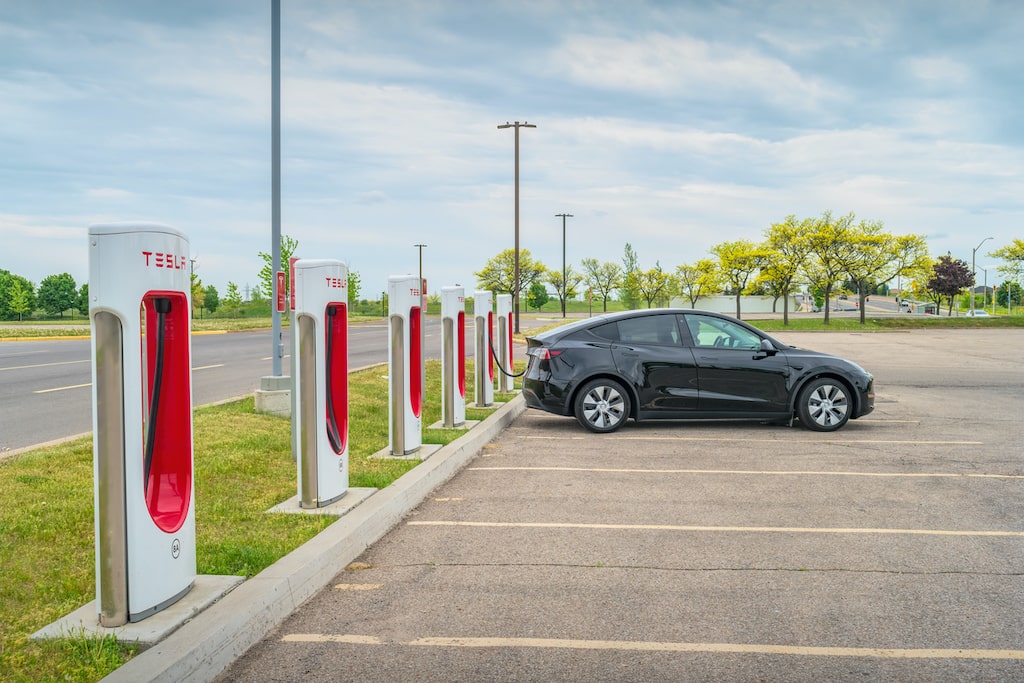
It’s a tough market for job seekers—but having a vision of the “fuelling stations of the future” on your resume might not hurt.
That’s one of the job responsibilities needed at Volkswagen Canada, which has been recruiting over the past few weeks for someone to lead its EV charging station strategy.
Auto-industry employment held steady in Canada through the first quarter of the year when Statistics Canada last tallied employment. But among the new entrants, Tesla and Rivian have announced pending layoffs, and Ford-backed autonomous-driving company Argo AI has cut six per cent of its workforce. Closer to home, the e-commerce auto site Clutch laid off 76 employees and its rival Canada Drives cut back on hiring. These cuts come after last year’s 26.2 per cent growth in roles in the battery-electric motor-vehicle sector, U.S. employment data shows.
Who’s hiring: While these layoffs could spell trouble, envisioning the EV future is a skill set still sought after by giant tech and retail brands, if recent job postings are any indication.
Amazon is hiring a software engineer based in Toronto, Vancouver or otherwise remotely, for Alexa Local Information, a division that uses hyper-local data for projects including “real-time EV Charging Station availability, enabling customers to make/cancel reservations and enable more flexible search.” Meanwhile, Circle K was recruiting for someone with expertise in mergers and acquisitions to determine where the Couche-Tard–owned brand has a “right to play in this new environment” as director of EV strategy and business development.
Though different industries, the postings have a lot in common with Volkswagen’s search for a commercial manager at its Electrify Canada subsidiary in Ajax, Ont., which focuses on identifying sales opportunities for charging stations and leading contract negotiations for public charging stations, heavy-duty corporate fleets and dealerships. Volkswagen Canada spokesperson Thomas Tetzlaff said the organization reports into Electrify America, which recently announced a big investment from Siemens, and the role is actively recruiting.
What’s driving the trend: Charging got another boost from the federal government, which announced funding for over 6,000 EV chargers this week, with the goal of installing a total of 50,000 over the next four years—and the Canadian Vehicle Manufacturers’ Association estimates another 650,000 public chargers need to be built in the next eight years. That means contracts to be won and apps to be built.
Why it matters: The auto-tech market is no longer hiring freely, so these job postings reflect that EV charging is a top priority in a more selective industry.
Yesterday, Prime Minister Justin Trudeau said at a press conference that Canada had added nearly 17,000 jobs this year to make hybrids, EVs and batteries.
Late last month, before Clutch’s layoffs became public, CEO Dan Park told The Logic he was hoping that the economic downturn would not slow down EVs’ big moment.
“If the entire world turned electric overnight, we’d embrace that and be excited about it,” he said. “What we’re seeing from a demand perspective is that people want more EVs; there just isn’t a large number of EVs on the market.”
This is Shift.
Read Shift—The Logic’s authoritative weekly newsletter on automotive technology industry news—for more; and if you know someone who should be reading it, they can sign up here.