Each of Canada’s major political parties sees a future where every car maker produces electric vehicles, and every car dealer sells them. What’s less clear is how they propose to convince Canadians to buy them.
Skip to content

Exclusive
Politicians want Canada to sell electric vehicles—but will they help you buy them?
Photo: iStock
Each of Canada’s major political parties sees a future where every car maker produces electric vehicles, and every car dealer sells them. What’s less clear is how they propose to convince Canadians to buy them.
“The one area that I would love to see more detail, across the party platforms, is helping more Canadians go electric. So that means specific policies targeting lower- and middle-income Canadians,” said Joanna Kyriazis, a senior policy advisor at Clean Energy Canada.
Talking Point
While U.S. politicians look aggressively at incentive programs for electric-vehicle buyers, Canada’s election has focused on supply-side mandates. Experts say that without specific policy reforms, existing platforms could leave a gap between the number of vehicles mandated and the number of consumers prepared to buy them.
In its platform, the Conservative Party said it would require 30 per cent of light-duty vehicles sold to be zero emissions by 2030. The NDP platform and the Liberal platform both reiterate plans the Liberals announced in June for all new light-duty vehicles sold in Canada to be zero-emissions by 2035.
There’s a long way to go. EVs made up just 3.5 per cent of new vehicle registrations in the country last year. And just because a car gets made doesn’t mean it’s affordable or practical.
Experts told The Logic that while it’s reassuring to see politicians agree on the importance of electrifying vehicles, they need to do something about affordability and charging if they want to deliver on their campaign promises. That means they’ll need policies that are missing from their platforms, like rebates scaled to income, safe places to charge at night, and charging ecosystems designed for curbsides and rural areas.
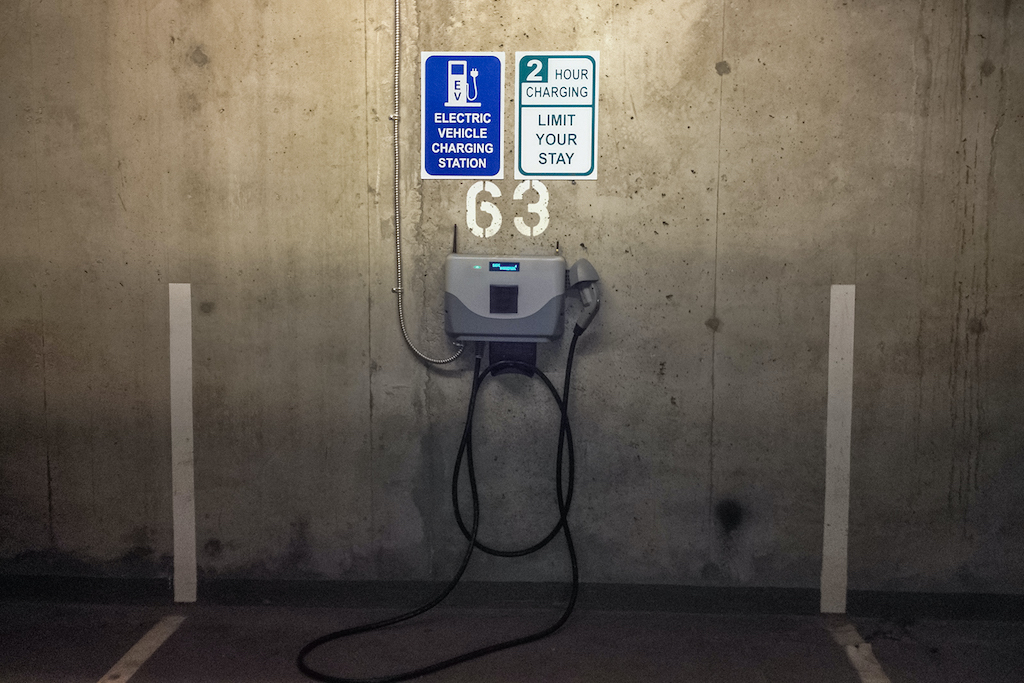
In the meantime, you’re unlikely to find an EV owner in Nunavut, where there still isn’t a single publicly accessible EV charger. You’ll also find few among the one-third of Canadians who are “garage orphans,” with no access to garages or driveways where they can charge their vehicles, who would have to leave their vehicle elsewhere to charge for anywhere between 30 minutes to 10 hours—or more.
“One of the most important roles for public funders is that …. they are the ones that make sure that everyone has equitable access to EV charging services,” said Travis Allan, vice-president of public affairs at charging-network operator AddEnergie.
None of the three top-polling parties responded to requests from The Logic to clarify how they would address these potential shortcomings in their platforms.
The Liberal platform specifies that they would put $100 million toward installing charging stations in existing buildings, and spend $700 million on 50,000 new chargers and hydrogen stations.
The Conservative document says they would invest in clean-energy infrastructure and work with provinces, territories and municipalities to encourage a minimum number of charging spaces for new developments. They would require government buildings to have charging stations, and work either mandatory charging stations or their required wiring into the building code, “working with the U.S.”
The NDP platform says only that they will build out charging infrastructure and help buyers cover the cost of a plug-in charger, without adding more details. The plan does, however, set aside $470 million in 2022–23 and a total of nearly $2.4 billion through 2025–26 for “zero-emissions-vehicle rebates and charging stations,” compared with the Liberals’ internal costing of $650 million in 2022–23, for a total of almost $2.2 billion through 2025–26. The Conservative platform doesn’t include it as a separate line item.
While the three parties have all pledged to build out EV charging infrastructure, the parties lack any direct goal mapping the number of chargers installed to the number of EVs sold, noted Brian Kingston, president and CEO of the Canadian Vehicle Manufacturers’ Association.
“The idea of setting, let’s say, three, five and 10-year targets for charging stations deployment is a really good one,” added Allan.
“It takes a significant amount of time to actually deploy the funding and access sites. Generally, what we want to do is actually build the charging stations in advance of the EV adoption targets, because people need to actually see that they’re able to charge their vehicle in order to feel comfortable enough to buy an electric vehicle.”
When it comes to affordability, there’s also some mismatch in Canada’s EV market. Younger online car shoppers were slightly more likely than older generations to browse electric or hybrid vehicles in the first quarter of this year, according to LowestRates.ca and Carpages.ca, with hybrid and electric vehicles representing 0.35 per cent of baby boomers’ page views, but 1.05 per cent of Gen Z’s. However, Carpages.ca president Ben Mirecki said high price points are a deterrent for electric and hybrid car shoppers across generations.
Meanwhile, the Tesla Model 3, which today costs between $52,990 and $74,990, was the top registered EV in Canada in the fourth quarter of 2019. A Dunsky Energy Consulting report prepared for Transport Canada found that in the same year, the dealerships most likely to have at least one plug-in EV on each lot were luxury brands Audi and Porsche. Transport Canada doesn’t track the household income of consumers that use its rebate program, but found that 61 per cent of car buyers were ages 35 to 59.
Many governments deal with these issues by offering a variety of incentives. Quebec and British Columbia had rebate programs that “stacked” on top of the federal subsidies, as well as mandates to eliminate sale of internal-combustion passenger vehicles by 2035 and 2040, respectively. Those two provinces, alongside Ontario, accounted for 95.4 per cent of new zero-emissions-vehicle registrations last year, according to Statistics Canada.
Yet the Conservative platform makes no mention of rebates for electric-vehicle purchases or the fate of the existing federal program. It proposes more “affordable” carbon prices alongside personal low-carbon savings accounts, which consumers would be able to spend toward things like a transit pass, bicycle or electric vehicle—although consumers would earn that money by buying hydrocarbon-based fuel.
The Liberals, meanwhile, are proposing pouring another $1.5 billion toward their iZEV program. The program has gotten scrutiny for subsidizing “luxury” vehicles at the threshold of $45,000, or $60,000 with upgrades, rapidly draining the account of its $2,500 to $5,000 allotments.
The Liberal platform says that this time around, they will finally fulfill a longstanding pledge to broaden the program to include a “wider range” of vehicles, including used vehicles, which make up about 60 per cent of Canada’s car sales. As for the NDP, it proposes waiving federal sales tax on ZEVs, with an incentive up to $15,000 per family for made-in-Canada vehicles.
Strong EV mandates, like those all parties propose, have been hailed in B.C. as “the most effective, low-cost and transformative policy.” But, said Kingston, having a zero-emissions vehicle on every single lot in Canada doesn’t mean consumers will buy them and hit those targets.
“I’d like to see more aggressive policies on the demand side coming up this election,” he said.



Loading...
Thanks for sharing!
You have shared 5 articles this month and reached the maximum amount of shares available.
CloseThis account has reached its share limit.
If you would like to purchase a sharing license please contact The Logic support at [email protected].
CloseGift the full article!
You have gifted 0 article(s) this month and have 5 remaining.
Recipients will be able to read the full text of the article after submitting their email address. They will not have access to other articles or subscriber benefits.
Photo: iStock
Most Popular This Week




In-depth, agenda-setting reporting
Great journalism delivered straight to your inbox.
Commentary
Carmichael: Canadian ignorance about India is a strategic weakness
Briefing
Aritzia shares pop after earnings rise 204%
First Nation in Alberta goes to court over fast-tracked oil pipeline
Chinese EV maker Geely Auto Group to launch in Canadian market in 2027
Best business newsletter in Canada
Get up to speed in minutes with insights and analysis on the most important stories of the day, every weekday.
Exclusive events
See the bigger picture with reporters and industry experts in subscriber-exclusive events.
Membership in The Logic Council
Membership provides access to our popular Slack channel, participation in subscriber surveys and invitations to exclusive events with our journalists and special guests.





