OTTAWA — The federal government has ordered an end to grants for sensitive research projects involving scientists from “foreign state actors that pose a risk to our national security,” but won’t provide a list of those countries and doesn’t yet know what all the sensitive research areas are, according to a spokesperson for Innovation Minister François-Philippe Champagne.
Skip to content

News
Feds won’t name countries targeted in research-security crackdown
List of ‘sensitive research areas’ not complete, uncertain how many projects affected
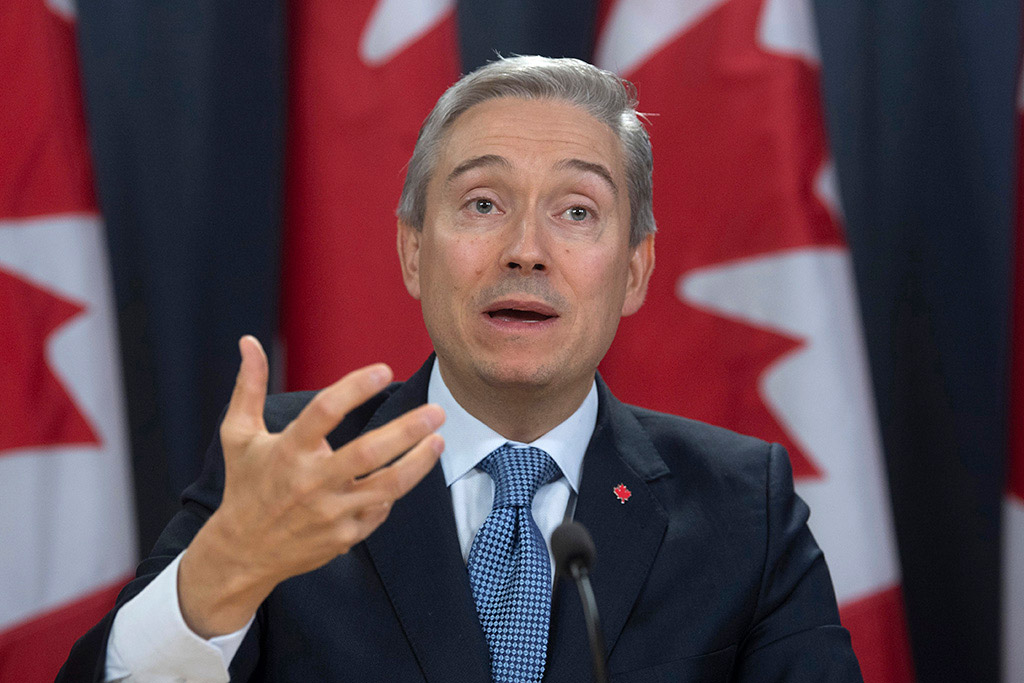
Innovation Minister François-Philippe Champagne in Ottawa in March 2020. Photo: Adrian Wyld/The Canadian Press
OTTAWA — The federal government has ordered an end to grants for sensitive research projects involving scientists from “foreign state actors that pose a risk to our national security,” but won’t provide a list of those countries and doesn’t yet know what all the sensitive research areas are, according to a spokesperson for Innovation Minister François-Philippe Champagne.
Champagne issued the order Tuesday evening, along with Health Minister Jean-Yves Duclos and Public Safety Minister Marco Mendicino. To keep advanced technological research out of the hands of adversaries, the government put new restrictions on the federal “granting councils” that support academic research projects and on the Canada Foundation for Innovation, which funds labs and equipment.
Talking Points
- The federal government wants its research grants to stop supporting collaborations with scientists working in institutions linked to regimes that could threaten Canada
- It isn’t saying which countries those are, exactly what areas of research are covered or how strong the link needs to be to be disqualifying
“Grant applications that involve conducting research in a sensitive research area will not be funded if any of the researchers working on the project are affiliated with a university, research institute or laboratory connected to military, national defence or state security entities of foreign state actors that pose a risk to our national security,” the ministers said.
Their statement did not include a list of sensitive research areas, did not name any countries that pose risks to Canada’s national security and did not offer guidelines for determining when an institution is “connected to” a country’s military or security agencies.
In March, Champagne called Russia out by name after its invasion of Ukraine, asking the granting agencies to stop funding any work that could benefit Vladimir Putin’s regime. In a Parliament Hill scrum Wednesday, Champagne said the new, unwritten restrictions apply to “China and others” and will cover “a wide range of research.”
“The process will be published in due course as it is being developed in collaboration with the granting councils, national security experts, and in consultation with research and science stakeholders,” Champagne’s spokesperson Laurie Bouchard told The Logic in an email. “The process will ensure that it doesn’t add more work for researchers.”
Related Articles
For now, the government is using the list of sensitive technologies that can trigger security reviews when a foreign company seeks to buy a Canadian firm that works in those fields, Bouchard wrote. Those range from weapons to ocean technologies to AI to energy to navigation.
“It is a start and the final list will come in due course,” she wrote.
The government also will not say what countries it considers risks to Canadian national security because “geopolitics are always in evolution,” Bouchard wrote.
The new restrictions will disqualify some grant proposals that have already been submitted, Bouchard said, and the government isn’t sure how many.
The new rules are supposed to be applied by entities like the Natural Sciences and Engineering Research Council of Canada (NSERC), which distributed more than $1.34 billion in grants last year, and the Canada Foundation for Innovation, which funds infrastructure like labs and equipment through grants to institutions like universities.
NSERC did not respond to questions from The Logic by deadline. Canada Foundation for Innovation spokesperson Malorie Bertrand said by email that it has no list of sensitive research areas or of foreign entities Canadian researchers should not work with, but is “ready to follow up on the letter from the ministers by building on our current practices” and by working with other players in Canada’s research ecosystem.
Until now, the foundation has asked the institutions it funds to be mindful of security risks from research carried out in facilities built with its help.
“For instance, we now ask funding recipients to ensure the security and integrity of projects by conducting due diligence to identify security risks, including, among others, physical security, cybersecurity, personnel, data and partnerships,” Bertrand wrote.
The government has published guidelines for the security risks that scientists should consider when forming research partnerships, though they’re explicitly “not aimed at limiting partnerships with any particular country or company.” They refer scientists to public reports from Canada’s spy agencies, issued in 2020, for hints as to countries of which they should be wary.
Those guidelines supported a 2021 move to require security reviews before NSERC could support research partnerships with private companies.
The latest stance came two weeks after a Globe and Mail report that researchers at multiple top Canadian schools have been collaborating on research with counterparts at China’s National University of Defence Technology.



Loading...
Thanks for sharing!
You have shared 5 articles this month and reached the maximum amount of shares available.
CloseThis account has reached its share limit.
If you would like to purchase a sharing license please contact The Logic support at [email protected].
CloseGift the full article!
You have gifted 0 article(s) this month and have 5 remaining.
Recipients will be able to read the full text of the article after submitting their email address. They will not have access to other articles or subscriber benefits.
Photo: Adrian Wyld/The Canadian Press
Most Popular This Week




In-depth, agenda-setting reporting
Great journalism delivered straight to your inbox.
The Big Read
Alberta’s referendum is just the start of the turmoil
Briefing
EverWind plans $10B data centre and wind development in Nova Scotia
Canada ready to force Stelco to sell its Canadian operations, Joly says
Feds plan a 60 MW defence-oriented data centre for Ottawa
Best business newsletter in Canada
Get up to speed in minutes with insights and analysis on the most important stories of the day, every weekday.
Exclusive events
See the bigger picture with reporters and industry experts in subscriber-exclusive events.
Membership in The Logic Council
Membership provides access to our popular Slack channel, participation in subscriber surveys and invitations to exclusive events with our journalists and special guests.






